

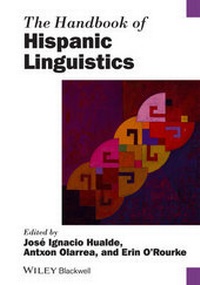
The Handbook of Hispanic Linguistics
Description

Reviews / Votes
"The Handbook of Hispanic Linguistics is a remarkable compendium encompassing a wide range of scientific inquiry on the many facets of Spanish language structure and use. While presenting complex research, it remains clear and accessible, constituting a valuable resource for not only for linguistic scholars, but also for advanced Spanish learners, and anyone with an interest in the field." (LINGUIST, 24 June 2015) "By combining the most crucial elements of current findings in theoretical and applied research, The Handbook of Hispanic Linguistics sheds new light on the increasing growth and importance of the Spanish language." (Morforetem, 24 January 2014) "The Handbook in its 40 well researched chapters presents aclear overview of different aspects of the Spanish language. Assuch it is destined to be an important and indispensible referenceresource which will be consulted for years to come." -Margarita Suñer, Cornell University "This handbook provides a comprehensive tour of thestate-of-the art research in all areas of Hispanic Linguistics. Forstudents and scholars interested in the Spanish language, it is atimely and invaluable reference book." - Maria LuisaZubizarreta, University of Southern California "The Handbook of Hispanic Linguistics is essentialand authoritative reading for those interested in any aspect ofSpanish. Its breadth of coverage is unmatched anywhere, and thediscussion is cutting-edge." - Ralph Penny, QueenMary, University of LondonMore details
Other editions
Additional editions
Persons
Content
Notes on Contributors
Cristina Baus is a post-doctoral researcher at the Speech Production and Biligualism, University Pompeu Fabra (Principal Investigator: Albert Costa). Her main research interest is the neural correlates of lexical access during biligual language production.
Ignacio Bosque is Full Professor of Spanish Linguistics at the Complutense University, Madrid, and a member of the Spanish Royal Academy. His main field of research is Spanish grammar (syntax, morphology, and the relationship between syntax and the lexicon). He has worked on some aspects of lexicography as well, with particular attention to collocations and other restricted combinations.
Josep María Brucart received his Ph.D. from the Autonomous University of Barcelona in 1984, with a dissertation titled “La elisión sintáctica en español.” He is currently Full Professor in the Department of Spanish Philology and member of the Center for Theoretical Linguistics at the Autonomous University of Barcelona.
José Camacho is Associate Professor at Rutgers University, New Jersey. He specializes in Syntactic Theory. In his research, he has focused on several aspects of the syntax of Spanish and Amazonian languages, such as null subjects, agreement, and switch-reference.
Héctor Campos is Assistant Professor of Spanish Linguistics, Theoretical Linguistics and Modern Greek at Georgetown University. His current research focuses on the Balkan languages, particularly Aromanian, Modern Greek and Albanian. His co-authored books with Linda Mëniku, Discovering Albanian and Colloquial Albanian, will appear in 2011. He is currently working on an in-depth comparative study of apposition structures in Spanish and Modern Greek. Together with some colleagues from the Aristotle University of Thessaloniki, he is also participating on a project to develop a bilingual Greek–Albanian program for elementary and high school students in Macedonia, Greece.
Rebeka Campos-Astorkiza gained her MA and Ph.D. at the University of Southern California and is Assistant Professor in the Hispanic Linguistics program at Ohio State University. She is the author of The Role and Representation of Minimal Contrast and the Phonetics–Phonology Interaction (2009) and has co-edited two issues of the International Journal of Basque Linguistics and Philology. Her research interests are phonetics and phonology, more precisely, experimental approaches to segmental phenomena and their theoretical implications.
María M. Carreira is a Professor of Spanish linguistics at California State University, Long Beach and Co-Director of the National Heritage Language Resource Center. She is the co-author of three Spanish textbooks, including one for SHL learners. Her research focuses on SHL teaching and Spanish in the United States.
Manuel Carreiras is an Ikerbasque Research Professor at the Basque Center on Cognition, Brain and Language, Donostia-San Sebastián, Spain.
J. Clancy Clements is Professor of Linguistics and Spanish and Portuguese at Indiana University, Bloomington. He began his work on Portuguese-based creoles, especially those in Asia, in 1986. More recently, he has written on immigrant Spanish, Caribbean Spanish, and the Portuguese–Spanish mixed language in Barrancos, Portugal. His writings include Genesis of a language: the formation and development of Korlai Portuguese (1996) and Linguistic legacy of Spanish and Portuguese: colonial expansion and language change (2009), several edited volumes, and many articles in the areas of contact linguistics and Spanish functional syntax. He currently sits on the advisory boards of the Journal of Pidgin and Creole Languages and Revista da Associaςão de Crioulos de Base Lexical Portuguesa e Espanhola (ACBLPE) and is vice-president of ACBLPE.
Sonia Colina is Professor of Spanish Linguistics at the University of Arizona. She is the author of Spanish Phonology (2009) and the co-editor, with Fernando Martínez-Gil, of Optimality-Theoretic Advances in Spanish Phonology (2006). Her research focuses on syllabic phenomena and Optimality Theory. She is particularly interested in the use of phonetic research to inform phonological analyses.
Concepción Company Company is Full Professor at the Universidad Nacional Autónoma de México. Her field research areas are Spanish historical syntax, linguistic variation, theory of language change, and philology. She is author of seven books, editor of 24, and author of more than 70 articles in international journals and chapters in collective books. She regularly has taught and given lectures at universities in various countries: Spain, Germany, Portugal, Canada, the United States, Argentina, Uruguay. She is member of the Academia Mexicana de la Lengua, correspondent member of Real Academia Española. She is the director of the international project Sintaxis histórica de la Lengua Española (2006, 2009).
Albert Costa is an ICREA Research Professor and an Associate Professor at the Department of Technology and Communication at the Universitat Pompeu Fabra, Barcelona. His research mainly focuses on the cognitive and brain processes involved in speech production. He addresses this issue both in monolingual and bilingual contexts. More recently, he has been concerned with the impact of bilingualism on the executive control system, beyond linguistic processes.
Jon Andoni Duñabeitia is a postdoctoral researcher at the Basque Center on Cognition, Brain and Language, Donostia-San Sebastián, Spain.
David Eddington is a Professor of Linguistics at Brigham Young University. He specializes in quantitative approaches to phonology and morphology including experimentation and computer modeling.
Luis Eguren is Catedrático de Lengua Española at the Universidad Autónoma de Madrid. His research interests concern theoretical linguistics and Spanish grammar. He has worked on a number of topics in the morphology and syntax of Spanish, including noun ellipsis and determiners.
Victoria Escandell-Vidal has a doctoral degree in Spanish Linguistics from the Universidad Complutense de Madrid and is Professor of Linguistics at Universidad Nacional de Educacióan a Distancia, Madrid. Her research covers grammar, semantics, pragmatics, and their interfaces. She has been visiting scholar at several European and South American universities and is presently on the editorial board of Revista Española de Lingüística, Revista Española de Lingüística Aplicada, Onomázein, Spanish in Context, Ciencias de la communication, and Inter-cultural Pragmatics.
Anna María Escobar is Associate Professor in the Department of Spanish, Italian, and Portuguese at the University of Illinois, Urbana-Champaign. Her research and teaching interests include sociolinguistics, contact linguistics, language variation and change, and grammaticalization. Her research focuses on the origin, development, and diffusion of contact variants in Spanish in contact with Quechua. She is author, co-author or co-editor of five books and several articles. Presently, she is writing a book on the emergence of Andean Spanish.
Ricardo Etxepare is a permanent researcher at the Centre National de la Recherche Scientifique (CNRS), where he is the head of the lab IKER (UMR5478). He specializes in the syntax–semantics interface, with a special interest for issues related to information structure and deictic anchoring. He combines his work on Romance, particularly on Spanish, with research on the Basque language.
Jerid Francom is Assistant Professor of Spanish and Linguistics at Wake Forest University. His research interests focus on the intersection between formal structure and language use through behavioral and computational methodologies.
Javier Gutiérrez-Rexach is Professor of Spanish Linguistics and Linguistics at Ohio State University. His areas of research are in semantics, syntax, pragmatics, and their interfaces in grammar. He has published extensively on topics related to quantification, non-declaratives, degree expressions, and the grammar of the Determiner Phrase.
José Ignacio Hualde is Professor in the Department of Spanish, Italian and Portuguese and the Department of Linguistics, University of Illinois at Urbana- Champaign.
José Manuel Igoa is Professor of Psychology at the Universidad Autónoma de Madrid, and a member of the Spanish GIP (PRG: Psycholinguistics Research Group), where he conducts research on word and sentence comprehension and production, figurative language understanding and bilingual language processing.
Iva Ivanova obtained her PhD from the Universitat de Barcelona, Barcelona, Spain. She has investigated topics such as bilingual lexical access and language control, lexical alignment in conversation, and structural priming. She is currently a postdoctoral fellow at the Department of Psychiatry and the Department of Psychology at the University of California, San Diego.
Bob de Jonge gained his Ph.D. on the use of ser and estar with age adjectives at the University of Leiden under supervision of Érica García. He is Associate Professor at the Romance Department of the University of Groningen, the Netherlands. He has worked on various topics in Romance (mainly Spanish, but also Italian)...
