

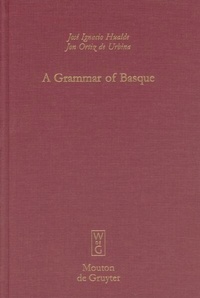
A Grammar of Basque
Description

As the only surviving pre-Indo-European language of western Europe, Basque has often attracted the interest of linguists. Whereas, traditionally, descriptive work on Basque has primarily focused on morphological features, including its complex system of verb-argument agreement and its strict ergative pattern of inflection, during the last two decades a new generation of Basque linguists has produced very sophisticated, theoretically-informed work on many aspects of the syntax, morphology and phonology of the language, revealing, for instance, a process of focalization with many interesting properties and the existence in some dialects of an accentual system strikingly similar to that of standard Japanese. The book, bringing together this accumulated knowledge on the structure of Basque, is considerably more complete than any other existing grammar of the language. Another interesting feature of this grammar is that the description is illustrated with fully-glossed examples extracted from a great number of written sources. Although the focus is the modern standard language, dialectal features are considered in detail and examples are taken from all dialects and periods.
More details
Other editions
Additional editions
Persons
Content
- Intro
- 1 Introduction (J.I. Hualde)
- 1.1. The Basque language and its name
- 1.2. The Basque language today: number of speakers, geographical distribution, official status, sociolinguistic aspects
- 2 Phonology
- 2.1. Segmental phonology (J.I. Hualde)
- 2.2. Accentuation (J.I. Hualde)
- 2.3. Intonation (G. Elordieta)
- 3. Morphology
- 3.1. The Noun Phrase: nouns, determiners and modifiers
- pronouns and names (R.L. Trask)
- 3.2. Case and number inflection of noun phrases (J.I. Hualde)
- 3.3. Postpositions (J.I. Hualde)
- 3.4. Adverbs (J.I. Hualde)
- 3.5. Verbs (J.I. Hualde, B. Oyharçabal and J. Ortiz de Urbina)
- 3.5.1. Nonfinite forms (J.I. Hualde)
- 3.5.2. Finite forms
- 3.5.3. Structural analysis of basic verbal paradigms (J.I. Hualde)
- 3.5.4. Tense, aspect and mood (B. Oyharçabal)
- 3.5.5. Periphrastic constructions (J. Ortiz de Urbina)
- 3.5.6. Semiauxiliary verbs (J. Ortiz de Urbina)
- 3.5.7. Modal particles
- 3.6. Conjunctions and connectors (J.I. Hualde)
- 3.7. Derivation (J.I. Hualde)
- 3.8. Compounds (J.I. Hualde)
- 4 Syntax
- 4.1. Valency and argument structure in the Basque verb (R. Etxepare)
- 4.1.1. Valency and the auxiliary system: an outline
- 4.1.2. Intransitive monovalent structures
- 4.1.3. Intransitive Bivalent Structures (dative-absolutive constructions)
- 4.1.4. Transitive Structures
- 4.1.5. Ditransitive Structures
- 4.1.6. Possessive constructions
- 4.1.7. Verbs of saying, thinking and judging
- 4.2. Nominal Predication: copulative sentences and secondary predication (I. Zabala)
- 4.3. Word order (J. Ortiz de Urbina)
- 4.4. Focalization (R. Etxepare & J. Ortiz de Urbina)
- 4.5. Negation (R. Etxepare)
- 4.6. Exclamatives (R. Etxepare)
- 4.7. Impersonal clauses (J. Ortiz de Urbina)
- 4.8. Causatives (J. Ortiz de Urbina)
- 4.9. Reciprocal and reflexive constructions (X. Artiagoitia)
- 4.10. Subordination (X. Artiagoitia, B. Oyharçabal, J.I. Hualde & J. Ortiz de Urbina)
- 4.10.1. Complementation (noun clauses) (X. Artiagoitia)
- 4.10.2. Adjunct subordination (X. Artiagoitia)
- 4.10.3. Relatives (B. Oyharçabal)
- 4.10.4. Comparative constructions (J.I. Hualde & J. Ortiz de Urbina)
- 4.11. Coordination (I. Amundarain)
- 5 Texts
- 5.1. Text 1
- 5.2. Text 2
- 5.3. Text 3
- 5.4. Text 4
- 5.5. Text 5
- Sources of examples
- References
- Index
