

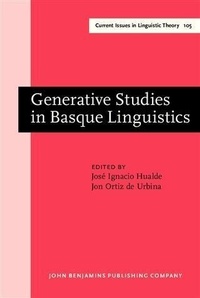
Generative Studies in Basque Linguistics
1st Edition
Published on 22. July 1993
VI, 334 pages
978-90-272-7706-0 (ISBN)
Description

In part due to its exotic place within the languages of Europe, but mainly because of its basic typological differences with better-described languages, Basque has often attracted the interest of linguists of very different theoretical persuasions. This book presents a collection of articles which are representative of work being done on Basque at the moment from a generative perspective. Most of the major issues in Basque Syntax, Morphology and Phonology are examined in this book and the implications of the Basque data for theories of universal grammar are made explicit.
More details
Other editions
Additional editions
Jose Ignacio Hualde | Jon Ortiz de Urbina
Generative Studies in Basque Linguistics
Book
07/1993
John Benjamins Publishing Co
€127.20
Shipment within 10-15 days
Content
- GENERATIVE STUDIES IN BASQUE LINGUISTICS
- Editorial page
- Title page
- Copyright page
- Table of contents
- Introduction
- REFERENCES
- The Structure of Inflection: A case study in Xo syntax
- 0. Introduction
- 1. Case marking and agreement
- 1.1 Case and thematic relations
- 1.2 Obligatory agreement clitics
- 1.3 Three-way pro-drop
- 1.4 Non-argumental agreement clines
- 1.5 Agreement patterns
- 2. Incorporated and non-incorporated verbal forms
- 2.1 The Aspect Projection
- 2.2 Evidence for Raising to Infl
- 3. The ordering of clitics in inflection
- 3.1 On number agreement
- 3.2 On the dative clitic
- 3.3 Linearity and hierarchy: Morphology and Syntax
- 4. The structure of inflection
- 5. Deriving clitic placement
- 5.1 Clitic ordering and the head parameter
- 5.2 On the notions 'prefix', 'Inflx' and 'suffix'
- 6. On the nature of third person absolutive clitics
- 6.1 Peculiarities in the third-person clitic paradigm
- 6.2 Third person absolutive: Tense and Modality
- 6.3 On the notion of head in Inflectional Morphology
- 7. A morpheme order-switching phenomenon
- 7.1 Ergative Displacement: a description
- 7.2 Heath (1976) and Ortiz de Urbina (1989).
- 7.3 A Case of Subatomic Move -a.
- 8. The mapping from S-structure onto phonetic form
- 8.1 Head government at PF: WAHL (1987).
- 8.2 Economy of Derivation and Representation (Chomsky 1989)
- 8.2 Assignment of phonological matrixes at PF
- 8.3 On 'Agglutinative' Morphology
- 9. Conclusions
- REFERENCES
- External Arguments in Basque
- 1. Basic properties of a Basque Sentence
- 1.1 Case
- 1.2 Agreement and Pro drop.
- 1.3 Free word order
- 2. S-Structure
- 2.1 Agreement and pro-drop
- 2.2 The morphological structure of the Auxiliary.
- 2.3 Control and Case
- 2.4 Wh-movement.
- 3. The VP internal hypothesis
- 4. The VP external hypothesis
- 4.1 Free word order in Basque
- 5. More on wh-movement
- 6. Similarities between the external and internal hypotheses
- 7. A final speculation
- REFERENCES
- Verb Agreement with Non Arguments: On allocutive agreement
- REFERENCES
- Basque Pronouns and Relativized Locality
- 0. Introduction
- 1. Background
- 2. Some problems for the minimally relativized locality approach
- 3. The Bounding Condition and its Consequences for the BT
- 4. The Two Reciprocal Expressions in Basque
- 5. Bere, bere burua and related matters
- 6. Further Questions and Conclusions
- REFERENCES
- BasqueHospitality and the Suffix -ko
- REFERENCES
- Adnominals in the Grammar of Basque
- REFERENCES
- Feature Percolation and Clausal Pied-Piping
- 0. Introduction
- 1. Specifiers as pied-pipers
- 2. Asymmetries in clausal pied-piping
- 2.1 Clausal pied-piping in Basque
- 2.2 [±wh] verbs and clausal pied-piping
- 2.3 Selectional mismatches
- 3. Analysis
- 3.1 Feature percolation and loss
- 3.2 Interrogative selection in a CP analysis
- 4. (SPEC, DP) as a pied-piping position
- 5 . Concluding remarks
- REFERENCES
- Basque Compound Nouns and Generative Morphology: Some data
- 1. The Dvandva Compounds
- 2. The Verb + Noun compounds and the Argument-Linking Principle
- 3. English -ed compound adjectives and Basque fnoun + participial adjective' structures
- REFERENCES
- Vowel Assimilation in Baztan and Levels in Phonology
- 1. Introduction
- 2. The Rule of Vowel Assimilation in Baztan
- 2. An analysis of Vowel Assimilation in Lexical Phonology
- 3. An Account of Vowel Assimilation in Baztan with BP's
- 3.1 Bila Phrases and Derivational Morphology
- 3.2 Bila Phrases, Inflection and Clitics
- 4 . Appendix: Bila Phrases, Morphology and Syntax
- 5. Concluding Remarks
- REFERENCES
- Syllable Structure in Modern Basque and in Proto-Basque
- 1. Syllable structure in modern Basque
- 1.2 Directionality: Evidence from Epenthesis
- 1.3 A Problem for the CCVC Template: Stray Strident in Some Dialects.
- 2. Syllable structure in Proto-Basque
- 2.1 The facts
- 2.3 Summary
- 3. Final remarks
- REFERENCES
- Topics in Souletin Phonology
- 0. Introduction
- 1. The sound system
- 1.1 Vowels
- 1.2 Rules affecting vowel sequences
- 1.3 Stops
- 1.4 Affricates
- 1.5 Sibilant fricatives
- 1.6 Other fricatives
- 1.7 Restrictions on the co-occurrence of aspirated segments
- 1.8 Liquids
- 1.9 Nasals
- 2. Syllable structure
- 3. Stress
- 3.1 Souletin stress among the Basque prosodie systems
- 3.2 Uninflected words
- 3.3 Compounds
- 3.4 Derivation
- 3.5 Inflected words
- REFERENCES
- INDEX OF SUBJECTS AND TERMS
