

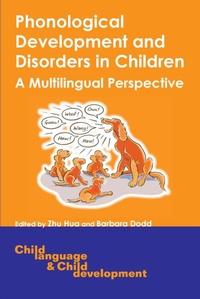
Phonological Development and Disorders in Children
A Multilingual Perspective
1st Edition
Published on 3. May 2006
496 pages
978-1-85359-890-6 (ISBN)
Description

This book critically examines the effects of language specificity on phonological acquisition and disorder through a collection of empirical studies of children learning typologically very different languages. The studies address many theoretical, clinical and methodological issues, such as: What role do developmental universals and the ambient language play in language acquisition? How should one account for the similarities and differences in the phonological development between normally and atypically developing children, between monolingual and bilingual children, and between bilingual children sharing one language? What implications do these similarities and differences have for clinical assessment and diagnosis? The book provides much-needed baseline information for clinical assessment and diagnosis.
Reviews / Votes
This is a useful book for therapists working with bilingual children as well as those who are researching phonological acquisition or want to increase their knowledge in this area. * Catrin Thomas in Speech & Language Therapy in Practice, Spring 2007 * This volume contributes a vast amount of information on the phonological development of little studied languages and language combinations. It provides data for the researcher into monolingual and bilingual typical and atypical phonological development. As well, the clinician will find useful normative data and therapy guidelines. * Leah Gedalyovich, Ben-Gurion University of the Negev, in Linguist List 17.3577 * Phonological development and disorders: A multilingual perspective fills a big gap in the knowledge base of those working in the field of child phonology. The volume covers diverse languages, from Arabic to Telegu to Welsh, and children with diverse language profiles: monolingual and bilingual, typical and atypical. The contributors include leading scholars in the field. Hua and Dodd are to be congratulated for this comprehensive and well-written book which will be an important resource for researchers, clinicians, and students interested in phonological development." * Professor Carol Stoel-Gammon, Department of Speech & Hearing Sciences, University of Washington. *More details
Series
Language
English
Place of publication
Bristol
United Kingdom
Publishing group
Channel View Publications Ltd
Target group
Professional and scholarly
Edition type
Digital original
ISBN-13
978-1-85359-890-6 (9781853598906)
Copyright in bibliographic data and cover images is held by Nielsen Book Services Limited or by the publishers or by their respective licensors: all rights reserved.
Schweitzer Classification
Other editions
Additional editions
Book
05/2006
Multilingual Matters
€133.63
Article exhausted; check different version
Persons
Zhu Hua, PhD, is a Senior Lecturer in Language and Communication at the University of Newcastle upon Tyne, UK. She is the author of Phonological Development in Specific Contexts: Studies of Chinese-Speaking Children and joint author of DEAP: Differential Evaluation of Articulation and Phonology. She has published extensively on child language (Journal of Child Language, Clinical Linguistics & Phonetics, International Journal of Language and Communication Disorders, etc.) and on cross-cultural pragmatics (Journal of Pragmatics, Multilingua, Language and Intercultural Communication, etc). Barbara Dodd, PhD, is Research Professor at the University of Queensland, Australia. She is the author of Differential Diagnosis and Treatment of Speech disordered children; joint editor of Hearing by Eye: The psychology of lip-reading, Evaluating Theories of Language: Implications from communication disorders, Hearing by Eye II: Advances in the psychology of speech-reading and audio-visual speech, joint author of QUIL: Queensland University Inventory of Literacy, PIPA: Preschool and Primary Inventory of Phonological Awareness, and DEAP: Differential Evaluation of Articulation and Phonology.
Content
Part 1: Introduction
1. A Multilingual Perspective on Phonological Development and Disorders - Zhu Hua (Univ. of Newcastle upon Tyne, UK) and Barbara Dodd (Univ. of Queensland)
2. The Need for Comparable Criteria in Multilingual Studies - Zhu Hua
Part 2: Monolingual Context
3. English Phonology: Acquisition and Disorder - Barbara Dodd, Alison Holm (Univ. of Queensland), Zhu Hua (Univ. of Newcastle upon Tyne, UK), Sharon Crosbie (Univ. of Queensland) and Jan Broomfield (Middlesbrough Primary Care Trust, UK)
4. Evidence from German-Speaking Children - Annette Fox (Europa Fachhochschul e Fresenius, Germany)
5. The Normal and Disordered Phonology of Putonghua (Modern Standard Chinese)-Speaking Children - Zhu Hua
6. Cantonese Phonological Development: Normal and Disordered - Lydia So (Univ. of Hong Kong)
7. Phonological Development of Maltese-Speaking Children - Helen Grech (Univ. of Malta)
8. Syllabic Constraints in the Phonological Errors of Children with Pre-lingual Hearing Loss: A Perspective from Telugu - Duggirala Vasanta (Osmania Univ. India)
9. Phonological Development and Disorders: Colloquial Egyptian Arabic - Wafaa Ammar (Univ. of Alexandria) and Ranya Morsi (Univ. of Reading, UK)
10. Phonological Acquisition and Disorders in Turkish - Seyhun Topbas (Anadolu Univ., Turkey) and Mehmet Yavas (Florida International Univ.)
Part 3: Bilingual Context
11. Aspects of Bilingual Phonology: The Case of Spanish-English Bilingual Children - Mehmet Yavas (Florida International Univ.) and Brian Goldstein (Temple Univ.)
12. Phonological Development and Disorder of Bilingual Children Acquiring Cantonese and English - Alison Holm and Barbara Dodd
13. Phonological Acquisition in Bilingual Pakistani Heritage Children in England - Carol Stow and Sean Pert (Rochdale Primary Care Trust, UK)
14. Phonological Development and Disorder of Bilingual Children Acquiring Welsh and English - Martin Ball, Nicole Mueller (Univ. of Louisiana at Lafayette) and Sian Munro (Univ. of Wales Institute, Cardiff)
15. Phonological Acquisition by Arabic-English Bilingual Children - Ghada Khattab (Univ. of Newcastle upon Tyne, UK)
16. Phonological Development of Cantonese-Putonghua Bilingual Children - Lydia So and Samuel Leung (Univ. of Hong Kong)
Part 4: Coda
17. Towards Developmental Universals - Zhu Hua and Barbara Dodd
References
Appendix
Index
1. A Multilingual Perspective on Phonological Development and Disorders - Zhu Hua (Univ. of Newcastle upon Tyne, UK) and Barbara Dodd (Univ. of Queensland)
2. The Need for Comparable Criteria in Multilingual Studies - Zhu Hua
Part 2: Monolingual Context
3. English Phonology: Acquisition and Disorder - Barbara Dodd, Alison Holm (Univ. of Queensland), Zhu Hua (Univ. of Newcastle upon Tyne, UK), Sharon Crosbie (Univ. of Queensland) and Jan Broomfield (Middlesbrough Primary Care Trust, UK)
4. Evidence from German-Speaking Children - Annette Fox (Europa Fachhochschul e Fresenius, Germany)
5. The Normal and Disordered Phonology of Putonghua (Modern Standard Chinese)-Speaking Children - Zhu Hua
6. Cantonese Phonological Development: Normal and Disordered - Lydia So (Univ. of Hong Kong)
7. Phonological Development of Maltese-Speaking Children - Helen Grech (Univ. of Malta)
8. Syllabic Constraints in the Phonological Errors of Children with Pre-lingual Hearing Loss: A Perspective from Telugu - Duggirala Vasanta (Osmania Univ. India)
9. Phonological Development and Disorders: Colloquial Egyptian Arabic - Wafaa Ammar (Univ. of Alexandria) and Ranya Morsi (Univ. of Reading, UK)
10. Phonological Acquisition and Disorders in Turkish - Seyhun Topbas (Anadolu Univ., Turkey) and Mehmet Yavas (Florida International Univ.)
Part 3: Bilingual Context
11. Aspects of Bilingual Phonology: The Case of Spanish-English Bilingual Children - Mehmet Yavas (Florida International Univ.) and Brian Goldstein (Temple Univ.)
12. Phonological Development and Disorder of Bilingual Children Acquiring Cantonese and English - Alison Holm and Barbara Dodd
13. Phonological Acquisition in Bilingual Pakistani Heritage Children in England - Carol Stow and Sean Pert (Rochdale Primary Care Trust, UK)
14. Phonological Development and Disorder of Bilingual Children Acquiring Welsh and English - Martin Ball, Nicole Mueller (Univ. of Louisiana at Lafayette) and Sian Munro (Univ. of Wales Institute, Cardiff)
15. Phonological Acquisition by Arabic-English Bilingual Children - Ghada Khattab (Univ. of Newcastle upon Tyne, UK)
16. Phonological Development of Cantonese-Putonghua Bilingual Children - Lydia So and Samuel Leung (Univ. of Hong Kong)
Part 4: Coda
17. Towards Developmental Universals - Zhu Hua and Barbara Dodd
References
Appendix
Index
