

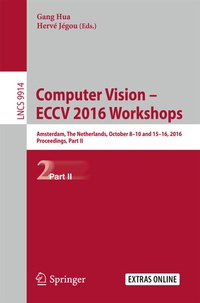
Computer Vision - ECCV 2016 Workshops
Description

The three-volume set LNCS 9913, LNCS 9914, and LNCS 9915 comprises the refereed proceedings of the Workshops that took place in conjunction with the 14th European Conference on Computer Vision, ECCV 2016, held in Amsterdam, The Netherlands, in October 2016.
The three-volume set LNCS 9913, LNCS 9914, and LNCS 9915 comprises the refereed proceedings of the Workshops that took place in conjunction with the 14th European Conference on Computer Vision, ECCV 2016, held in Amsterdam, The Netherlands, in October 2016.
27 workshops from 44 workshops proposals were selected for inclusion in the proceedings. These address the following themes: Datasets and Performance Analysis in Early Vision; Visual Analysis of Sketches; Biological and Artificial Vision; Brave New Ideas for Motion Representations; Joint ImageNet and MS COCO Visual Recognition Challenge; Geometry Meets Deep Learning; Action and Anticipation for Visual Learning; Computer Vision for Road Scene Understanding and Autonomous Driving; Challenge on Automatic Personality Analysis; BioImage Computing; Benchmarking Multi-Target Tracking: MOTChallenge; Assistive Computer Vision and Robotics; Transferring and Adapting Source Knowledge in Computer Vision; Recovering 6D Object Pose; Robust Reading; 3D Face Alignment in the Wild and Challenge; Egocentric Perception, Interaction and Computing; Local Features: State of the Art, Open Problems and Performance Evaluation; Crowd Understanding; Video Segmentation; The Visual Object Tracking Challenge Workshop; Web-scale Vision and Social Media; Computer Vision for Audio-visual Media; Computer VISion for ART Analysis; Virtual/Augmented Reality for Visual Artificial Intelligence; Joint Workshop on Storytelling with Images and Videos and Large Scale Movie Description and Understanding Challenge.
More details
Other editions
Additional editions
Content
Datasets and Performance Analysis in Early Vision.- Visual Analysis of Sketches.- Biological and Artificial Vision.- Brave New Ideas for Motion Representations.- Joint Imagenet and MS Coco Visual Recognition Challenge.- Geometry Meets Deep Learning.- Action and Anticipation for Visual Learning.- Computer Vision for Road Scene Understanding and Autonomous Driving.- Challenge on Automatic Personality Analysis.- BioImage Computing.- Benchmarking Multi-Target Tracking: MOTChallenge.- Assistive Computer Vision and Robotics.- Transferring and Adapting Source Knowledge in Computer Vision.- Recovering 6D Object Pose.- Robust Reading.- 3D Face Alignment in the Wild and Challenge.- Egocentric Perception, Interaction and Computing.- Local Features: State of the Art, Open Problems and Performance Evaluation.- Crowd Understanding.- Video Segmentation.- The Visual Object Tracking Challenge Workshop.- Web-scale Vision and Social Media.- Computer Vision for Audio-visual Media.- Computer VISion for ART Analysis.- Virtual/Augmented Reality for Visual Artificial Intelligence.- Joint Workshop on Storytelling with Images and Videos and Large Scale Movie Description and Understanding Challenge.
