

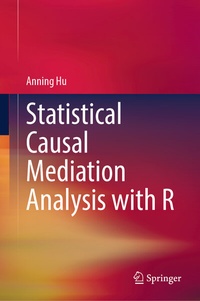
Statistical Causal Mediation Analysis with R
Description

This book comprehensively covers various causal mediation analysis (CMA) methods developed across multiple fields, organizing them into a reader-friendly progression of methodological advancements. Interest in the mechanisms that form causal relationships is widespread across various fields, including sociology, demography, economics, political science, psychology, epidemiology, public health, and educational studies, to name a few. Compared to the well-established research focusing on bivariate causality, CMA-the study of mediation mechanisms within the framework of causal inference-requires more complex identification assumptions, estimation methods, and nuanced interpretations of the results. Therefore, to conduct CMA with rigor, one must acquaint themselves with a distinct and systematic body of knowledge that is clearly separate from traditional linear regression modeling or structural equation modelling (SEM). Against this backdrop, the objectives of the proposed book are twofold. Firstly, it aims to offer readers an approachable and engaging explanation of the statistical theories underpinning the diverse methods of CMA. Specifically, we highlight the crucial mediation identification assumptions-a critical aspect frequently neglected by practitioners and educators. Secondly, the book intends to guide readers through detailed, step-by-step examples of applying CMA methods in practical research contexts. Through this approach, readers are anticipated to gain practical skills necessary for addressing their own research or teaching challenges. This book begins with traditional methods that rely on differences or products of coefficients in linear regression modeling, moves on to CMA involving a single mediator, and advances to more sophisticated approaches that manage parallel or sequentially ordered mediators. Additionally, sensitivity analysis is introduced as an important supplementary analytical step. Thus, the content spans from conventional CMA tools to the forefront methodologies that have emerged in recent decades. The book is designed to be self-sufficient, characterized by a balanced and well-integrated presentation of both theory and application.
More details
Other editions
Additional editions
Person
Dr. Hu Anning is Distinguished Professor of Sociology and the Vice Dean of Graduate School of Fudan University. His research interests include social inequality, education, culture, and social research methods. Dr. Hu has published over 100 peer-reviewed academic articles and three monographs, with research appearing in major sociological outlets, such as Sociology, British Journal of Sociology, Chinese Sociological Review, Social Science Research, Journal of Marriage and Family, Poetics, Research in Social Stratification and Mobility, and the China Quarterly, to name a few. Two of the published monographs are focused on statistical methodology, which are, respectively, Applied Statistical Causal Inference and the Theoretical Foundation of Causal Inference in the Social Sciences.
Content
Introduction and Background.- Mediation in the Causal Inference Framework.- Estimation of the Causal Mediation Analysis.- Moving from the Single-Mediator to the Multi-Mediator Question.- Sensitivity Analysis.- Conclusion.
