

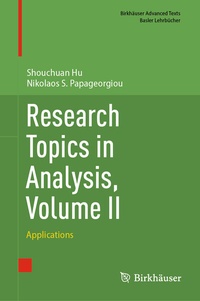
Research Topics in Analysis, Volume II
Description

This book, the second of two volumes, presents significant applications for understanding modern analysis. It empowers young researchers with key techniques and applications to explore various subfields of this broad subject and introduces relevant frameworks for immediate deployment.
The applications list begins with Degree Theory, a useful tool for studying nonlinear equations. Chapter 2 deals with Fixed Point Theory, and Chapter 3 introduces Critical Point Theory. Chapter 4 presents the main spectral properties of linear, nonlinear, anisotropic, and double-phase differential operators. Chapter 5 covers semilinear and nonlinear elliptic equations with different boundary conditions, while Chapter 6 addresses dynamic systems monitored by ordinary and partial differential equations. Chapter 7 delves into optimal control problems, and Chapter 8 discusses some economic models, providing a brief presentation of Game Theory and Nash equilibrium.
By offering a clear and comprehensive overview of modern analysis tools and applications, this work can greatly benefit mature graduate students seeking research topics, as well as experienced researchers interested in this vast and rich field of mathematics.
Reviews / Votes
"Every chapter comes with a remarks section detailing the origin of the results presented in the main body of the text. . this volume along with its predecessor covers a lot of ground in abstract analysis and will be a useful resource for many readers." (Dirk Werner, zbMATH 1558.46002, 2025)
More details
Other editions
Additional editions
Persons
Shouchuan Hu is a Distinguished Professor at Missouri State University, USA. He holds a PhD in Mathematics from the University of Texas at Arlington. Dr. Hu is Director of the AIMS - American Institute of Mathematical Sciences and Editor-in-Chief of the "Discrete and Continuous Dynamical Systems" journal. He co-authored, along with Dr. Papageorgiou, the two-volume set "Handbook of Multivalued Analysis" (1997), published by Springer.
Nikolaos S. Papageorgiou is a Professor at the National Technical University of Athens, Greece. He holds a PhD in Applied Mathematics (1983) from Harvard University, USA, and degrees in Mathematics and Electrical Engineering, both from Massachusetts Institute of Technology - MIT. Dr. Papageorgiou has co-authored over a dozen books, including "Exercises in Analysis" (2016) and "Nonlinear Analysis - Theory and Methods" (2019), both published by Springer.
Content
Degree Theory.- Fixed Point Theory.- Critical Point Theory.- Spectra of Differential Operators.- Elliptic Boundary Value Problems.- Evolution Equations.- Calculus of Variations.- Mathematical Economics and Game Theory.- References.- Index.
