

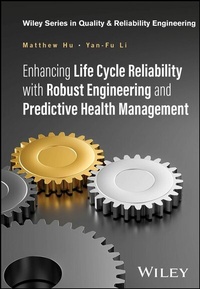
Enhancing Life Cycle Reliability with Robust Engineering and Predictive Health Management
Description

Enhancing Life Cycle Reliability with Robust Engineering and Predictive Health Management
Complete process for ensuring product performance through robust concept design, robust optimization, selection, and verification in an uncontrollable user environment
Enhancing Life Cycle Reliability with Robust Engineering and Predictive Health Management enables readers to build a robustness-thinking-based approach for robust design for reliability and prognostic health management (PHM), explaining best practices from early product design through the entire product lifecycle, leading to lower costs and shorter development cycles. The text integrates key tools and emerging reliability management systems into a comprehensive program for developing more robust and reliable technology-based products.
The text provides value-added strategies for robustness development in new products and health management with three main types of robustness development and reliability growth case studies: intrinsic, instrumental, and collective. Readers can harness multiple forms of engineering knowledge to inform decision-making within reliability contexts.
To ensure customer satisfaction, the text helps readers consciously consider noise factors (environmental variation during the product's usage, manufacturing variation, and component deterioration) and cost of failure in the field for the Robust Design method.
Written by two highly qualified authors, this book includes information on:
- Effective reliability efforts in an integrated product development environment, failure mode avoidance, and reliability analysis using the physics-of-failure process
- Essentials of robustness and robust design in reliability improvement, covering design-in reliability up front, eliminating failures prior to testing, and increasing fielded reliability
- Rapid, cost-effective deployment of health and usage monitoring systems and improving diagnostic and prognostic techniques and processes
- ROI analyses for PHM, selecting and deploying sensors, setting up data transmission channels, and developing data collection and data pre-processing functions
Comprehensive in scope, this book is an essential resource on the subject for all individuals responsible for product development and design, increasing life-cycle product reliability, process quality, or reducing costs in a design, development, manufacturing, and maintenance.
More details
Other editions
Additional editions
Persons
Matthew Hu, Senior Vice President, Engineering and Quality, Haylion Technologies, and Adjunct Professor, University of Houston, USA. Dr. Hu is a Certified Robust Design Expert using Taguchi Method, a Certified LSS Master Black Belt, and a certified DFSS Master Black Belt.
Yan-Fu Li, Professor, Tsinghua University, China. He is the Principal Investigator (PI) of several government projects including the key project funded by National Natural Science Foundation of China.
Content
Series Editor's Foreword xv
Preface xvii
Acknowledgments xxiii
1 Enchaining Lifecycle Reliability with Robust Engineering and Prognostic Health Management 1
1.1 Introduction 2
1.2 Purpose 3
1.3 Essentials of Robustness and Robust Design in Reliability Improvement 4
1.4 Effective Reliability Efforts in an Integrated Product Development Environment 4
1.5 Enhancing Reliability Integration into the Product Development Process 6
1.6 Physics of Failure (PoF) 7
1.7 Failure-mode Avoidance 9
1.8 Design for Six Sigma 10
1.9 Design for Reliability 16
1.10 Prognostics and Health Management 17
1.11 The Importance of Digital Quality in Lifecycle Reliability Through Robustness Development and Predictive Health Management 23
1.12 Digital Quality in Lifecycle Reliability 23
1.13 Predictive Health Management (PHM) 25
1.14 Critical Parameter Development and Management (CPD&M): A Comprehensive Overview 27
2 Robustness Thinking and Strategies for Reliability Development 33
2.1 Introduction 34
2.2 What Is Robustness Thinking? 40
2.3 The Challenge and Limitation of Conventional Reliability Approach 44
2.4 Why Robust Design? 61
2.5 The Importance and Principle of Flow in Robustness Thinking 62
2.6 Robustness Development Strategy 71
2.7 Three Phases of Robust Design 73
2.8 Understanding and Mitigating Mistakes in Design and Manufacturing 75
3 Robust Design Principles, Tactics, and Primary Tools 79
3.1 Introduction 79
3.2 Ideal Function: Ideal Transformation System Input and Output Relationship 80
3.3 Ideal Function and Quality Problems 81
3.4 Identification and Classification of Design Parameters: P-Diagram 82
3.5 Opportunity for Robustness Development 87
3.6 Two-Step Optimization 89
3.7 Robustness Measurement: S/N Ratio 90
3.8 S/N Ratio Improvement and Variation Reduction 92
3.9 S/N Ratio, the Additive Model, and the Conservative Laws of Physics 93
3.10 The Static Signal-to-Noise Ratios 94
3.11 Dynamic Signal-to-Noise Ratios 98
3.12 Robust Parameter Design Strategy and Steps 100
3.13 Quality Measurement: Loss Function 108
3.14 Robust Technology Development 109
4 Robust Design for Reliability (RDfR) A Comprehensive Approach to Product Excellence 117
4.1 Introduction 117
4.2 Robust Design for Reliability: A Comprehensive Approach to Product Excellence 120
4.3 Roadmap for Robust Design for Reliability Execution 127
4.4 Robust Design Principles for Prognostic Health Management 159
4.5 Scorecard for Robust Design for Reliability Implementation 161
4.6 Digital Quality Through Robust Design for Reliability 165
4.7 Critical Parameter Development and Management (CPD&M) Process and Phases 170
5 Predictive & Health Management 173
5.1 Justification for PHM in Robust System Design 173
5.2 System Components and Their Functions 176
6 Characterizing Failure Signatures 191
6.1 Characterizing Failure Signatures 191
7 Guidelines for PHM System Implementation 209
7.1 Enabling Technologies for PHM 210
7.2 Identifying and Selecting Robust Sensors for PHM 211
7.3 Integration and Validation for PHM-Ready Systems 211
7.4 Advanced Computing Platforms for PHM Analytics 213
7.5 AI-accelerated Hardware 214
7.6 Evaluation Metrics for PHM Systems 214
7.7 Robust PHM System 215
7.8 Robust Prototype and Test-Bench Development for PHM System Validation 219
7.9 Modular, Robust PHM Prototype Architecture 220
7.10 Test-Bench Design for Robustness Validation 220
7.11 Embedding Robustness into PHM Prototyping 222
7.12 Verification Against Real-World Failure Data 222
7.13 Organizational Integration and Governance 225
7.14 Case Study of PHM System Development 228
8 Case Study for Robust Design for Reliability (RDfR) 239
8.1 Introduction 239
8.2 RDfR Phases in DPSM Case Study 242
8.3 Achieving System Robustness through Optimization 254
8.4 Optimize Phase 254
8.5 Conclusion: Comprehensive Approach to Robust Optimization and Mistake Prevention 263
References 271
Index 273
Preface
The Critical Role of Quality and Reliability in Modern Engineering Systems
In today's fast-evolving technological landscape, the importance of quality and reliability in engineered systems cannot be overstated. Modern products-integrating advanced hardware, software, interconnected systems, rich electronics, and intricate subsystem interactions-are increasingly complex. Reliability requirements remain stringent or even intensify, as failures can lead to catastrophic consequences. For instance, the infamous sudden acceleration issues in Toyota vehicles severely damaged the company's profits and reputation, underscoring how a single failure can erode trust and cause profound implications.
Product failures in the field result in:
- Financial losses: Repair costs, warranty claims, product recalls, and heightened liability expenses.
- Customer dissatisfaction: Loss of trust, reduced market share, and declining revenue.
- Operational disruptions: Delays in next-generation development as teams resolve current issues, alongside persistent service demands from defective designs.
- Reputational damage: Negative publicity and diminished brand equity.
- Safety risks: Endangerment of human lives, especially in critical applications like autonomous vehicles, medical devices, aerospace systems, or IoT ecosystems.
- Internal impacts: Management distraction from future growth and declining employee morale and retention due to preventable failures.
To address these challenges, reliability engineering has shifted from a reactive discipline to a proactive, strategic function that drives innovation and competitive advantage. Viewing reliability as "quality over time"-the probability of survival without failure over a specified period, while maintaining consistent performance amid evolving stresses-positions it as a quality anchor. By embedding quality and reliability into the product development process, organizations can deliver robust systems that perform consistently under real-world conditions, sustaining customer satisfaction throughout the lifecycle.
At its core, product development is a risk management exercise. Failing to meet expectations for features, functionality, reliability, service life, or cost of ownership amplifies these risks. A disciplined, repeatable process is essential to capture institutional knowledge, reduce reliance on individual expertise, and ensure consistency across teams. This proactive mindset fosters innovation, mitigates risks, and aligns design decisions with long-term goals.
Reliability and Robustness: A Strategic Mindset
Robustness over time is not merely an engineering objective-it is a strategic mindset that shapes every stage of product development. Robustness over time is not just a task, but a way of thinking-one that drives action plans and execution from the earliest stages of product development, particularly in technology development. This philosophy transforms how teams approach design, shifting from isolated checklists or afterthoughts to an integrated, forward-looking perspective that permeates all decisions. By embedding robustness into the mindset from the start, teams can proactively identify potential risks, optimize design choices, and ensure the final product performs reliably under a wide range of conditions.
This mindset emphasizes:
- Proactive risk identification: Anticipating failure modes, stressors, and variability sources early in the concept phase, rather than waiting for issues to emerge during testing.
- Cross-functional collaboration: Engaging diverse teams-including engineering, manufacturing, quality, supply chain, and even end-user representatives-to explore design alternatives, share insights, and validate assumptions collaboratively.
- Preventive focus: Moving away from reactive failure mitigation in late-stage testing or post-launch fixes to systematic prevention during initial concept and design phases, thereby avoiding costly rework.
- Real-world simulation and adaptation: Accounting for variations in materials, processes, usage patterns, environmental stressors, and emerging technologies to ensure sustained performance, with built-in flexibility for future adaptations.
- Action-oriented execution: Translating the mindset into concrete action plans, such as milestone reviews focused on robustness metrics, iterative simulations, and cross-team workshops that prioritize long-term durability over short-term gains.
- Cultural integration: Fostering an organizational culture where robustness is a core value, encouraging continuous learning, knowledge sharing, and accountability at all levels to sustain this way of thinking across projects.
In technology-driven fields like AI, IoT, and autonomous systems, where innovation cycles are rapid and uncertainties abound, this mindset is particularly vital. It enables teams to navigate emerging challenges, such as evolving regulatory requirements or unforeseen integration issues, by building in margins for error and adaptability. Ultimately, by adopting robustness as a foundational way of thinking, organizations not only minimize risks but also unlock opportunities for differentiation, such as developing products that evolve with user needs or withstand technological disruptions. This approach ensures that robustness is a guiding principle from concept to launch, maximizing long-term performance, customer satisfaction, and market resilience.
The Modern Challenge: Balancing Speed, Reliability, and Robustness in Accelerated Development Cycles
The rapid advancement of technologies like autonomous driving, artificial intelligence (AI), Internet of Things (IoT), and advanced robotics has revolutionized product development. Reliability professionals must deliver innovative, high-performance products faster while exceeding customer expectations for durability, safety, and functionality. This pressure is intensified by the need to ensure robustness amid complex, unpredictable real-world conditions, often without physical prototypes.
Robustness-the ability to maintain stable performance despite variations in design, manufacturing, usage, and environmental factors-is foundational to long-term reliability. Key factors impacting robustness include:
- Design parameter variations: Differences in component tolerances, material properties, or specifications.
- Material properties: Inconsistencies in raw materials or degradation from wear, corrosion, or fatigue.
- Use conditions: Diverse user behaviors, operational patterns, and misuse scenarios.
- Manufacturing processes: Variations in production techniques, assembly methods, or quality control.
- System interconnections: Complex interactions between hardware, software, and networked components.
- Environmental stressors: Exposure to temperature extremes, humidity, vibration, electromagnetic interference, or other external factors.
These elements introduce variability that can compromise performance if unaddressed. Comprehensive robustness assessment and development provide a proactive framework to identify and mitigate risks early, reducing costly iterations and preventing failures in testing or post-launch.
A Structured Approach to Robustness Development: Integrating Six Sigma and IDOV
Achieving robust designs requires a structured, proactive framework. The robust design for reliability approach, often combined with Design for Six Sigma (DFSS), embeds robustness from the outset. Six Sigma provides a data-driven methodology, rooted in the scientific method: observe problems, hypothesize, analyze data, and implement solutions.
Central to this are critical-to-quality (CTQ) metrics, which translate customer needs into measurable parameters, and critical parameter management (CPM), which flows requirements down to subsystems while rolling up performance data for verification.
Six Sigma methodologies include:
- DMAIC (Define-Measure-Analyze-Improve-Control): Corrective for existing processes, eliminating defects.
- DFSS: Preventive, designing quality and reliability in from the start.
The IDOV (Identify-Design-Optimize-Validate) framework, aligned with DFSS, drives robust, error-free outcomes by integrating Six Sigma's rigor, DFSS's prevention, and reliability engineering's system perspective.
IDOV Phases:
- Identify:
- Define customer requirements and CTQs.
- Identify variability sources (e.g., materials, use conditions, tolerances).
- Establish performance and reliability goals.
- Design:
- Develop designs accounting for variations and stressors.
- Use simulations to explore alternatives and assess robustness.
- Incorporate redundancy, fault tolerance, or adaptive controls.
- Optimize:
- Based on robustness thinking, apply robust optimization methodologies like the Taguchi method or equivalent in the presence of noisy environments to minimize variability and maximize performance.
- Identify critical design parameters and select them as potential health indicators for the assessment of PHM application through the whole lifecycle for time reliability.
- Apply techniques like...
