

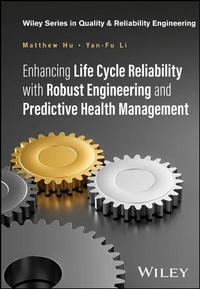
Enhancing Life Cycle Reliability with Robust Engineering and Predictive Health Management
Description

Enhancing Life Cycle Reliability with Robust Engineering and Predictive Health Management
Complete process for ensuring product performance through robust concept design, robust optimization, selection, and verification in an uncontrollable user environment
Enhancing Life Cycle Reliability with Robust Engineering and Predictive Health Management enables readers to build a robustness-thinking-based approach for robust design for reliability and prognostic health management (PHM), explaining best practices from early product design through the entire product lifecycle, leading to lower costs and shorter development cycles. The text integrates key tools and emerging reliability management systems into a comprehensive program for developing more robust and reliable technology-based products.
The text provides value-added strategies for robustness development in new products and health management with three main types of robustness development and reliability growth case studies: intrinsic, instrumental, and collective. Readers can harness multiple forms of engineering knowledge to inform decision-making within reliability contexts.
To ensure customer satisfaction, the text helps readers consciously consider noise factors (environmental variation during the product's usage, manufacturing variation, and component deterioration) and cost of failure in the field for the Robust Design method.
Written by two highly qualified authors, this book includes information on:
- Effective reliability efforts in an integrated product development environment, failure mode avoidance, and reliability analysis using the physics-of-failure process
- Essentials of robustness and robust design in reliability improvement, covering design-in reliability up front, eliminating failures prior to testing, and increasing fielded reliability
- Rapid, cost-effective deployment of health and usage monitoring systems and improving diagnostic and prognostic techniques and processes
- ROI analyses for PHM, selecting and deploying sensors, setting up data transmission channels, and developing data collection and data pre-processing functions
Comprehensive in scope, this book is an essential resource on the subject for all individuals responsible for product development and design, increasing life-cycle product reliability, process quality, or reducing costs in a design, development, manufacturing, and maintenance.
More details
Other editions
Additional editions
Persons
Matthew Hu, Senior Vice President, Engineering and Quality, Haylion Technologies, and Adjunct Professor, University of Houston, USA. Dr. Hu is a Certified Robust Design Expert using Taguchi Method, a Certified LSS Master Black Belt, and a certified DFSS Master Black Belt.
Yan-Fu Li, Professor, Tsinghua University, China. He is the Principal Investigator (PI) of several government projects including the key project funded by National Natural Science Foundation of China.
Content
Series Editor's Foreword xv
Preface xvii
Acknowledgments xxiii
1 Enchaining Lifecycle Reliability with Robust Engineering and Prognostic Health Management 1
1.1 Introduction 2
1.2 Purpose 3
1.3 Essentials of Robustness and Robust Design in Reliability Improvement 4
1.4 Effective Reliability Efforts in an Integrated Product Development Environment 4
1.5 Enhancing Reliability Integration into the Product Development Process 6
1.6 Physics of Failure (PoF) 7
1.7 Failure-mode Avoidance 9
1.8 Design for Six Sigma 10
1.9 Design for Reliability 16
1.10 Prognostics and Health Management 17
1.11 The Importance of Digital Quality in Lifecycle Reliability Through Robustness Development and Predictive Health Management 23
1.12 Digital Quality in Lifecycle Reliability 23
1.13 Predictive Health Management (PHM) 25
1.14 Critical Parameter Development and Management (CPD&M): A Comprehensive Overview 27
2 Robustness Thinking and Strategies for Reliability Development 33
2.1 Introduction 34
2.2 What Is Robustness Thinking? 40
2.3 The Challenge and Limitation of Conventional Reliability Approach 44
2.4 Why Robust Design? 61
2.5 The Importance and Principle of Flow in Robustness Thinking 62
2.6 Robustness Development Strategy 71
2.7 Three Phases of Robust Design 73
2.8 Understanding and Mitigating Mistakes in Design and Manufacturing 75
3 Robust Design Principles, Tactics, and Primary Tools 79
3.1 Introduction 79
3.2 Ideal Function: Ideal Transformation System Input and Output Relationship 80
3.3 Ideal Function and Quality Problems 81
3.4 Identification and Classification of Design Parameters: P-Diagram 82
3.5 Opportunity for Robustness Development 87
3.6 Two-Step Optimization 89
3.7 Robustness Measurement: S/N Ratio 90
3.8 S/N Ratio Improvement and Variation Reduction 92
3.9 S/N Ratio, the Additive Model, and the Conservative Laws of Physics 93
3.10 The Static Signal-to-Noise Ratios 94
3.11 Dynamic Signal-to-Noise Ratios 98
3.12 Robust Parameter Design Strategy and Steps 100
3.13 Quality Measurement: Loss Function 108
3.14 Robust Technology Development 109
4 Robust Design for Reliability (RDfR) A Comprehensive Approach to Product Excellence 117
4.1 Introduction 117
4.2 Robust Design for Reliability: A Comprehensive Approach to Product Excellence 120
4.3 Roadmap for Robust Design for Reliability Execution 127
4.4 Robust Design Principles for Prognostic Health Management 159
4.5 Scorecard for Robust Design for Reliability Implementation 161
4.6 Digital Quality Through Robust Design for Reliability 165
4.7 Critical Parameter Development and Management (CPD&M) Process and Phases 170
5 Predictive & Health Management 173
5.1 Justification for PHM in Robust System Design 173
5.2 System Components and Their Functions 176
6 Characterizing Failure Signatures 191
6.1 Characterizing Failure Signatures 191
7 Guidelines for PHM System Implementation 209
7.1 Enabling Technologies for PHM 210
7.2 Identifying and Selecting Robust Sensors for PHM 211
7.3 Integration and Validation for PHM-Ready Systems 211
7.4 Advanced Computing Platforms for PHM Analytics 213
7.5 AI-accelerated Hardware 214
7.6 Evaluation Metrics for PHM Systems 214
7.7 Robust PHM System 215
7.8 Robust Prototype and Test-Bench Development for PHM System Validation 219
7.9 Modular, Robust PHM Prototype Architecture 220
7.10 Test-Bench Design for Robustness Validation 220
7.11 Embedding Robustness into PHM Prototyping 222
7.12 Verification Against Real-World Failure Data 222
7.13 Organizational Integration and Governance 225
7.14 Case Study of PHM System Development 228
8 Case Study for Robust Design for Reliability (RDfR) 239
8.1 Introduction 239
8.2 RDfR Phases in DPSM Case Study 242
8.3 Achieving System Robustness through Optimization 254
8.4 Optimize Phase 254
8.5 Conclusion: Comprehensive Approach to Robust Optimization and Mistake Prevention 263
References 271
Index 273
