

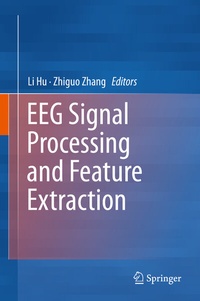
EEG Signal Processing and Feature Extraction
Description

This book presents the conceptual and mathematical basis and the implementation of both electroencephalogram (EEG) and EEG signal processing in a comprehensive, simple, and easy-to-understand manner. EEG records the electrical activity generated by the firing of neurons within human brain at the scalp. They are widely used in clinical neuroscience, psychology, and neural engineering, and a series of EEG signal-processing techniques have been developed. Intended for cognitive neuroscientists, psychologists and other interested readers, the book discusses a range of current mainstream EEG signal-processing and feature-extraction techniques in depth, and includes chapters on the principles and implementation strategies.
More details
Other editions
Additional editions
Persons
Dr. Li Hu is a Principle Investigator at the Institute of Psychology, Chinese Academy of Sciences, China. He is also an Honorary Senior Research Associate at University College London. Dr. Hu has contributed to the development of novel techniques to facilitate the analysis of event-related EEG responses. He has published more than 60 research articles in this field, and was sponsored by the National Natural Science Foundation of China for Excellent Young Scholars.
Dr. Zhiguo Zhang is a Professor at the School of Biomedical Engineering, Health Science Center, Shenzhen University, China. His research focuses on neural signal analysis, brain-computer interaction, machine learning for brain decoding and digital signal processing. He has published more than 60 articles in these fields.
Content
Introduction.- EEG: origin and measurement.- Electroencephalography, Evoked potentials and event-related potentials.- ERP Experimental design.- EEG Preprocessing and denoising.- Spectral and time-frequency analysis.- Blind source separation.- Microstate analysis.- Source analysis.- Single-trial analysis.- Nonlinear neural dynamics.- Connectivity analysis.- Spatial complex brain network.- Temporal complex network analysis.- Machine learning.- Deep learning.- Statistical analysis.- Simultaneous EEG-fMRI.- EEG/ERP data analysis toolboxes.- Summary and conclusions.
