

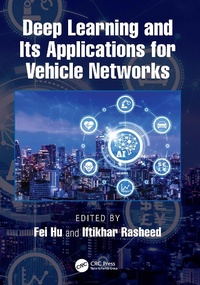
Deep Learning and Its Applications for Vehicle Networks
1st Edition
Published on 12. May 2023
356 pages
978-1-000-87723-6 (ISBN)
Description

Deep Learning (DL) is an effective approach for AI-based vehicular networks and can deliver a powerful set of tools for such vehicular network dynamics. In various domains of vehicular networks, DL can be used for learning-based channel estimation, traffic flow prediction, vehicle trajectory prediction, location-prediction-based scheduling and routing, intelligent network congestion control mechanism, smart load balancing and vertical handoff control, intelligent network security strategies, virtual smart and efficient resource allocation and intelligent distributed resource allocation methods.
This book is based on the work from world-famous experts on the application of DL for vehicle networks. It consists of the following five parts:
(I) DL for vehicle safety and security: This part covers the use of DL algorithms for vehicle safety or security.
(II) DL for effective vehicle communications: Vehicle networks consist of vehicle-to-vehicle and vehicle-to-roadside communications. This part covers how Intelligent vehicle networks require a flexible selection of the best path across all vehicles, adaptive sending rate control based on bandwidth availability and timely data downloads from a roadside base-station.
(III) DL for vehicle control: The myriad operations that require intelligent control for each individual vehicle are discussed in this part. This also includes emission control, which is based on the road traffic situation, the charging pile load is predicted through DL andvehicle speed adjustments based on the camera-captured image analysis.
(IV) DL for information management: This part covers some intelligent information collection and understanding. We can use DL for energy-saving vehicle trajectory control based on the road traffic situation and given destination information; we can also natural language processing based on DL algorithm for automatic internet of things (IoT) search during driving.
(V) Other applications. This part introduces the use of DL models for other vehicle controls.
Autonomous vehicles are becoming more and more popular in society. The DL and its variants will play greater roles in cognitive vehicle communications and control. Other machine learning models such as deep reinforcement learning will also facilitate intelligent vehicle behavior understanding and adjustment. This book will become a valuable reference to your understanding of this critical field.
This book is based on the work from world-famous experts on the application of DL for vehicle networks. It consists of the following five parts:
(I) DL for vehicle safety and security: This part covers the use of DL algorithms for vehicle safety or security.
(II) DL for effective vehicle communications: Vehicle networks consist of vehicle-to-vehicle and vehicle-to-roadside communications. This part covers how Intelligent vehicle networks require a flexible selection of the best path across all vehicles, adaptive sending rate control based on bandwidth availability and timely data downloads from a roadside base-station.
(III) DL for vehicle control: The myriad operations that require intelligent control for each individual vehicle are discussed in this part. This also includes emission control, which is based on the road traffic situation, the charging pile load is predicted through DL andvehicle speed adjustments based on the camera-captured image analysis.
(IV) DL for information management: This part covers some intelligent information collection and understanding. We can use DL for energy-saving vehicle trajectory control based on the road traffic situation and given destination information; we can also natural language processing based on DL algorithm for automatic internet of things (IoT) search during driving.
(V) Other applications. This part introduces the use of DL models for other vehicle controls.
Autonomous vehicles are becoming more and more popular in society. The DL and its variants will play greater roles in cognitive vehicle communications and control. Other machine learning models such as deep reinforcement learning will also facilitate intelligent vehicle behavior understanding and adjustment. This book will become a valuable reference to your understanding of this critical field.
More details
Edition
1. Auflage
Language
English
Place of publication
London
United Kingdom
Publishing group
Taylor & Francis Ltd
Target group
College/higher education
Professional and scholarly
Illustrations
31 Tables, black and white; 125 Line drawings, black and white; 35 Halftones, black and white; 160 Illustrations, black and white
ISBN-13
978-1-000-87723-6 (9781000877236)
Copyright in bibliographic data and cover images is held by Nielsen Book Services Limited or by the publishers or by their respective licensors: all rights reserved.
Schweitzer Classification
Other editions
Additional editions
Fei Hu | Iftikhar Rasheed
Deep Learning and Its Applications for Vehicle Networks
Book
12/2024
1st Edition
CRC Press
€67.60
Shipment within 10-20 days
Fei Hu | Iftikhar Rasheed
Deep Learning and Its Applications for Vehicle Networks
Book
05/2023
1st Edition
CRC Press
€164.00
Shipment within 10-20 days
Persons
Dr. Fei Hu is a professor in the department of Electrical and Computer Engineering at the University of Alabama. He has published over 10 technical books with CRC press. His research focus includes cyber security and networking. He obtained his Ph.D. degrees at Tongji University (Shanghai, China) in the field of Signal Processing (in 1999), and at Clarkson University (New York, USA) in Electrical and Computer Engineering (in 2002). He has published over 200 journal/conference papers and books. Dr. Hu's research has been supported by U.S. National Science Foundation, Cisco, Sprint, and other sources. He won the school's President's Faculty Research Award (<1% faculty were awarded each year) in 2020.
Dr. Iftikhar Rasheed has already published many book chapters and journal papers. He is currently an Assistant Professor in the Department of Telecommunication Engineering at The Islamia University Bahawalpur, Pakistan. He obtained his Ph.D. degrees at the University of Alabama, Tuscaloosa, Alabama, USA in the field of Electrical Engineering (in 2020). His research interests include wireless communications, 5G cellular systems, and artificial intelligence, vehicle to everything (V2X) communications, and cybersecurity.
Dr. Iftikhar Rasheed has already published many book chapters and journal papers. He is currently an Assistant Professor in the Department of Telecommunication Engineering at The Islamia University Bahawalpur, Pakistan. He obtained his Ph.D. degrees at the University of Alabama, Tuscaloosa, Alabama, USA in the field of Electrical Engineering (in 2020). His research interests include wireless communications, 5G cellular systems, and artificial intelligence, vehicle to everything (V2X) communications, and cybersecurity.
Content
Part I. Deep Learning for Vehicle Safety and Security
1. Deep Learning for Vehicle Safety. 2. Deep Learning for Driver Drowsiness Classification for a Safe Vehicle Application. 3. A Deep Learning Perspective on Connected Automated Vehicle (CAV) Cybersecurity and Threat Intelligence..
Part II. Deep Learning for Vehicle Communications
4. Deep Learning for UAV Network Optimization. 5. State-of-the-Art in PHY Layer Deep Learning for Future Wireless Communication Systems and Networks. 6. Deep Learning-Based Index Modulation Systems for Vehicle Communications. 7. Deep Reinforcement Learning Applications in Connected-Automated Transportation Systems.
Part III. Deep Learning for Vehicle Control
8. Vehicle Emission Control on Road with Temporal Tra?c Information using Deep Reinforcement Learning. 9. Load Prediction of Electric Vehicle Charging Pile. 10. Deep Learning for Autonomous Vehicles: A Vision-Based Approach to Self-Adapted Robust Control.
Part IV. DL for Information Management
11. A Natural Language Processing Based Approach for Automating IoT Search. 12. Towards Incentive-Compatible Vehicular Crowdsensing: A Reinforcement Learning-Based Approach. 13. Sub-Signal Detection from Noisy Complex Signals Using Deep Learning and Mathematical Morphology.
Part V. Miscellaneous
14. The Basics of Deep Learning Algorithms and their effect on driving behavior and vehicle communications. 15. Integrated Simulation of Deep Learning, Computer Vision and Physical Layer of UAV and Ground Vehicle Networks.
1. Deep Learning for Vehicle Safety. 2. Deep Learning for Driver Drowsiness Classification for a Safe Vehicle Application. 3. A Deep Learning Perspective on Connected Automated Vehicle (CAV) Cybersecurity and Threat Intelligence..
Part II. Deep Learning for Vehicle Communications
4. Deep Learning for UAV Network Optimization. 5. State-of-the-Art in PHY Layer Deep Learning for Future Wireless Communication Systems and Networks. 6. Deep Learning-Based Index Modulation Systems for Vehicle Communications. 7. Deep Reinforcement Learning Applications in Connected-Automated Transportation Systems.
Part III. Deep Learning for Vehicle Control
8. Vehicle Emission Control on Road with Temporal Tra?c Information using Deep Reinforcement Learning. 9. Load Prediction of Electric Vehicle Charging Pile. 10. Deep Learning for Autonomous Vehicles: A Vision-Based Approach to Self-Adapted Robust Control.
Part IV. DL for Information Management
11. A Natural Language Processing Based Approach for Automating IoT Search. 12. Towards Incentive-Compatible Vehicular Crowdsensing: A Reinforcement Learning-Based Approach. 13. Sub-Signal Detection from Noisy Complex Signals Using Deep Learning and Mathematical Morphology.
Part V. Miscellaneous
14. The Basics of Deep Learning Algorithms and their effect on driving behavior and vehicle communications. 15. Integrated Simulation of Deep Learning, Computer Vision and Physical Layer of UAV and Ground Vehicle Networks.
