

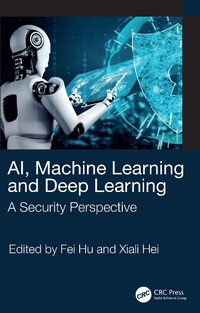
AI, Machine Learning and Deep Learning
A Security Perspective
1st Edition
Published on 5. June 2023
346 pages
978-1-000-87887-5 (ISBN)
Description

Today, Artificial Intelligence (AI) and Machine Learning/ Deep Learning (ML/DL) have become the hottest areas in information technology. In our society, many intelligent devices rely on AI/ML/DL algorithms/tools for smart operations. Although AI/ML/DL algorithms and tools have been used in many internet applications and electronic devices, they are also vulnerable to various attacks and threats. AI parameters may be distorted by the internal attacker; the DL input samples may be polluted by adversaries; the ML model may be misled by changing the classification boundary, among many other attacks and threats. Such attacks can make AI products dangerous to use.
While this discussion focuses on security issues in AI/ML/DL-based systems (i.e., securing the intelligent systems themselves), AI/ML/DL models and algorithms can actually also be used for cyber security (i.e., the use of AI to achieve security).
Since AI/ML/DL security is a newly emergent field, many researchers and industry professionals cannot yet obtain a detailed, comprehensive understanding of this area. This book aims to provide a complete picture of the challenges and solutions to related security issues in various applications. It explains how different attacks can occur in advanced AI tools and the challenges of overcoming those attacks. Then, the book describes many sets of promising solutions to achieve AI security and privacy. The features of this book have seven aspects:
This is the first book to explain various practical attacks and countermeasures to AI systems
Both quantitative math models and practical security implementations are provided
It covers both "securing the AI system itself" and "using AI to achieve security"
It covers all the advanced AI attacks and threats with detailed attack models
It provides multiple solution spaces to the security and privacy issues in AI tools
The differences among ML and DL security and privacy issues are explained
Many practical security applications are covered
While this discussion focuses on security issues in AI/ML/DL-based systems (i.e., securing the intelligent systems themselves), AI/ML/DL models and algorithms can actually also be used for cyber security (i.e., the use of AI to achieve security).
Since AI/ML/DL security is a newly emergent field, many researchers and industry professionals cannot yet obtain a detailed, comprehensive understanding of this area. This book aims to provide a complete picture of the challenges and solutions to related security issues in various applications. It explains how different attacks can occur in advanced AI tools and the challenges of overcoming those attacks. Then, the book describes many sets of promising solutions to achieve AI security and privacy. The features of this book have seven aspects:
This is the first book to explain various practical attacks and countermeasures to AI systems
Both quantitative math models and practical security implementations are provided
It covers both "securing the AI system itself" and "using AI to achieve security"
It covers all the advanced AI attacks and threats with detailed attack models
It provides multiple solution spaces to the security and privacy issues in AI tools
The differences among ML and DL security and privacy issues are explained
Many practical security applications are covered
More details
Edition
1. Auflage
Language
English
Place of publication
London
United Kingdom
Publishing group
Taylor & Francis Ltd
Target group
College/higher education
Professional and scholarly
Illustrations
47 Tables, black and white; 131 Line drawings, black and white; 5 Halftones, black and white; 136 Illustrations, black and white
ISBN-13
978-1-000-87887-5 (9781000878875)
Copyright in bibliographic data and cover images is held by Nielsen Book Services Limited or by the publishers or by their respective licensors: all rights reserved.
Schweitzer Classification
Other editions
Additional editions
Book
12/2024
1st Edition
CRC Press
€67.60
Shipment within 10-20 days
Book
06/2023
1st Edition
CRC Press
€164.60
Shipment within 10-20 days
Persons
Dr. Fei Hu is a professor in the department of Electrical and Computer Engineering at the University of Alabama. He has published over 10 technical books with CRC press. His research focus includes cyber security and networking. He obtained his Ph.D. degrees at Tongji University (Shanghai, China) in the field of Signal Processing (in 1999), and at Clarkson University (New York, USA) in Electrical and Computer Engineering (in 2002). He has published over 200 journal/conference papers and books. Dr. Hu's research has been supported by U.S. National Science Foundation, Cisco, Sprint, and other sources. He won the school's President's Faculty Research Award (<1% faculty were awarded each year) in 2020.
Dr. Xiali (Sharon) Hei is an assistant professor in the School of Computing and Informatics at the University of Louisiana at Lafayette. Her research focus is cyber and physical security. Prior to joining the University of Louisiana at Lafayette, she was an assistant professor at Delaware State University from 2015-2017 and Frostburg State University 2014-2015. Sharon received his Ph.D. in computer science from Temple University in 2014, focusing on computer security.
Dr. Xiali (Sharon) Hei is an assistant professor in the School of Computing and Informatics at the University of Louisiana at Lafayette. Her research focus is cyber and physical security. Prior to joining the University of Louisiana at Lafayette, she was an assistant professor at Delaware State University from 2015-2017 and Frostburg State University 2014-2015. Sharon received his Ph.D. in computer science from Temple University in 2014, focusing on computer security.
Content
Part I. Secure AI/ML Systems: Attack Models
1. Machine Learning Attack Models, 2. Adversarial Machine Learning: A New Threat Paradigm for Next-generation Wireless Communications, 3. Threat of Adversarial Attacks to Deep Learning: A Survey, 4. Attack Models for Collaborative Deep Learning, 5. Attacks on Deep Reinforcement Learning Systems: A Tutorial, 6. Trust and Security of Deep Reinforcement Learning, 7. IoT Threat Modeling using Bayesian Networks
Part II. Secure AI/ML Systems: Defenses
8. Survey of Machine Learning Defense Strategies, 9. Defenses Against Deep Learning Attacks, 10. Defensive Schemes for Cyber Security of Deep Reinforcement Learning, 11. Adversarial Attacks on Machine Learning Models in Cyber-Physical Systems, 12. Federated Learning and Blockchain: An Opportunity for Artificial Intelligence with Data Regulation
Part III. Using AI/ML Algorithms for Cyber Security
13. Using Machine Learning for Cyber Security: Overview, 14. Performance of Machine Learning and Big Data Analytics Paradigms in Cyber Security, 15. Using ML and DL Algorithms for Intrusion Detection in Industrial Internet of Things.
Part IV. Applications
16. On Detecting Interest Flooding Attacks in Named Data Networking (NDN)-based IoT Searches, 17. Attack on Fraud Detection Systems in Online Banking Using Generative Adversarial Networks, 18. An Artificial Intelligence-assisted Security Analysis of Smart Healthcare Systems, 19. A User-centric Focus for Detecting Phishing Emails
1. Machine Learning Attack Models, 2. Adversarial Machine Learning: A New Threat Paradigm for Next-generation Wireless Communications, 3. Threat of Adversarial Attacks to Deep Learning: A Survey, 4. Attack Models for Collaborative Deep Learning, 5. Attacks on Deep Reinforcement Learning Systems: A Tutorial, 6. Trust and Security of Deep Reinforcement Learning, 7. IoT Threat Modeling using Bayesian Networks
Part II. Secure AI/ML Systems: Defenses
8. Survey of Machine Learning Defense Strategies, 9. Defenses Against Deep Learning Attacks, 10. Defensive Schemes for Cyber Security of Deep Reinforcement Learning, 11. Adversarial Attacks on Machine Learning Models in Cyber-Physical Systems, 12. Federated Learning and Blockchain: An Opportunity for Artificial Intelligence with Data Regulation
Part III. Using AI/ML Algorithms for Cyber Security
13. Using Machine Learning for Cyber Security: Overview, 14. Performance of Machine Learning and Big Data Analytics Paradigms in Cyber Security, 15. Using ML and DL Algorithms for Intrusion Detection in Industrial Internet of Things.
Part IV. Applications
16. On Detecting Interest Flooding Attacks in Named Data Networking (NDN)-based IoT Searches, 17. Attack on Fraud Detection Systems in Online Banking Using Generative Adversarial Networks, 18. An Artificial Intelligence-assisted Security Analysis of Smart Healthcare Systems, 19. A User-centric Focus for Detecting Phishing Emails
