

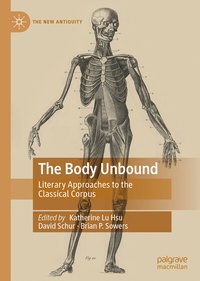
The Body Unbound
Description

This book explores the body's physical limits and the ways in which the confines of the body are delineated, transgressed, or controlled in literary and philosophical texts. Drawing on classics, philosophy, religious studies, medieval studies, and critical theory and examining material ranging from Homer to Game of Thrones , this volume facilitates an interdisciplinary investigation into how the boundaries of the body define the human form in language. This volume's essays suggest that the body's meaning is perhaps never more evident than in the violation of its wholeness. The boundaries of the body are areas of transition between states and are therefore vulnerable. As individuals find themselves isolated from their world and one another, their bodies regularly allow for physical interactions, incur transgressions and violations, and undergo profound transformations. Thus sympathy, sexuality, disease, and violence are among the main themes of the volume, which, ultimately, reexamines the place of the body in our understanding of what it means to be human.
More details
Other editions
Additional editions
Persons
Katherine Lu Hsu is Assistant Professor of Classics at College of the Holy Cross, USA. She is author of The Violent Hero: Heracles in the Greek Imagination (2021) and articles on Greek tragedy and myth. She has also taught at Brooklyn College, CUNY, USA, where she directed the Latin/Greek Institute.
David Schur is Associate Professor of Classics at Brooklyn College, CUNY, USA, and the CUNY Graduate Center. He has written studies of Heraclitus, Homer, and Plato, as well as Kafka and Freud. He is especially interested in methodologies of literary close reading.
Brian P. Sowers is Assistant Professor of Classics at Brooklyn College, CUNY, USA. He has published on late antique reading communities, early Christian female martyrs, and the use of ancient literature to resist contemporary white supremacy. His first book is In Her Own Words: The Life and Poetry of Aelia Eudocia (2020).
Content
1. Introduction; Katherine Lu Hsu, David Schur, Brian P. Sowers.- 2. Pain, Power, and Human Community: Empathy as a "Physical Problem" in Pseudo-Aristotle and Beyond ; Brooke Holmes.- 3. The Dread Wayfarer: Philoctetes' Foot; David Schur.- 4. Wounded Immortals: The Painful Paradoxes of Prometheus and Chiron; Katherine Lu Hsu.- 5. Deep Cuts: Rhetoric of Human Dissection, Vivisection, and Surgery in Latin Literature; Michael Goyette.- 6. Why is Male Breast Milk Kosher?: Breastfeeding, Gender, and the Leaky Body in Rabbinic Literature; Jordan D. Rosenblum.- 7. Fragment as Plenitude: Victricius of Rouen on Saintly Bodies; Virginia Burrus.- 8. Violating Vergil's Corpus: The Penetrated Body in Cento Literature; Brian P. Sowers.- 9. Nothing to Lose: Logsex and Genital Injury in Peter of Cornwall's Book of Revelations; Karl Steel.- 10. The Risks of Riding a Dolphin: A Motif in Some Greek and Roman Narratives of Desire; Craig Williams.- 11. Sinister Adaptation: Sensationalism and Violence against Women in Anglo-American Cinema and Roman Drama; T. H. M. Gellar-Goad.
