

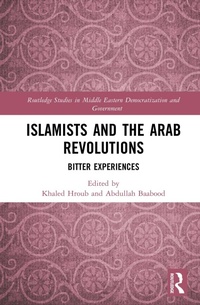
Islamists and the Arab Revolutions
Bitter Experiences
1st Edition
Published on 10. November 2025
276 pages
978-1-040-42886-3 (ISBN)
Description

This monograph offers the most comprehensive and regionally grounded analysis to date of how Islamist movements across the Middle East responded to - and were transformed by - the 2010-2011 Arab uprisings.
Far from a monolithic force, Islamist actors across Egypt, Tunisia, Yemen, Morocco, Libya, Jordan, Syria, Sudan, and the Gulf reacted in divergent and contradictory ways to the revolutionary wave. This volume brings together scholars from within the region who not only document the evolving role of Islamist parties in their respective contexts but also critically examine how their ideologies, internal structures, and political strategies were challenged, revised, or, in some cases, further radicalized. Drawing on case studies of both participation and repression, electoral victories and authoritarian backlash, the chapters offer a panoramic view of Islamists navigating revolution, governance, exile, and counter-revolution. From the Muslim Brotherhood's dramatic rise and fall in Egypt to Ennahda's contested governance in Tunisia, and the fragmented Islamist scene in post-Qaddafi Libya, this book reveals how the Arab uprisings served as a turning point - exposing both the potential and the limits of political Islam.
Essential reading for scholars and students of Middle East politics, Islamist movements, revolutionary studies, and democratization, this book provides crucial insights into the turbulent interplay between ideology, power, and social transformation in the contemporary Arab world.
Far from a monolithic force, Islamist actors across Egypt, Tunisia, Yemen, Morocco, Libya, Jordan, Syria, Sudan, and the Gulf reacted in divergent and contradictory ways to the revolutionary wave. This volume brings together scholars from within the region who not only document the evolving role of Islamist parties in their respective contexts but also critically examine how their ideologies, internal structures, and political strategies were challenged, revised, or, in some cases, further radicalized. Drawing on case studies of both participation and repression, electoral victories and authoritarian backlash, the chapters offer a panoramic view of Islamists navigating revolution, governance, exile, and counter-revolution. From the Muslim Brotherhood's dramatic rise and fall in Egypt to Ennahda's contested governance in Tunisia, and the fragmented Islamist scene in post-Qaddafi Libya, this book reveals how the Arab uprisings served as a turning point - exposing both the potential and the limits of political Islam.
Essential reading for scholars and students of Middle East politics, Islamist movements, revolutionary studies, and democratization, this book provides crucial insights into the turbulent interplay between ideology, power, and social transformation in the contemporary Arab world.
More details
Series
Edition
1. Auflage
Language
English
Place of publication
London
United Kingdom
Publishing group
Taylor & Francis Ltd
Target group
College/higher education
Illustrations
1 Tables, black and white
File size
3,59 MB
ISBN-13
978-1-040-42886-3 (9781040428863)
Copyright in bibliographic data and cover images is held by Nielsen Book Services Limited or by the publishers or by their respective licensors: all rights reserved.
Schweitzer Classification
Other editions
Additional editions
Book
11/2025
1st Edition
Routledge
€197.70
Shipment within 15-20 days
Persons
Khaled Hroub is a Professor at Northwestern University in Qatar. He previously taught Middle East history and politics at the University of Cambridge. His research focuses on Arab politics and religion, with emphasis on Palestine and the broader Middle East. He is the author of several books, including works on Hamas and religious broadcasting in the region. He holds a Ph.D. in International Relations from the University of Cambridge.
Abdullah Baabood is the Qatar Chair for Islamic Area Studies and a Visiting Professor at Waseda University. He has held prominent academic positions at Qatar University and the University of Cambridge, with a focus on Gulf politics, economics, and foreign relations. He holds a Ph.D. in International Relations from the University of Cambridge and an MBA from the University of Kent.
Abdullah Baabood is the Qatar Chair for Islamic Area Studies and a Visiting Professor at Waseda University. He has held prominent academic positions at Qatar University and the University of Cambridge, with a focus on Gulf politics, economics, and foreign relations. He holds a Ph.D. in International Relations from the University of Cambridge and an MBA from the University of Kent.
Content
1 Introduction - Islamists and the Arab Revolutions: Diverse Experiences and Bitter Lessons
KHALED HROUB AND ABDULLAH BAABOOD
2 Egypt - Walk in Place: Political and Ideological Revisionism within Egypt's Post-013 Muslim Brotherhood
MOHAMMAD AFFAN AND HEBA RAOUF EZZAT
3 Egypt - The Lure of Politics: Transformations of Egypt's Salafists during and after the 2011 Revolution
KHALIL AL-ANANI
4 Tunisia - The Tunisian Ennahda Movement after the 2020 Revolution: Failure and Uncertainty
SALAH EDDIN JOURCHI
5 Yemen - The Yemeni Islah Party: Developments and Stagnation in the Arab Spring
ATEQ JARALLAH
6 Morocco - Was There a "Moroccan Spring" for the Justice and Development Party?
ABDELALI HAMIDINE
7 Oman - Islamists and the "Omani Spring"
SAID SULTAN AL HASHIMI
8 Libya - Libyan Islamists during and after the Arab Spring
OSAMA KUBBAR
9 Jordan - The "Brotherhood" after the Arab Spring: Political, Intellectual, and Organizational Crises and Transformations
MOHAMMAD ABU RUMMAN
10 Bahrain and Kuwait's Islamists and Their "Spring": A Critique of the Experience
BAQER ALNAJJAR
11 Syria - Incomplete Transformations: Islamists and the Challenge of Revolution and Rule in Syria, 2011-2022
ABDULRAHMAN ALHAJ
12 Sudan - Islamists in Power: From Freedom Seekers to Authoritarian Rulers
KHALID ELTIGANI ELNOUR
KHALED HROUB AND ABDULLAH BAABOOD
2 Egypt - Walk in Place: Political and Ideological Revisionism within Egypt's Post-013 Muslim Brotherhood
MOHAMMAD AFFAN AND HEBA RAOUF EZZAT
3 Egypt - The Lure of Politics: Transformations of Egypt's Salafists during and after the 2011 Revolution
KHALIL AL-ANANI
4 Tunisia - The Tunisian Ennahda Movement after the 2020 Revolution: Failure and Uncertainty
SALAH EDDIN JOURCHI
5 Yemen - The Yemeni Islah Party: Developments and Stagnation in the Arab Spring
ATEQ JARALLAH
6 Morocco - Was There a "Moroccan Spring" for the Justice and Development Party?
ABDELALI HAMIDINE
7 Oman - Islamists and the "Omani Spring"
SAID SULTAN AL HASHIMI
8 Libya - Libyan Islamists during and after the Arab Spring
OSAMA KUBBAR
9 Jordan - The "Brotherhood" after the Arab Spring: Political, Intellectual, and Organizational Crises and Transformations
MOHAMMAD ABU RUMMAN
10 Bahrain and Kuwait's Islamists and Their "Spring": A Critique of the Experience
BAQER ALNAJJAR
11 Syria - Incomplete Transformations: Islamists and the Challenge of Revolution and Rule in Syria, 2011-2022
ABDULRAHMAN ALHAJ
12 Sudan - Islamists in Power: From Freedom Seekers to Authoritarian Rulers
KHALID ELTIGANI ELNOUR
