

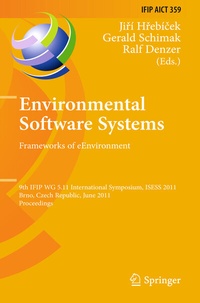
Environmental Software Systems. Frameworks of eEnvironment
9th IFIP WG 5.11 International Symposium, ISESS 2011, Brno, Czech Republic, June 27-29, 2011, Proceedings
Published on 28. June 2011
XXIV, 680 pages
978-3-642-22285-6 (ISBN)
Description

This book constitutes the refereed proceedings of the 9th IFIP WG 5.11 International Symposium on Environmental Software Systems, ISESS 2011, held in Brno, Czech Republic, in June 2011. The 68 revised full papers presented together with four invited talks were carefully reviewed and selected from numerous submissions. The papers are organized in the following topical sections: eEnvironment and cross-border services in digital agenda for Europe; environmental information systems and services - infrastructures and platforms; semantics and environment; information tools for global environmental assessment; climate services and environmental tools for urban planning and climate change - applications and services.
More details
Other editions
Additional editions

Jiri Hrebicek | Gerald Schimak | Ralf Denzer
Environmental Software Systems. Frameworks of eEnvironment
9th IFIP WG 5.11 International Symposium, ISESS 2011, Brno, Czech Republic, June 27-29, 2011, Proceedings
Book
06/2011
1st Edition
Springer
€106.99
Shipment within 7-9 days
Content
- Intro
- Title Page
- Preface
- Organization
- Table of Contents
- Invited Talks
- eEnvironment: Reality and Challenges for eEnvironment Implementation in Europe
- Introduction
- Introduction to eEnvironment Vision
- eEnvironment and eDemocracy
- Development of eEnvironment Infrastructure
- eEnvironment and Digital Agenda for Europe
- eEnvironment Services in the Digital Agenda for Europe
- eEnvironment Services and European Neighbourhood
- eEnvironment and Open Government Data Initiative
- Vision for Extending eEnvironment to a Single Information Space in Europe for the Environment
- Conclusion
- References
- Making Progress in Integrated Modelling and Environmental Decision Support
- Introduction
- Integrated Modelling
- Where Are We Now?
- The Legacy of Models
- Protocols and Guidelines
- Participatory Modelling
- Paradigms for Integrated Modelling
- Methods and Tools
- The Software and Hardware Technology
- Where Would We Like to Be?
- Uncertainty Management
- Problem Framing
- Model and Data Assurance, Uncertainty and Sensitivity
- Long Term Modelling Projects
- Software Development Methodologies
- How Do We Get There and What Are the Opportunities?
- References
- Microsoft Open Government Data Initiative (OGDI), Eye on Earth Case Study
- Open Data Driving Open Government
- The Open Government Challenge
- Why is Public Data So Important?
- The European Open Government Data Initiative (European OGDI) Solution
- Overcoming Barriers towards Open Government
- Why Use the Cloud for Open Data?
- Open Data Projects Using Microsoft Technologies
- Open Data Terms of Use
- Case Studies
- Environmental Data Sharing: Eye on Earth a Cloud-Based, Web 2.0 Solution
- Open Data Applications: Rennes - Waste Collection Points
- Open Data Applications: Paris - Sorting on Streetside Trees
- Open Data Applications: Paris - Public Toilettes on Windows Phone 7
- Environmental Statistics at the CZSO: Past Development and Future Trends
- Introduction
- Development of the Environmental Statistics at the CZSO
- Own Statistical Surveys and Overtaken Data
- Statistical Survey on Environmental Expenditure
- Waste Production Survey
- Environmental Accounting
- Discussion
- Conclusion
- References
- eEnvironment and Cross-Border Services in Digital Agenda for Europe
- The National Secretariat GEOSS/GMES - Implementation of GEOSS and GMES in the Czech Republic
- Introduction
- Czech Approach to GMES
- Conclusion
- References
- Vision and Requirements of Scenario-Driven Environmental Decision Support Systems Supporting Automation for End Users
- Introduction
- The SUDPLAN Vision
- The Scenario Management System Requirements
- Needs Assessment
- User Requirements Derivation
- User Requirements Overview
- Architecture and Status of Implementation
- References
- OGD2011 - Requirements Analysis for an Open Data Strategy (in Austria)
- Introduction
- Need for Definitions
- Open Government: Transparency and Democracy, Participation and Collaboration
- Legal Issues
- Impact on Society
- Innovation and Knowledge Society
- Impact on Economy/Industry
- Licenses, Models for Exploitation, Terms of Use
- Data relevant Aspects
- Data Governance
- Applications and Use Cases
- Technological Aspects
- Conclusion
- SISE Semantics Interpretation Concept
- Introduction
- Expert System vs. Ontology
- Expert System
- Ontology
- Expert System and Ontology Combination Advantages/Disadvantages
- Ontology Based Expert System
- Idea of Implementation
- Conclusion
- References
- Flood Management and Geoinformation Support within the Emergency Cycle (EU Example)
- Introduction
- Flood Management in the Czech Republic
- Legal Framework
- Activities in the Flood Management
- Flood Related Spatial Data and Services to Support Activities within the Disaster Management Cycle
- Geoinformation for Prevention - Flood Zone Mapping, Insurance Maps, Flood Risk Mapping
- Geoinformation for Preparation - Integrated Warning Service System, Flood Modelling
- Geoinformation for Response - Flood Management Plan
- Adaptive Mapping in Crisis Management
- Conceptual Framework - Study "FLOOD"
- Context Composition
- Conclusion
- References
- Capturing of Uncertainty by Geographical IS in Decision Support for Selected Aspects of Quality of Life
- Introduction
- Modelling of Landscape Phenomena
- Geodata and Map Algebra
- Fuzzy Logic
- Principles of Fuzzy Sets Integration into Geographic IS
- Application to the Well-Being Factor
- Conclusions
- References
- Knowledge-Based Service Architecture for Multi-risk Environmental Decision Support Applications
- Introduction
- Problem Statement
- Developing a Knowledge-Based Service Architecture
- Knowledge-Based Services for In-Situ Sensors and Sensor Networks
- Knowledge-Based Services for Real-Time and Multi-modal Data
- Conclusions
- References
- GMES - The EU Earth Observation Programme
- Introduction
- GMES - From the GMES Programme
- Architecture of GMES
- Space Infrastructure
- In-Situ Infrastructure
- Users
- GMES Services
- GMES - Operational EO Service
- Conclusion
- References
- Can Volunteered Geographic Information Be a Participant in eEnvironment and SDI?
- Introduction
- Overview of Related Literature
- Using VGI in SDI: The OpenStreetMap Case Study
- Metadata
- Collaborative Contributions
- Spatial Scale Issues
- Conclusions
- References
- 3D Modelling as a Tool for Landscape Restoration and Analysis
- Introduction
- Data and Methods
- Old Maps
- Aerial Photographs
- DTM and DSM Creation
- Hot Spot Characterization
- Analysis
- Castle Jezerí Analysis
- Lake Most Analysis
- The Open-Cast Mine Bílina Analysis
- Conclusion
- References
- GINA (Geographical Information Assistant) Fresh Wind in Environmental Mapping
- Introduction
- GINA System
- Usage Scenarios
- Integration Possibilities
- Hardware Equipment
- Services for Customers
- References of Usage
- Company Profile
- References
- Environmental Information Systems on the Internet: A Need for Change
- Introduction
- eEnvironment Services for Three Spheres
- Terrain: Mapping Terrestrial Biodiversity
- Atmosphere: Monitoring Individualized Pollen Exposure
- Marine: Managing Marine Resources
- Beyond Foreseen eEnvironment Services
- Generalization and Requirements Analysis
- The Value Chain of Environmental Knowledge Generation
- Overview of Stakeholders
- Requirements for a Next Generation of eEnvironment Services
- Future Internet: A Framework for Implementing Change
- Summary and Outlook
- References
- Geospatial Virtual Appliances Using Open Source Software
- Brief Introduction to Virtualization
- VirtualBox
- The Virtual Appliance Strategy
- Integrated Landscape Management System
- HRU Virtual Appliance Solution
- QGIS Integration
- Summary
- References
- How to Analyse User Requirements for Service-Oriented Environmental Information Systems
- Introduction
- Co-development of Requirements and Capabilities
- The SERVUS Design Methodology
- Analysis of User Requirements
- Conclusion and Outlook
- References
- Building an Environmental Information System for Personalized Content Delivery
- Introduction
- Discovery of Environmental Nodes
- Processing, Orchestration and Retrieval of Environmental Nodes
- Service-Oriented Infrastructure
- Outlook
- References
- Environmental Information Systems and Services - Infrastructures and Platforms
- Using Negotiation for Dynamic Composition of Services in Multi-organizational Environmental Management
- Introduction
- Environment Management Scenario
- Dynamic Workflows
- Self-configuration Using Service Negotiation
- Conclusions
- References
- data.reegle.info - A New Key Portal for Open Energy Data
- Introduction
- Linked Open Data W3C Standards
- SKOS and RDF Format
- Thesauri
- The reegle Thesauri
- reegle.info as a Linked Open Data Publisher/Consumer
- The data.reegle.info SPARQL Endpoint
- Benefits for reegle Users
- Glossary, Web Search
- Visualizing Knowledge
- Country Energy Profiles - A reegle Mash-Up
- Outlook
- References
- GENESIS, a Flexible Solution for Building Networks of Collaborative Environmental Services
- Introduction
- Genesis Solution
- Discovery Services
- Data Access Services
- Data Processing Services
- Orchestration Services
- Genesis Service Portal
- Genesis Pilots
- Genesis Actors
- Conclusion
- Reference
- An Environmental Decision Support System for Water Issues in the Oil Industry
- Introduction
- Requirements of End Users
- Focus on What Is Needed
- Needs Analysis
- Details of the Application
- System Platform
- Integration of Models
- References
- Open Environmental Platforms: Top-Level Components and Relevant Standards
- Introduction
- Top-Level Components of the Environmental Monitoring Platform
- Service and Content Models
- Semantically Enhanced Infrastructure
- Value-Added Services and Content
- End-User Applications
- Relevant Standards
- Challenges and Outlook
- References
- Best Practice Network GS SOIL Promoting Access to European, Interoperable and INSPIRE Compliant Soil Information
- Introduction
- The GS SOIL Portal
- Data Quality, Data Management and Metadata
- Soil Specific Multilingual Thesaurus
- Application Schema, Data Harmonization and Interoperability
- Outlook
- References
- A Concept of a Virtual Research Environment for Long-Term Ecological Projects with Free and Open Source Software
- Introduction
- General Working Steps of Long-Term Research Projects
- Virtual Research Environment
- VRE Services
- GeoNetwork Opensource
- Consideration of Standards
- Implementation of GNOS
- Functions
- Long-Term Data Management
- Conclusions
- References
- Corporate Sustainability Reporting and Measuring Corporate Performance
- Introduction
- GRI and UNEP FI Proposals
- Modelling Tools for Measuring Corporate Performance
- Corporate Performance
- Economic Performance
- Environmental Performance
- Social and Governance Performance
- Conclusion
- References
- Software Architectures for Distributed Environmental Modeling
- Introduction
- Fundamental Architectural Patterns
- Process and Workflow Management
- Architecture for Linking Processes and Events
- Architecture for Formal Modeling Workflows
- Collaboration Support
- An Example of a Collaborative Modeling Website
- Discussion
- References
- Supporting the Use of Environmental Information Systems and Services - Experiences with a Course for Postgraduate Professional Education
- Introduction
- Programme Description
- Course Development
- Competence Focus - Learning Goals
- Teaching Approach - Learning Methods and Tools
- Programme Results
- Outcome of Project Work
- Evaluation Results
- Conclusions and Outlook
- References
- Envimat.cz - Online Database of Environmental Profiles of Building Materials and Structures
- Introduction
- General Methodology
- Evaluated Parameters
- Existing Databases
- Differences among Various Databases
- Methodology of Envimat
- EPD
- Goals and Objectives of Envimat
- Envimat Architecture
- Envimat Interface
- Catalogue Inputs
- Conclusion
- References
- The ENVISION Environmental Portal and Services Infrastructure
- Introduction
- Architecture
- Portlets for the Scenario Web Sites
- Portlets for the ENVISION Portal
- Setting Up a Scenario Web Site
- Importing a Resource
- Annotating a Web Service
- Discovering a Web Service
- Composing an Environmental Model
- Creating the Scenario Web Site
- Accessing the Environmental Model
- Open Challenges
- Conclusion
- References
- Crop Simulation Model Registrator and Polyvariant Analysis
- Introduction
- Extending Relational Database Meta-information
- Model Interaction API
- Automated Computer Experiment with Crop Model
- Operation Principles and Implementation
- Examples of Usage
- Perspectives
- References
- Process Methodology for Emergency Management
- Introduction
- Methodologies Based on Business Process
- Object Process Methodology
- Rational Unified Process
- Methodology for Modelling and Analysis of Business Process
- Business Driven Development
- Process Oriented Methodology
- Phases
- Roles
- Work Products
- Recommendations for Emergency Management
- Organizational Structure
- Legislation and Documentation
- Different Types of Information
- Psychological Aspects
- Using of Standards
- Conclusions
- References
- Architecture of a Pan-European Framework for Integrated Soil Water Erosion Assessment
- Introduction
- Setting Soil Erosion in a Wider Context
- Methods
- Modeling Architecture
- Mathematical Notation and Semantic Array Programming
- The Soil Water Erosion Model
- Conclusions
- References
- Towards a Universal Search in Environmental Information Systems
- Introduction
- Target System Descriptions
- Preprocessing
- Presenting Search Results (Mash-up)
- Conclusion and Outlook
- References
- Methodology for the Efficiency Evaluation of the Municipal Environmental Protection Expenditure
- Introduction
- Public Environmental Protection Expenditure
- Methodology of Efficiency Evaluation
- Environmental Protection Expenditure Efficiency and Effectiveness
- Economic Aspect of Evaluation
- Environmental Aspect of Evaluation
- Social Aspect of Evaluation
- Summary of the Methodology
- Case Study of the Efficiency Evaluation Using the Methodology
- Evaluation of Economic Aspect of Efficiency and Effectiveness
- Evaluation of Environmental Aspect
- Evaluation of Social Aspect
- Summary and Outlook
- References
- CryoLand - GMES Service Snow and Land Ice - Interoperability, Service Integration and User Access
- Introduction
- Infrastructure Requirements
- High-Level Requirements
- Neighbouring Systems
- CryoLand Architecture
- Architecture Definition Approach
- Architecture Baseline and Good Practice
- Enterprise Viewpoint
- Information Viewpoint
- Computational (Service) Viewpoint
- Technology Viewpoint
- Engineering Viewpoint
- Status of Development
- Conclusion and Outlook
- References
- RBIS - An Environmental Information System for Integrated Landscape Management
- Introduction
- Integrated Landscape Management System (ILMS)
- River Basin Information System (RBIS)
- System Architecture
- Time Series Data Management (RBISts)
- Geodate Management and Visualization (RBISmap)
- Further RBIS Modules
- RBIS Role in the ILMS Workflow
- Use of RBIS in Research Projects
- Summary and Outlook
- References
- Semantics and Environment
- User-Friendly Access to Structured Environmental Data
- Motivation
- Look-and-Feel of the HIPPOLYTOS Semantic-Metadata Search
- Look-and-Feel of the KOIOS Schema-Agnostic Search
- Summary and Future Work
- References
- Leveraging Ontologies for Environmental Information Systems
- Introduction
- Enhancing Search Facilities - How Ontologies Can Help
- Semantic Search Scenarios - Why Are Full-Text Engines Not Enough?
- Architectural Aspects - Spicing Up the Established Search Infrastructure
- Ontologies - Where Do They Come From?
- Fostering Integrated Domain Knowledge - Ontology Mapping
- Driving the Change - A Comprehensive Ontology Management
- Conclusions
- References
- An Architecture for the Semantic Enhancement of Environmental Resources
- Introduction
- Requirements of SISE
- Needs, Gaps and Objectives of TaToo
- The TaToo Architecture
- TaToo Architecture - Added Value for SISE
- Generalization and Future Research
- References
- Building Environmental Semantic Web Applications with Drupal
- Introduction
- Drupal and Semantic Web
- Proof of Concept Application
- Retrieving Biodiversity Data from GBIF and DBpedia
- Defining the Data Model and Semantic Annotations
- Binding Data into Drupal
- Mashups and Visualization
- Conclusions and Outlook
- References
- Semantics Annotations of Ontology for Scenario: Anthropogenic Impact and Climate Change Issues
- Introduction
- Description of the Scenario
- Align Ontology for POP's and Cancer Domain
- Analyze of POP's and Cancer Interests
- Identification of Basic Concepts
- Alignment Domain Ontology to the TaToo Ontology Framework
- Description of Basic Concepts
- Conclusions
- References
- Towards a Semantically Unified Environmental Information Space
- Introduction
- Application of the Semantic Web Technologies in the Environmental Domain
- Environmental Data Identification and Representation
- Semantic Annotation of Environmental Data
- A Short ``howto'' Guide for Environmental Data Providers
- Semantic Linking of Environmental Data
- Conclusions
- References
- A Model for Semantic Annotation of Environmental Resources: The TaToo Semantic Framework
- Introduction
- Ontology Framework
- The Minimal Environmental Resource Model
- Integrating Domains
- Conclusions
- References
- Climate Twins - An Attempt to Quantify Climatological Similarities
- Introduction
- Theory and Methodology
- Climate Data
- Similarity Measures
- Application
- Technical Infrastructure
- Input Data
- Interactive Map Application
- Summary and Outlook
- References
- Semantic Wiki in Environmental Project Management
- Semantic wiki in Real Project Management
- Semantic Support in Existing wiki Systems
- Projects Presentation in a Broader Context
- Semantic Extension in the wiki
- Key Requirements
- Technology
- Functionality
- System Integration
- Conclusion and Further Work
- References
- The Relevance of Measurement Data in Environmental Ontology Learning
- Introduction
- Materials and Methods
- Results
- Discussion
- Conclusions
- References
- Using Semantic Search as a Means of Support for Research Projects
- Introduction
- Materials and Methods
- The Semantic Web and Web 2.0
- Semantic Searching and Search Engines
- Results
- XBRL
- Using the Social Communication Means as Support of the Project Solution
- Conclusion
- References
- Information Tools for Global Environmental Assessment
- Conceptual Model Enhancing Accessibility of Data from Cancer-Related Environmental Risk Assessment Studies
- Introducing Problems with Data Accessibility
- Persistent Organic Pollutants as Model for Cancer Risk Studies
- Cancer Epidemiology as Endpoint in Risk Studies
- Proposed Conceptual Model and Reasoning of Its Structure
- Projection of Proposed Conceptual Model to Data Standards
- Impact of Proposed Data Model on Data Processing and Analysis
- Examples of Practical Implementation
- Conclusions and Future Challenges
- References
- GENASIS Information System: A Global Environmental Assessment of Persistent Organic Pollutants
- Introduction
- Background
- Initiation of the GENASIS Project
- Information Database
- Analytical and Interpretation Tools
- Deliverables and Impacts of the GENASIS Project
- References
- Is On-Line Data Analysis Safety? Pitfalls Steaming from Automated Processing of Heterogeneous Environmental Data and Possible Solutions
- Introduction
- Suggested Methodology
- Results of Methodology Testing
- Conclusion
- References
- CETOCOEN Project: From the Laboratory to the Field and Beyond
- Introduction
- Background
- CETOCOEN Project and Its Goals
- Project Deliverables and Impacts
- References
- Spatial Soil Modeling of Organochlorine Pesticides, Their Pools and Volatilization Fluxes
- Introduction
- Data Sources
- Methodology
- Determination of the Spatial and Quantitative Distribution of POPs in Soil
- Construction of a Fugacity Model for Determining the Volatilization of POPs from Czech Soils
- Results and Conclusions
- References
- Global Environmental Assessment Requires Global Functional Searching Engines: Robust Application of TaToo Tools
- Introduction
- Description of the Scenario
- System for Visualizing of Oncological Data
- Global Environmental Assessment Information System
- Relevance of the Scenario
- TaToo Architecture
- Tagging Portlet
- Discovery Portlets
- TaToo Evaluate and Validate Portlet
- Conclusions
- References
- Temporal Changes in Biological Communities Affecting Models for Evaluating of Ecological Status
- Introduction
- Study Area
- Statistical Methods
- Results
- Conclusion
- References
- Autocalibration of Environmental Process Models Using a PAC Learning Hypothesis
- Introduction
- "Goodness of Fit" Measure for Hydrological Models
- The Method
- Data Used in Experiments
- SWAT Manual Calibration
- SWAT-CUP
- SWAT PAC Learning
- Conclusions
- References
- Modeling Heterogeneous Experts' Preference Ratings for Environmental Impact Assessment through a Fuzzy Decision Making System
- Introduction
- Handling Heterogeneous Experts EIA Data Using Fuzzy Numbers
- FDMS for EIA
- Conclusion
- References
- Climate Services and Environmental Tools for Urban Planning and Climate Change Applications and Services
- New Methods of Flash Flood Forecasting in the Czech Republic
- Introduction
- The Method
- Results and Dicussion
- Conclusion
- References
- Web Services for Incorporation of Air Quality and Climate Change in Long-Term Urban Planning for Europe
- Introduction
- Methods
- Air Quality Downscaling Model
- Air Quality Downscaling in Common Services
- Air Quality Downscaling Results
- Conclusions
- References
- The Global Warming, Sustainability, and Environmental Tax: Dynamic General Equilibrium Model
- Introduction
- Economic Model and Short-Run Equilibrium
- Formal Model
- Short-Run GE and Specification of Functions
- Long-Run General Equilibrium Dynamics
- The Variation of CO2 in the Atmosphere
- The Variation of Population
- Simulations
- Zero Greenhouse Effect Case
- Active Greenhouse Effect Case: a3=1/4 and x0=1/10
- Active Greenhouse Effect Case: a3=1/4 and x0&1/10
- Active Greenhouse Effect Case: a3=1/4 and x0=5/10
- Conclusions
- References
- Going Public with Advanced Simulations
- The New Challenges of Water Management
- The Solution, Part One: A New, Large-Scale Hydrologic Model with High Resolution
- The Solution, Part Two: Storing Data in an Efficient and Flexible Database
- The Solution, Part Three: A Web-Based User Interface
- The Solution, Part Four: An Operational Production Line for WFD Support Services
- Conclusions
- References
- Design and Development of Web Services for Accessing Free Hydrological Data from the Czech Republic
- Introduction
- CUAHSI Hydrologic Information System
- HydroServer
- HydroCatalog
- Client Applications
- Software Design and Implementation
- Analysis of Requirements
- Evaluation of Data Sources
- Implementation of HydroServer for Small Organizations
- Overcoming Data Security Concerns
- Conclusion
- References
- SUDPLAN's Experiences with the OGC-Based Model Web Services for the Climate Change Usage Area
- Introduction
- Data, Transport, and Model Runs in Service Oriented Architecture
- Selection of Standards to be Used by SUDPLAN
- Data Transport: SOS, WCS, WFS, WMS?
- Model Invocation: SPS, WPS?
- O&M Encoding of Timeseries of Fields
- Using UncertML to Describe Statistical Data
- Using SensorML to Describe Models and Required Parameters
- Different Model Types Used in SUDPLAN
- Climate Scenario Data
- Rain Timeseries Downscaling
- Air Quality Downscaling
- Software Used
- Common Services
- Scenario Management System
- Local Models
- Conclusion and Outlook
- References
- Modelling Micro-climate Characteristics for Urban Planning and Building Design
- Introduction
- Applied Regional Climate Simulations
- Uncertainty Assessment of Regional Climate Simulations
- Future Climate Year Selection
- Urban Microclimate Simulations
- Development of Transfer Functions for Temperature and Wind Characteristics
- Functions to Transfer Regional to Local Temperature
- Functions to Transfer Regional to Local Wind Characteristics
- Conclusions
- References
- Using a Commercial Optimisation Tool for Fine Tuning of Parameters of an Eutrophication Model
- Introduction
- The Optimisation Tool ISSOP
- Parameter Optimisation and Sensitivity
- Results and Discussion
- Conclusions
- References
- Downscaling of Short-Term Precipitation Time Series for Climate Change Impact Assessment
- Introduction
- Downscaling Method: Delta Change
- Technical Solution
- Output and Visualization
- Concluding Remarks and Future Prospects
- References
- Integrating Climate Change in the Urban Planning Process - A Case Study
- Introduction
- Case Study - Basic Conditions
- Objectives
- Requirements and Deficiencies
- Supported Tasks
- Targeted Users
- The Solution
- The Urban Planning Workbench - Supporting the Planning and Decision Making Process
- Integration of Local Models - Merge the City Planner and Model Results
- Integration of Climate Change Information in City Planning Processes
- Benefits of the Wuppertal Pilot
- Summary and Future Research
- References
- Decision-Support System for Urban Air Pollution under Future Climate Conditions
- Introduction
- System Description
- System Features
- Sub-Models
- Regional Climate Modelling
- Urban Heat Island Effect Modelling
- Regional Air Quality Modelling
- Local-Scale Air Quality Modelling
- Economic Evaluation of Air Pollution
- Conclusion
- References
- Towards User Requirements for an Information System of the Integrated Rhine Programme
- Introduction
- Implementation of the Integrated Rhine Programme
- Approach for the Requirements Analysis
- Use Case Example
- Conclusion and Outlook
- References
- E-HypeWeb: Service for Water and Climate Information - and Future Hydrological Collaboration across Europe?
- Introduction
- Material and Methods
- The HYPE Model
- The European HYPE Model Set-Up (E-HYPE)
- HYSS
- E-HypeWeb and Balt-HypeWeb
- Results
- Discussion and Visions for the Future
- Better Input Data
- Open Source Community
- Hydrological Laboratory and New Technologies
- Conclusions
- References
- Development of an Information Portal for the Lake Winnipeg Basin Initiative
- Introduction
- LWBI Information Portal Considerations
- LWBI Information Portal Architecture
- Using Standards as the Backbone of the LWBI Information Portal
- Portal Functionality
- Web Personalization
- Knowledge Discovery Platform
- Community of Models
- Conclusions
- References
- Erratum
- Erratum: An Environmental Decision Support System forWater Issues in the Oil Industry
- Author Index
