

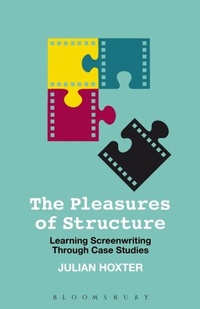
The Pleasures of Structure
Learning Screenwriting Through Case Studies
1st Edition
Published on 26. February 2015
312 pages
978-1-4411-9385-8 (ISBN)
Description

The Pleasures of Structure starts from the premise that the ability to develop a well understood and articulated story structure is the most important skill a screenwriter can develop. For example, good structure requires a great premise and rigorous character development. Without clear character motivations and goals--which are themselves indicative of key structural beats--your story is going exactly nowhere. Using the simple and flexible 'W' model of screenplay structure developed in the prequel Write What You Don't Know, Hoxter sets this out as its starting point. This model is tested against a range of examples which are chosen to explore the flexibility not only of that model but of movie storytelling more generally. Writers and students often worry that they are asked to work 'to formula'. This book will test that formula to breaking point.
For example, the first case study will offer the example of a well written, professional, mainstream movie against which our later and more adventurous examples can be compared. So the lessons we learn examining the animated family adventure movie How To Train Your Dragon lead us directly to ask questions of our second case study, the acclaimed Swedish vampire movie Lat den Raette Komma In (Let The Right One In). Both movies have protagonists with the same basic problem, the same goal, and they use the same basic structure to tell their stories. Of course they are very different films and they work on their audiences in very different ways. Our linked case studies will expose how simple choices, like reversing the order of elements of the protagonist's transformational arc and shifting ownership of key story beats, has an enormous impact on how we respond to a structural model that is otherwise functionally identical.
For example, the first case study will offer the example of a well written, professional, mainstream movie against which our later and more adventurous examples can be compared. So the lessons we learn examining the animated family adventure movie How To Train Your Dragon lead us directly to ask questions of our second case study, the acclaimed Swedish vampire movie Lat den Raette Komma In (Let The Right One In). Both movies have protagonists with the same basic problem, the same goal, and they use the same basic structure to tell their stories. Of course they are very different films and they work on their audiences in very different ways. Our linked case studies will expose how simple choices, like reversing the order of elements of the protagonist's transformational arc and shifting ownership of key story beats, has an enormous impact on how we respond to a structural model that is otherwise functionally identical.
Reviews / Votes
Julian Hoxter is a great teacher and an always entertaining writer. His deep knowledge of the history and practice of American screenwriting makes his latest book another 'must read.' In The Pleasures of Structure he embeds simple, helpful story concepts into a wide range of detailed and up-to-date case study examples, making them relevant for aspiring writers who want to work in every aspect of cinema from the mainstream and genre, to the wilder worlds of indie and microbudget screenwriting. The excellent critical glossary of screenwriting terms at the end also makes this book truly unique--it is worth the purchase price alone. * Michael Grais, Filmmaker and Acclaimed Screenwriter of Poltergeist * In the world of the screenwriter the simple things we see are always complicated. Hoxter has the knack to unpack and to explain. A cogent, witty and absorbing read. Hoxter boldly goes...! * Tony Moon, Filmmaker and Senior Lecturer in the Faculty of the Creative Industries, Southampton Solent University, UK * A stunningly thoughtful and unique approach to teaching screenwriting grounded in both a love of movies and exceptional research. Whether you are a veteran writer or starting your first screenplay, the 'W' model provides guidance without limiting your creativity or forcing you into a restrictive structure. The breadth and depth of research support Hoxter's concepts and the case studies provide practical examples of how to apply them. The Pleasures of Structure is a must read for all screenwriters. * Michael Whalen, Award-Winning Producer, Screenwriter, and Knight-Ridder / San Jose Mercury News Endowed Professor and Professor of Communication, Santa Clara University, USA *More details
Edition
1. Auflage
Language
English
Place of publication
New York
United States
Publishing group
Bloomsbury Publishing PLC (Digital)
Illustrations
25 bw illus
ISBN-13
978-1-4411-9385-8 (9781441193858)
Copyright in bibliographic data and cover images is held by Nielsen Book Services Limited or by the publishers or by their respective licensors: all rights reserved.
Schweitzer Classification
Other editions
Additional editions
Book
04/2015
Bloomsbury Academic USA
€50.99
Shipment within 15-20 days
Person
Julian Hoxter is the Screenwriting Coordinator and Associate Professor of Screenwriting in the Cinema Department of San Francisco State University, USA. He is an award winning educator and filmmaker whose films have been shown in festivals around the world. He has taught screenwriting and filmmaking in the US and the UK for over 15 years.
Content
Preface
Introduction: American Screenwriting Today
Section One: Principles of Movie Storytelling
The Origins of Story, Part One: Evolution, Storytelling, and Selective Advantage
The Origins of Story, Part Two: Written Culture, Ring Compositions, and the Principle of Parallelism
The Skeleton of a Story: Internal Story Logic
Putting Flesh on a Story's Bones: Narration and Pleasure in the Telling of the Tale
Keeping the Story Flowing: Narrative Economy and Screenplay Format
Modeling Movie Structure: The 'W' Model of Story Structure
Alternative Approaches to Scripting
Revision: What Have We Learned in this Chapter?
Section Two: Case Studies
Act One: First Down Angle (Recognition)
Act Two: From Avoidance to Commitment
Act Two: First Up Angle (Avoidance)
Act Two: Second Down Angle (Commitment)
Act Three: Second Up Angle (Resolution)
How to Train Your Dragon as a Ring
Let the Right One In as a Ring
Winter's Bone as a Ring
Section Three: Screenwriting, A Critical Glossary
Part One: Screenplay
Part Two: Development
Part Three: The Screenwriting Industry
Part Four: Story Structure
Part Five: Character Development
Conclusion
Index
Introduction: American Screenwriting Today
Section One: Principles of Movie Storytelling
The Origins of Story, Part One: Evolution, Storytelling, and Selective Advantage
The Origins of Story, Part Two: Written Culture, Ring Compositions, and the Principle of Parallelism
The Skeleton of a Story: Internal Story Logic
Putting Flesh on a Story's Bones: Narration and Pleasure in the Telling of the Tale
Keeping the Story Flowing: Narrative Economy and Screenplay Format
Modeling Movie Structure: The 'W' Model of Story Structure
Alternative Approaches to Scripting
Revision: What Have We Learned in this Chapter?
Section Two: Case Studies
Act One: First Down Angle (Recognition)
Act Two: From Avoidance to Commitment
Act Two: First Up Angle (Avoidance)
Act Two: Second Down Angle (Commitment)
Act Three: Second Up Angle (Resolution)
How to Train Your Dragon as a Ring
Let the Right One In as a Ring
Winter's Bone as a Ring
Section Three: Screenwriting, A Critical Glossary
Part One: Screenplay
Part Two: Development
Part Three: The Screenwriting Industry
Part Four: Story Structure
Part Five: Character Development
Conclusion
Index
