

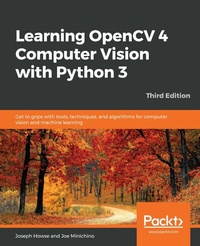
Learning OpenCV 4 Computer Vision with Python 3
Get to grips with tools, techniques, and algorithms for computer vision and machine learning
3rd Edition
Published on 23. September 2024
372 pages
978-1-78953-064-3 (ISBN)
Description

Updated for OpenCV 4 and Python 3, this book covers the latest on depth cameras, 3D tracking, augmented reality, and deep neural networks, helping you solve real-world computer vision problems with practical code
Key Features
Build powerful computer vision applications in concise code with OpenCV 4 and Python 3
Learn the fundamental concepts of image processing, object classification, and 2D and 3D tracking
Train, use, and understand machine learning models such as Support Vector Machines (SVMs) and neural networks
Book DescriptionComputer vision is a rapidly evolving science, encompassing diverse applications and techniques. This book will not only help those who are getting started with computer vision but also experts in the domain. You'll be able to put theory into practice by building apps with OpenCV 4 and Python 3. You'll start by understanding OpenCV 4 and how to set it up with Python 3 on various platforms. Next, you'll learn how to perform basic operations such as reading, writing, manipulating, and displaying still images, videos, and camera feeds. From taking you through image processing, video analysis, and depth estimation and segmentation, to helping you gain practice by building a GUI app, this book ensures you'll have opportunities for hands-on activities. Next, you'll tackle two popular challenges: face detection and face recognition. You'll also learn about object classification and machine learning concepts, which will enable you to create and use object detectors and classifiers, and even track objects in movies or video camera feed. Later, you'll develop your skills in 3D tracking and augmented reality. Finally, you'll cover ANNs and DNNs, learning how to develop apps for recognizing handwritten digits and classifying a person's gender and age. By the end of this book, you'll have the skills you need to execute real-world computer vision projects.What you will learn
Install and familiarize yourself with OpenCV 4 s Python 3 bindings
Understand image processing and video analysis basics
Use a depth camera to distinguish foreground and background regions
Detect and identify objects, and track their motion in videos
Train and use your own models to match images and classify objects
Detect and recognize faces, and classify their gender and age
Build an augmented reality application to track an image in 3D
Work with machine learning models, including SVMs, artificial neural networks (ANNs), and deep neural networks (DNNs)
Who this book is forIf you are interested in learning computer vision, machine learning, and OpenCV in the context of practical real-world applications, then this book is for you. This OpenCV book will also be useful for anyone getting started with computer vision as well as experts who want to stay up-to-date with OpenCV 4 and Python 3. Although no prior knowledge of image processing, computer vision or machine learning is required, familiarity with basic Python programming is a must.
Key Features
Build powerful computer vision applications in concise code with OpenCV 4 and Python 3
Learn the fundamental concepts of image processing, object classification, and 2D and 3D tracking
Train, use, and understand machine learning models such as Support Vector Machines (SVMs) and neural networks
Book DescriptionComputer vision is a rapidly evolving science, encompassing diverse applications and techniques. This book will not only help those who are getting started with computer vision but also experts in the domain. You'll be able to put theory into practice by building apps with OpenCV 4 and Python 3. You'll start by understanding OpenCV 4 and how to set it up with Python 3 on various platforms. Next, you'll learn how to perform basic operations such as reading, writing, manipulating, and displaying still images, videos, and camera feeds. From taking you through image processing, video analysis, and depth estimation and segmentation, to helping you gain practice by building a GUI app, this book ensures you'll have opportunities for hands-on activities. Next, you'll tackle two popular challenges: face detection and face recognition. You'll also learn about object classification and machine learning concepts, which will enable you to create and use object detectors and classifiers, and even track objects in movies or video camera feed. Later, you'll develop your skills in 3D tracking and augmented reality. Finally, you'll cover ANNs and DNNs, learning how to develop apps for recognizing handwritten digits and classifying a person's gender and age. By the end of this book, you'll have the skills you need to execute real-world computer vision projects.What you will learn
Install and familiarize yourself with OpenCV 4 s Python 3 bindings
Understand image processing and video analysis basics
Use a depth camera to distinguish foreground and background regions
Detect and identify objects, and track their motion in videos
Train and use your own models to match images and classify objects
Detect and recognize faces, and classify their gender and age
Build an augmented reality application to track an image in 3D
Work with machine learning models, including SVMs, artificial neural networks (ANNs), and deep neural networks (DNNs)
Who this book is forIf you are interested in learning computer vision, machine learning, and OpenCV in the context of practical real-world applications, then this book is for you. This OpenCV book will also be useful for anyone getting started with computer vision as well as experts who want to stay up-to-date with OpenCV 4 and Python 3. Although no prior knowledge of image processing, computer vision or machine learning is required, familiarity with basic Python programming is a must.
More details
Edition
3rd Revised edition
Language
English
Place of publication
Birmingham
United Kingdom
Target group
Professional and scholarly
US School Grade: College Graduate Student
Edition type
Revised edition
File size
95,50 MB
ISBN-13
978-1-78953-064-3 (9781789530643)
Copyright in bibliographic data and cover images is held by Nielsen Book Services Limited or by the publishers or by their respective licensors: all rights reserved.
Schweitzer Classification
Other editions
Additional editions
Joseph Howse | Joe Minichino
Learning OpenCV 4 Computer Vision with Python 3
Get to grips with tools, techniques, and algorithms for computer vision and machine learning
Book
02/2020
3rd Edition
Packt Publishing
€57.50
Shipment within 3-4 weeks
Persons
Howse Joseph :
Joseph Howse lives in a Canadian fishing village, where he chats with his cats, crafts his books, and nurtures an orchard of hardy fruit trees. He is President of Nummist Media Corporation, which exists to support his books and to provide mentoring and consulting services, with a specialty in computer vision. On average, in 2015-2022, Joseph has written 1.4 new books or new editions per year for Packt. He also writes fiction, including an upcoming novel about the lives of a group of young people in the last days of the Soviet Union.Minichino Joe :
Joe Minichino is an R&D labs engineer at Teamwork. He is a passionate programmer who is immensely curious about programming languages and technologies and constantly experimenting with them. Born and raised in Varese, Lombardy, Italy, and coming from a humanistic background in philosophy (at Milan's Universita Statale), Joe has lived in Cork, Ireland, since 2004. There, he became a computer science graduate at the Cork Institute of Technology.
Joseph Howse lives in a Canadian fishing village, where he chats with his cats, crafts his books, and nurtures an orchard of hardy fruit trees. He is President of Nummist Media Corporation, which exists to support his books and to provide mentoring and consulting services, with a specialty in computer vision. On average, in 2015-2022, Joseph has written 1.4 new books or new editions per year for Packt. He also writes fiction, including an upcoming novel about the lives of a group of young people in the last days of the Soviet Union.Minichino Joe :
Joe Minichino is an R&D labs engineer at Teamwork. He is a passionate programmer who is immensely curious about programming languages and technologies and constantly experimenting with them. Born and raised in Varese, Lombardy, Italy, and coming from a humanistic background in philosophy (at Milan's Universita Statale), Joe has lived in Cork, Ireland, since 2004. There, he became a computer science graduate at the Cork Institute of Technology.
Content
Table of Contents
Understanding OpenCV and Setting Up Environment
Handling Files, Cameras, and GUIs
Processing Images with OpenCV
Depth Estimation and Segmentation
Detecting and Recognizing Faces
Retrieving Images and Searching Using Image Descriptors
Building Custom Object Detectors
Tracking Objects
Camera Models and Augmented Reality
Neural Networks with OpenCV - An Introduction
Appendix 1: Bending Color Space with a Curves Filter
Understanding OpenCV and Setting Up Environment
Handling Files, Cameras, and GUIs
Processing Images with OpenCV
Depth Estimation and Segmentation
Detecting and Recognizing Faces
Retrieving Images and Searching Using Image Descriptors
Building Custom Object Detectors
Tracking Objects
Camera Models and Augmented Reality
Neural Networks with OpenCV - An Introduction
Appendix 1: Bending Color Space with a Curves Filter
