

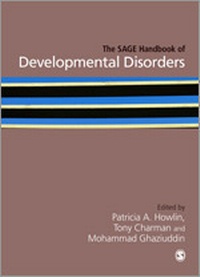
The SAGE Handbook of Developmental Disorders
1st Edition
Published on 31. January 2011
592 pages
978-1-4462-5279-6 (ISBN)
Description

Over the last four decades, breakthroughs in genetic knowledge, together with the emergence of disciplines devoted to the scientific study of developmental disorders have resulted in much greater awareness of the many different behavioural and genetic phenotypes involved. It is now evident that not only do different disorders have different causes and different manifestations, but different neurological and biochemical bases, different responses to intervention, and different life courses.
Reflecting the enormous changes that have taken place in our knowledge and understanding of developmental disorders, this groundbreaking international volume brings this vast and complex field together for the first time. The Editors have collected together the world's leading academic scholars and clinicians, to explore how current research across a range of different disciplines can inform clinical practice and help to improve the lives of individuals and their families.
Reflecting the enormous changes that have taken place in our knowledge and understanding of developmental disorders, this groundbreaking international volume brings this vast and complex field together for the first time. The Editors have collected together the world's leading academic scholars and clinicians, to explore how current research across a range of different disciplines can inform clinical practice and help to improve the lives of individuals and their families.
Reviews / Votes
"Highly Recommended" -- R. Ludy * Choice *All prices
More details
Language
English
Place of publication
London
United Kingdom
Target group
Professional and scholarly
Academics, researchers, clinicians and advanced students involved in the study of developmental disorders, includng those in clinical psychology, child psychiatry, child mental health, child genetics and pediatrics, speech language pathology, developmental disabilities and special education
ISBN-13
978-1-4462-5279-6 (9781446252796)
Copyright in bibliographic data and cover images is held by Nielsen Book Services Limited or by the publishers or by their respective licensors: all rights reserved.
Schweitzer Classification
Other editions
Additional editions
Patricia Howlin | Tony Charman | Mohammad Ghaziuddin
The SAGE Handbook of Developmental Disorders
Book
04/2014
1st Edition
SAGE Publications Ltd
€75.30
Shipment within 15-20 days
Patricia Howlin | Tony Charman | Mohammad Ghaziuddin
The SAGE Handbook of Developmental Disorders
Book
01/2011
1st Edition
SAGE Publications Inc
€201.00
Shipment within 10-20 days
Persons
Patricia Howlin PhD is Professor of Clinical Child Psychology at the Institute
of Psychiatry, King's College, London. Prof. Charman holds the Chair in Clinical Child Psychology at the Institute of Psychiatry, Psychology & Neuroscience, King's College London. His main research interest is the investigation of social cognitive development in children with autism and the clinical application of this work via screening, diagnostic, epidemiological, intervention, and 'at risk' studies. He is a Chartered Clinical Psychologist and works in a specialist service for children with autism and complex neurodevelopmental conditions at the South London and Maudsley NHS Foundation Trust. He has published more than 250 peer-reviewed papers and over 30 book chapters. He has served on a number of expert panels for the Medical Research Council and NICE in the UK, NIH in the USA and the WHO. He has worked closely with Ambitious about Autism, the National Autistic Society, Research Autism and Autistica to advocate for services and positive policy development for individuals with autism spectrum disorders and their families. Mohammad Ghaziuddin is an Associate Professor of Child Psychiatry at the University of Michigan
in Ann Arbor, USA.
of Psychiatry, King's College, London. Prof. Charman holds the Chair in Clinical Child Psychology at the Institute of Psychiatry, Psychology & Neuroscience, King's College London. His main research interest is the investigation of social cognitive development in children with autism and the clinical application of this work via screening, diagnostic, epidemiological, intervention, and 'at risk' studies. He is a Chartered Clinical Psychologist and works in a specialist service for children with autism and complex neurodevelopmental conditions at the South London and Maudsley NHS Foundation Trust. He has published more than 250 peer-reviewed papers and over 30 book chapters. He has served on a number of expert panels for the Medical Research Council and NICE in the UK, NIH in the USA and the WHO. He has worked closely with Ambitious about Autism, the National Autistic Society, Research Autism and Autistica to advocate for services and positive policy development for individuals with autism spectrum disorders and their families. Mohammad Ghaziuddin is an Associate Professor of Child Psychiatry at the University of Michigan
in Ann Arbor, USA.
Content
PART ONE: OVERVIEW
Introduction - Patricia Howlin, Tony Charman and Mohammad Ghaziuddin
PART TWO: DISORDERS WITH A KNOWN GENETIC CAUSE
Down Syndrome: General Overview - Deborah J. Fidler and Lisa Daunhauer
Down Syndrome: Lifetime Course and Strategies for Intervention - Janet Carr
Fragile X Syndrome: Medical and Genetic Aspects - R.J. Hagerman et al
Fragile X Syndrome: Life Course and Strategies for Intervention - Andrea Schneider and David Hessl
Williams Syndrome: Overview and Recent Advances in Research - Daniela Plesa Skwerer and Helen Tager-Flusburg
Prader-Willi Syndrome - Joyce Whittington and Anthony Holland
Angelman Syndrome - Bernard Dan and Karine Pelc
Rett Disorder - Alison Kerr and Hayley Archer
Smith-Magenis Syndrome - Jenny Sloneem and Orlee Udwin
Tuberous Sclerosis Complex - Petrus J de Vries
Velo-Cardio-Facial Syndrome/ 22q11 Deletion Syndrome - Frederick Sundram and Kieran C Murphy
Cornelia de Lange, Cri du Chat and Rubistein Taybi Syndromes - Chris Oliver et al
PART THREE: DISORDERS WITH COMPLEX OR AS YET UNKNOWN CAUSES
Attention-Deficit/ Hyperactivity Disorder - Timothy E Wilens and Thomas J Spencer
Autism Spectrum Disorders: General Overview - Catherine Lord, So Hyun Kim and Adriana DiMartino
Autism Spectrum, Disorders: Interventions and Outcomes - Patricia Howlin and Tony Charman
Developmental Language Disorders: Overview - Courtenay Frazier Norbury
Developmental Language Disorders: Lifetime Course and Strategies for Intervention - Rhea Paul and Kimberly Gilbert
Intellectual Disability: Concepts, Definitions and Assessment - Cory Shulman et al
Intellectual Disability: Lifetime Course and Strategies for Intervention - Jane McCarthy and Nick Bouras
The Disintegrative Disorders - Fred R Volkmar
Epileptic Disorders - Ian Miller and Roberto Tuchman
Tourette Syndrome - Mary M Robertson and Andrea E Cavanna
PART FOUR: ENVIRONMENTALLY INDUCED DISORDERS
Acquired Brain Injury during Childhood - Anna Mandalis, Frank Muscara, and Vicki Anderson
Foetal Alcohol Spectrum Disorders - Kieran D O'Malley
Preterm and Low Birth Weight Babies - Dieter Wolke
Extreme Deprivation - Michael Rutter and Camilla Azis-Clauson
Introduction - Patricia Howlin, Tony Charman and Mohammad Ghaziuddin
PART TWO: DISORDERS WITH A KNOWN GENETIC CAUSE
Down Syndrome: General Overview - Deborah J. Fidler and Lisa Daunhauer
Down Syndrome: Lifetime Course and Strategies for Intervention - Janet Carr
Fragile X Syndrome: Medical and Genetic Aspects - R.J. Hagerman et al
Fragile X Syndrome: Life Course and Strategies for Intervention - Andrea Schneider and David Hessl
Williams Syndrome: Overview and Recent Advances in Research - Daniela Plesa Skwerer and Helen Tager-Flusburg
Prader-Willi Syndrome - Joyce Whittington and Anthony Holland
Angelman Syndrome - Bernard Dan and Karine Pelc
Rett Disorder - Alison Kerr and Hayley Archer
Smith-Magenis Syndrome - Jenny Sloneem and Orlee Udwin
Tuberous Sclerosis Complex - Petrus J de Vries
Velo-Cardio-Facial Syndrome/ 22q11 Deletion Syndrome - Frederick Sundram and Kieran C Murphy
Cornelia de Lange, Cri du Chat and Rubistein Taybi Syndromes - Chris Oliver et al
PART THREE: DISORDERS WITH COMPLEX OR AS YET UNKNOWN CAUSES
Attention-Deficit/ Hyperactivity Disorder - Timothy E Wilens and Thomas J Spencer
Autism Spectrum Disorders: General Overview - Catherine Lord, So Hyun Kim and Adriana DiMartino
Autism Spectrum, Disorders: Interventions and Outcomes - Patricia Howlin and Tony Charman
Developmental Language Disorders: Overview - Courtenay Frazier Norbury
Developmental Language Disorders: Lifetime Course and Strategies for Intervention - Rhea Paul and Kimberly Gilbert
Intellectual Disability: Concepts, Definitions and Assessment - Cory Shulman et al
Intellectual Disability: Lifetime Course and Strategies for Intervention - Jane McCarthy and Nick Bouras
The Disintegrative Disorders - Fred R Volkmar
Epileptic Disorders - Ian Miller and Roberto Tuchman
Tourette Syndrome - Mary M Robertson and Andrea E Cavanna
PART FOUR: ENVIRONMENTALLY INDUCED DISORDERS
Acquired Brain Injury during Childhood - Anna Mandalis, Frank Muscara, and Vicki Anderson
Foetal Alcohol Spectrum Disorders - Kieran D O'Malley
Preterm and Low Birth Weight Babies - Dieter Wolke
Extreme Deprivation - Michael Rutter and Camilla Azis-Clauson
