

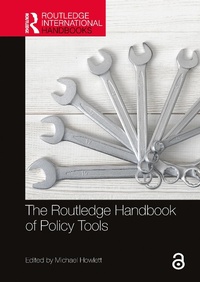
The Routledge Handbook of Policy Tools
1st Edition
Published on 10. August 2022
620 pages
978-1-000-62262-1 (ISBN)
Description

This handbook provides a unique, systematic and comprehensive overview from leading experts in the field of the policy-making tools deployed at all the phases of the policy process. It covers the fundamentals of both new and established policy tools - from regulation and public enterprises to subsidies and information campaigns, as well as new tools, such as social impact investing, nudges, crowdsourcing, co-production and new digital governance and data analysis techniques.
The book consists of nine sections with five corresponding to the major research emphases of studies on policy tools across the stages of the policy cycle (agenda-setting, formulation, decision-making, implementation and evaluation). These are accompanied by overviews of key research and concepts, a discussion of how different kinds of tools can be usefully combined in simple or complex policy portfolios or mixes, and a concluding section on future research directions. Consolidating the state of knowledge and uniting classic foundational material with recent advancements in theory and practice in one location, the handbook is a defining volume in this field.
The Routledge Handbook of Policy Tools is essential reading and an authoritative reference for scholars, students, researchers and practitioners of public policy, public administration, and public management, as well as those interested in comparative politics and government, public organizations and the use of policy tools and instruments in individual policy areas from climate change to public health.
The book consists of nine sections with five corresponding to the major research emphases of studies on policy tools across the stages of the policy cycle (agenda-setting, formulation, decision-making, implementation and evaluation). These are accompanied by overviews of key research and concepts, a discussion of how different kinds of tools can be usefully combined in simple or complex policy portfolios or mixes, and a concluding section on future research directions. Consolidating the state of knowledge and uniting classic foundational material with recent advancements in theory and practice in one location, the handbook is a defining volume in this field.
The Routledge Handbook of Policy Tools is essential reading and an authoritative reference for scholars, students, researchers and practitioners of public policy, public administration, and public management, as well as those interested in comparative politics and government, public organizations and the use of policy tools and instruments in individual policy areas from climate change to public health.
Reviews / Votes
"Comprised of 44 chapters and featuring a line-up of distinguished international scholars, this excellent handbook is the best and the most comprehensive overview available of the policy tools approach in public policy research. This is why all university students, academic researchers, and policy practitioners interested in policy tools should read it."Daniel Beland, McGill University, Canada
"This comprehensive volume provides definitive analyses of the critical connections between choosing appropriate policy tools and achieving desired policy outcomes. Michael Howlett has assembled a stellar cast of international scholars. They demonstrate the critical challenges of designing policy mixes for important problems, while taking account of evaluation evidence and changing political contexts. They provide new insights into how emerging problems are being tackled through new techniques such as big data analysis, behavioural psychology and co-production."
Brian Head, University of Queensland, Australia
"This excellent volume advances understandings of how combinations of policy tools manipulate both the substance and the processes of policymaking. It provides a great service to anyone interested in using tools as an analytical framework. And it will be welcomed by everyone who is concerned with better understanding how the policy process works."
Jenny M Lewis, University of Melbourne, Australia
"The Handbook's combination of the policy tools approach with the stages where the tools are deployed in the policy process - e.g., agenda setting, policy formulation and policy decision-making - has never been this comprehensively, systematically and successfully carried out before in the literature."
Evert Vedung, Uppsala University, Sweden
"The study of policy instruments traditionally constitutes a central topic of policy sciences. In the last decade, the research on policy tools accelerated very significantly. This important and complete book takes research on policy tools to a new level by organizing and synthesizing a large volume of new findings and perspectives."
Arnost Vesely, Charles University, Czech Republic
More details
Series
Edition
1. Auflage
Language
English
Place of publication
London
United Kingdom
Publishing group
Taylor & Francis Ltd
Target group
College/higher education
Professional and scholarly
Illustrations
72 Tables, black and white; 23 Line drawings, black and white; 23 Illustrations, black and white
ISBN-13
978-1-000-62262-1 (9781000622621)
Copyright in bibliographic data and cover images is held by Nielsen Book Services Limited or by the publishers or by their respective licensors: all rights reserved.
Schweitzer Classification
Other editions
Additional editions
Michael Howlett
The Routledge Handbook of Policy Tools
Book
08/2024
1st Edition
Routledge
€71.80
Shipment within 15-20 days
Michael Howlett
The Routledge Handbook of Policy Tools
Book
08/2022
1st Edition
Routledge
€335.60
Shipment within 15-20 days
Person
Michael Howlett is Burnaby Mountain Professor and Canada Research Chair (Tier 1) in the Department of Political Science at Simon Fraser University in Vancouver, BC, Canada.
Content
Part 1: Introduction 1. What is a Policy Tool? An Overview of the Tools Approach to Public Policy 2. The History of the Tools Approach in the Policy Sciences: Key Definitions and Problematics 3. Where Tools are Deployed in the Policy Process: Policy Instruments and the Policy Cycle 4. The Need to Understand and Integrate Procedural and Substantive Tools Part 2: Basic Concepts 5. How Tools Work: Policy Instruments as Activators and Mechanisms 6. What Tools Do: Policy Targeting and Behaviour 7. Portfolios of Policy Tools: Types of Policy Mixes 8. Understanding Primary and Secondary Relationships Among Policy Tools in Policy Mixes Part 3: Agenda-Setting Tools 9. Agenda-Setting Tools in Theory and Practice 10. Formal Agenda-Setting Government Tools: Periodic Evaluations and Reviews 11. Tools to Promote Popular Mobilization and Social Advocacy: Social Identities, Policy Programs, Careers, and Education 12: Consultation Tools and Agenda-Setting 13: Tools for Managing the Media: Monitoring, Branding and Messaging Part 4: Policy Formulation Tools 14. Policy Formulation Tools: New Perspectives 15. Indicators and Measures as Policy Tools 16. A tools-based approach to understanding and optimizing policy advice in and beyond policy formulation 17. Tools for Structuring Policy Advice: Commissions of Inquiry and Task Forces as Policy Formulation Instruments 18. Collaboration as a Policy Tool in the Policy Formulation and Other Aspects of the Policy Process Part 5: Decision-Making Tools 19. Supporting Decision-Making within the Policy Cycle: Techniques and Tools 20. Scenario Analysis, Forecasting and Backcasting as Policy Tools 21. Formal problem structuring tools and multi-criteria decision analysis 22. Simulation Modeling as a Policy Tool 23. Policy Experiments and Pilots as Tools for Decision-Making Part 6: Policy Implementation Tools 24. The Organizational Tools of Government: The "Forgotten Fundamental" 25. Implementing Regulatory Tools: Regulatory Tools and the Use of Authority 26. Treasure Tools: Using Public Funds to Achieve Policy Objectives 27. Information as a Policy Tool: The Role of Government Communication 28. Non-State Market-Driven Tools: Capacity Challenges in Non-State Governance Contexts Part 7: Policy Evaluation Tools 29. Theoretical Framework for Public Policy Evaluation: Investigative Designs and Outcomes in a Global Setting 30. Policy Evaluation Instruments: Tools for Learning 31. Tools in Internal and External Evaluations 32. Administrative Procedure as a Tool for Participatory and Efficient Public Governance 33. The Democratic Potential of Evaluation as a Policy Making Instrument: A Possibility or a Chimera? Part 8: Selecting and Mixing Tools 34. Policy Tools and (New) Governance Arrangements: Policy Mixes and Their Effectiveness 35. Measuring Policy instrument interactions in policy mixes: Surveying the conceptual and methodological landscape 36. Policy Tools and the Attributes of Effectiveness: Spaces, Mixes and Instruments 37. Changing the Composition of Policy Mixes: Lock-In, Path Dependency, and the Sequencing of Policy Tools 38. Changing Policy Tools on the Fly: Calibrating Policy Instruments Part 9: The Future of Policy Tools 39. The Future of Policy Tools: Past Trends and Current Directions 40. Collaboration as the Future of Organizational Tools 41. Big Data, Artificial Intelligence and the Future of Regulatory Tools 42. The Future of Financial Tools: Will Social Impact Bonds Yield Results? 43. The Future of Informational Tools with Big Data Informatics: Opportunities and Challenges for Evidence-Based Policy-Making 44. The Future of Behavioural Tools in Public Policy
