

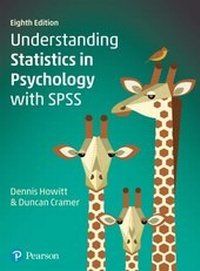
Understanding Statistics in Psychology with SPSS
8th Edition
Published on 13. March 2020
752 pages
978-1-292-28233-6 (ISBN)
Description

A clear and comprehensive introduction to Statistics with step by step guidance on using SPSS to carry out statistical analysis. Understanding Statistics in Psychology with SPSS is geared towards helping students to properly understand statistical techniques so gaining the confidence to apply them with the help of SPSS. The full text downloaded to your computer
With eBooks you can:
search for key concepts, words and phrases
make highlights and notes as you study
share your notes with friends
eBooks are downloaded to your computer and accessible either offline through the Bookshelf (available as a free download), available online and also via the iPad and Android apps.
Upon purchase, you'll gain instant access to this eBook.
Time limit
The eBooks products do not have an expiry date. You will continue to access your digital ebook products whilst you have your Bookshelf installed.
With eBooks you can:
search for key concepts, words and phrases
make highlights and notes as you study
share your notes with friends
eBooks are downloaded to your computer and accessible either offline through the Bookshelf (available as a free download), available online and also via the iPad and Android apps.
Upon purchase, you'll gain instant access to this eBook.
Time limit
The eBooks products do not have an expiry date. You will continue to access your digital ebook products whilst you have your Bookshelf installed.
All prices
More details
Edition
8th edition
Language
English
Place of publication
Harlow
United Kingdom
Target group
Professional and scholarly
ISBN-13
978-1-292-28233-6 (9781292282336)
Copyright in bibliographic data and cover images is held by Nielsen Book Services Limited or by the publishers or by their respective licensors: all rights reserved.
Schweitzer Classification
Other editions
Additional editions
Dennis Howitt | Duncan Cramer
Understanding Statistics in Psychology with SPSS
Book
03/2020
8th Edition
Pearson Education Limited
€88.08
Shipment within 10-20 days
Persons
Dennis Howitt and Duncan Cramer are based at Loughborough University.
Content
Chapter 1 Why statistics?
Chapter 2 Some basics: Variability and measurement
Chapter 3 Describing variables: Tables and diagrams
Chapter 4 Describing variables numerically: Averages, variation and spread
Chapter 5 Shapes of distributions of scores
Chapter 6 Standard deviation and z-scores: Standard unit of measurement in statistics
Chapter 7 Relationships between two or more variables: Diagrams and tables
Chapter 8 Correlation coefficients: Pearson's correlation and Spearman's rho
Chapter 9 Regression: Prediction with precision
Chapter 10 Samples from populations
Chapter 11 Statistical significance for the correlation coefficient: A practical introduction to statistical inference
Chapter 12 Standard error: Standard deviation of the means of samples
Chapter 13 Related t-test: Comparing two samples of related/correlated/paired scores
Chapter 14 Unrelated t-test: Comparing two samples of unrelated/uncorrelated/ independent scores
Chapter 15 What you need to write about your statistical analysis
Chapter 16 Confidence intervals
Chapter 17 Effect size in statistical analysis: Do my findings matter?
Chapter 18 Chi-square: Differences between samples of frequency data
Chapter 19 Probability
Chapter 20 One-tailed versus two-tailed significance testing
Chapter 21 Ranking tests: Nonparametric statistics
Chapter 22 Variance ratio test: F-ratio to compare two variances
Chapter 23 Analysis of variance (ANOVA): One-way unrelated or uncorrelated ANOVA
Chapter 24 ANOVA for correlated scores or repeated measures
Chapter 25 Two-way or factorial ANOVA for unrelated/uncorrelated scores: Two studies for the price of one?
Chapter 26 Multiple comparisons with in ANOVA: A priori and post hoc tests
Chapter 27 Mixed-design ANOVA: Related and unrelated variables together
Chapter 28 Analysis of covariance (ANCOVA): Controlling for additional variables
Chapter 29 Multivariate analysis of variance (MANOVA)
Chapter 30 Discriminant (function) analysis - especially in MANOVA
Chapter 31 Statistics and analysis of experiments
Chapter 32 Partial correlation: Spurious correlation, third or confounding variables, suppressor variables
Chapter 33 Factor analysis: Simplifying complex data
Chapter 34 Multiple regression and multiple correlation
Chapter 35 Path analysis
Chapter 36 Meta-analysis: Combining and exploring statistical findings from previous research
Chapter 37 Reliability in scales and measurement: Consistency and agreement
Chapter 38 Influence of moderator variables on relationships between two variables
Chapter 39 Statistical power analysis: Getting the sample size right
Chapter 40 Log-linear methods: Analysis of complex contingency tables
Chapter 41 Multinomial logistic regression: Distinguishing between several different categories or groups
Chapter 42 Binomial logistic regression
Chapter 43 Data mining and big data
Chapter 2 Some basics: Variability and measurement
Chapter 3 Describing variables: Tables and diagrams
Chapter 4 Describing variables numerically: Averages, variation and spread
Chapter 5 Shapes of distributions of scores
Chapter 6 Standard deviation and z-scores: Standard unit of measurement in statistics
Chapter 7 Relationships between two or more variables: Diagrams and tables
Chapter 8 Correlation coefficients: Pearson's correlation and Spearman's rho
Chapter 9 Regression: Prediction with precision
Chapter 10 Samples from populations
Chapter 11 Statistical significance for the correlation coefficient: A practical introduction to statistical inference
Chapter 12 Standard error: Standard deviation of the means of samples
Chapter 13 Related t-test: Comparing two samples of related/correlated/paired scores
Chapter 14 Unrelated t-test: Comparing two samples of unrelated/uncorrelated/ independent scores
Chapter 15 What you need to write about your statistical analysis
Chapter 16 Confidence intervals
Chapter 17 Effect size in statistical analysis: Do my findings matter?
Chapter 18 Chi-square: Differences between samples of frequency data
Chapter 19 Probability
Chapter 20 One-tailed versus two-tailed significance testing
Chapter 21 Ranking tests: Nonparametric statistics
Chapter 22 Variance ratio test: F-ratio to compare two variances
Chapter 23 Analysis of variance (ANOVA): One-way unrelated or uncorrelated ANOVA
Chapter 24 ANOVA for correlated scores or repeated measures
Chapter 25 Two-way or factorial ANOVA for unrelated/uncorrelated scores: Two studies for the price of one?
Chapter 26 Multiple comparisons with in ANOVA: A priori and post hoc tests
Chapter 27 Mixed-design ANOVA: Related and unrelated variables together
Chapter 28 Analysis of covariance (ANCOVA): Controlling for additional variables
Chapter 29 Multivariate analysis of variance (MANOVA)
Chapter 30 Discriminant (function) analysis - especially in MANOVA
Chapter 31 Statistics and analysis of experiments
Chapter 32 Partial correlation: Spurious correlation, third or confounding variables, suppressor variables
Chapter 33 Factor analysis: Simplifying complex data
Chapter 34 Multiple regression and multiple correlation
Chapter 35 Path analysis
Chapter 36 Meta-analysis: Combining and exploring statistical findings from previous research
Chapter 37 Reliability in scales and measurement: Consistency and agreement
Chapter 38 Influence of moderator variables on relationships between two variables
Chapter 39 Statistical power analysis: Getting the sample size right
Chapter 40 Log-linear methods: Analysis of complex contingency tables
Chapter 41 Multinomial logistic regression: Distinguishing between several different categories or groups
Chapter 42 Binomial logistic regression
Chapter 43 Data mining and big data
