

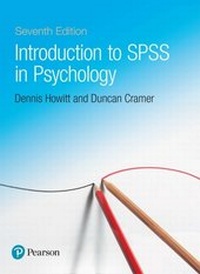
Introduction to SPSS in Psychology
Description

Introduction to SPSS in Psychology, 7th edition is the essential step by step guide to SPSS for students taking their first course in statistics. This well-established text provides a clear and comprehensive coverage of how to carry out statistical analyses using SPSS.
Full colour SPSS screenshots, clear explanation and a wide ranging coverage make it the perfect companion for students who want to be able to analyse data with confidence.
The full text downloaded to your computer
With eBooks you can:
- search for key concepts, words and phrases
- make highlights and notes as you study
- share your notes with friends
eBooks are downloaded to your computer and accessible either offline through the Bookshelf (available as a free download), available online and also via the iPad and Android apps.
Upon purchase, you'll gain instant access to this eBook.
Time limit
The eBooks products do not have an expiry date. You will continue to access your digital ebook products whilst you have your Bookshelf installed.
All prices
More details
Other editions
Additional editions
Persons
Dennis Howitt and Duncan Cramer are with Loughborough University.
Content
- Part 1 Introduction to SPSS
- 1 Brief introduction to statistics
- 2 Basics of SPSS data entry and statistical analysis
- Part 2 Descriptive statistics
- 3 Describing variables: Tables
- 4 Describing variables: Diagrams
- 5 Describing variables numerically: Averages, variation and spread
- 6 Shapes of distributions of scores
- 7 Relationships between two or more variables: Tables
- 8 Relationships between two or more variables: Diagrams
- 9 Correlation coefficients: Pearson's correlation and Spearman's rho
- 10 Regression: Prediction with precision
- Part 3 Significance testing and basic inferential tests
- 11 Related t-test: Comparing two samples of related/correlated/paired scores
- 12 Unrelated t-test: Comparing two groups of unrelated/uncorrelated/independent scores
- 13 Confidence intervals
- 14 Chi-square: Differences between unrelated samples of frequency data
- 15 McNemar's test: Differences between related samples of frequency data
- 16 Ranking tests for two groups: Non-parametric statistics
- 17 Ranking tests for three or more groups: Non-parametric statistics
- Part 4 Analysis of variance
- 18 Analysis of variance (ANOVA): One-way unrelated or uncorrelated ANOVA
- 19 Analysis of variance for one-way correlated scores or repeated measures
- 20 Two-way analysis of variance for unrelated/uncorrelated scores
- 21 Multiple comparison in ANOVA
- 22 Analysis of variance for two-way correlated scores or repeated measures
- 23 Two-way mixed analysis of variance (ANOVA)
- 24 Analysis of covariance (ANCOVA)
- 25 Multivariate analysis of variance (MANOVA)
- Part 5 More advanced statistics
- 26 Partial correlation
- 27 Factor analysis
- 28 Item reliability and inter-rater agreement
- 29 Stepwise multiple regression
- 30 Simultaneous or standard multiple regression
- 31 Simple mediational analysis
- 32 Hierarchical multiple regression
- 33 Log-linear analysis
- 34 Meta-analysis
- Part 6 Data handling procedures
- 35 Missing values
- 36 Recoding values
- 37 Computing a scale score with some values missing
- 38 Computing a new group variable from existing group variables
- 39 Selecting cases
- 40 Reading ASCII or text files into the Data Editor
