

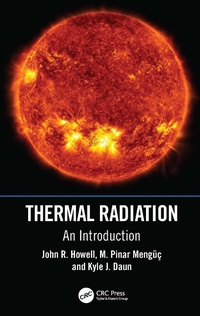
Thermal Radiation
An Introduction
1st Edition
Published on 20. March 2023
476 pages
978-1-000-83101-6 (ISBN)
Description

Thermal Radiation: An Introduction is a complete textbook for a one-semester introductory graduate course on radiative energy transfer. It bridges the gap between a basic introduction and comprehensive coverage of thermal radiation, focusing on insight into radiative transfer as practiced by engineers. Covering radiative transfer among surfaces, with an introduction to the effects of participating media between surfaces, the book includes surface and medium property characteristics and solutions to the radiative transfer equation in simple geometries.
Tailored and organized specifically to suit a one-semester graduate course in radiative heat transfer
Emphasis is placed on insight into radiative transfer as practiced by engineers
Discusses how radiation is incorporated into finite element analysis (FEA) codes
The textbook is intended for instructors and graduate students in a first-year course on radiative heat transfer or advanced heat transfer. Supplementary resources for students and instructors are available online.
Tailored and organized specifically to suit a one-semester graduate course in radiative heat transfer
Emphasis is placed on insight into radiative transfer as practiced by engineers
Discusses how radiation is incorporated into finite element analysis (FEA) codes
The textbook is intended for instructors and graduate students in a first-year course on radiative heat transfer or advanced heat transfer. Supplementary resources for students and instructors are available online.
More details
Edition
1. Auflage
Language
English
Place of publication
London
United Kingdom
Publishing group
Taylor & Francis Ltd
Target group
College/higher education
Illustrations
32 Tables, black and white; 229 Line drawings, black and white; 34 Halftones, black and white; 263 Illustrations, black and white
ISBN-13
978-1-000-83101-6 (9781000831016)
Copyright in bibliographic data and cover images is held by Nielsen Book Services Limited or by the publishers or by their respective licensors: all rights reserved.
Schweitzer Classification
Other editions
Additional editions
Book
03/2023
1st Edition
CRC Press
€134.10
Shipment within 10-20 days
Persons
John R. (Jack) Howell received his academic degrees from Case Western Reserve University (then Case Institute of Technology), Cleveland, Ohio. He began his engineering career as a researcher at NASA Lewis (now Glenn) Research Center (1961-1968) and then took academic positions at the University of Houston (1978-1988) and the University of Texas at Austin, where he remained until retirement in 2012. He is presently Ernest Cockrell, Jr., Memorial Chair Emeritus. He pioneered the use of the Monte Carlo method for the analysis of radiative heat transfer in complex systems that contain absorbing, emitting, and scattering media. Jack has concentrated his research on computational techniques for radiative transfer and combined-mode problems for over 60 years. Recently, he has adapted inverse solution techniques to combined-mode problems and to radiation at the nanoscale. His awards in heat transfer include the ASME/AIChE Max Jakob Medal (1998), ASME Heat Transfer Memorial Award (1991), AIAA Thermophysics Award (1990), the Poynting Award from JQSRT (2013) and the 2018 International Center for Heat and Mass Transfer Luikov Medal. He is an elected member of the U.S. National Academy of Engineering (2005) and a foreign member of the Russian Academy of Sciences (1999). He is an Honorary Fellow of the American Society of Mechanical Engineering (ASME).
M. Pinar Menguec completed his BSc and MS in mechanical engineering from the Middle East Technical University (METU) in Ankara, Turkey. He earned his PhD in mechanical engineering from Purdue University in 1985. He joined the faculty at the University of Kentucky the same year and was promoted to the ranks of associate and full professor in 1988 and 1993, respectively. In 2008, he was named an Engineering Alumni Association professor. Later that year, he joined OEzyegin University in Istanbul as the founding head of the Mechanical Engineering Department. In 2009 he established the Center for Energy, Environment, and Economy (CEEE), which he still directs.
Kyle Daun received his BSc from the University of Manitoba (1997), his MASc from the University of Waterloo (1999), and his PhD from the University of Texas at Austin (2003). From 2004 to 2007, he worked at the National Research Council Canada as a Natural Sciences and Engineering Research Council of Canada postdoctoral fellow and later as a research officer. While at NRC, he investigated radiation heat transfer in solid oxide fuel cells and helped develop and improve laser-based combustion diagnostics. In 2007, he returned to the University of Waterloo, where he is now a Professor in the Department of Mechanical and Mechatronics Engineering. Professor Daun's research interests include inverse problems in radiative transfer, laser-based combustion diagnostics, nanoscale transport phenomena, and heat transfer in manufacturing. He has published over 250 contributions, including 90 refereed journal papers. Professor Daun is a fellow of the Humboldt Foundation, a DFG Mercator Fellow, and a Fellow of the American Society of Mechanical Engineering. In 2010, he received the JQSRT Ray Viskanta Young Scientist Award.
M. Pinar Menguec completed his BSc and MS in mechanical engineering from the Middle East Technical University (METU) in Ankara, Turkey. He earned his PhD in mechanical engineering from Purdue University in 1985. He joined the faculty at the University of Kentucky the same year and was promoted to the ranks of associate and full professor in 1988 and 1993, respectively. In 2008, he was named an Engineering Alumni Association professor. Later that year, he joined OEzyegin University in Istanbul as the founding head of the Mechanical Engineering Department. In 2009 he established the Center for Energy, Environment, and Economy (CEEE), which he still directs.
Kyle Daun received his BSc from the University of Manitoba (1997), his MASc from the University of Waterloo (1999), and his PhD from the University of Texas at Austin (2003). From 2004 to 2007, he worked at the National Research Council Canada as a Natural Sciences and Engineering Research Council of Canada postdoctoral fellow and later as a research officer. While at NRC, he investigated radiation heat transfer in solid oxide fuel cells and helped develop and improve laser-based combustion diagnostics. In 2007, he returned to the University of Waterloo, where he is now a Professor in the Department of Mechanical and Mechatronics Engineering. Professor Daun's research interests include inverse problems in radiative transfer, laser-based combustion diagnostics, nanoscale transport phenomena, and heat transfer in manufacturing. He has published over 250 contributions, including 90 refereed journal papers. Professor Daun is a fellow of the Humboldt Foundation, a DFG Mercator Fellow, and a Fellow of the American Society of Mechanical Engineering. In 2010, he received the JQSRT Ray Viskanta Young Scientist Award.
Content
1. Why Study Radiation Energy Transfer? 2. The Basics of Thermal Radiation. 3. Radiative Properties at Interfaces. 4. Predicted and Measured Surface Properties. 5. Configuration Factors for Diffuse Surfaces. 6. Radiation Exchange in Enclosures Bounding Transparent Media. 7. Radiation Combined with Boundary Conduction and Convection. 8. Properties of Participating Media. 9. Radiative Transfer in Participating Media. 10. Numerical methods for radiative transfer problems. 11. Radiation in Solids, Windows, and Coatings. 12. Emerging Areas. Appendix. Radiation Constants and Blackbody Functions.
