

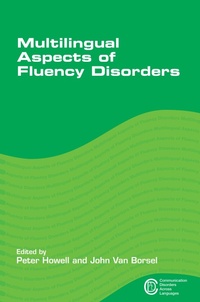
Multilingual Aspects of Fluency Disorders
Published on 11. May 2011
416 pages
978-1-84769-500-0 (ISBN)
Description

This book contains contributions by scholars working on diverse aspects of speech who bring their findings to bear on the practical issue of how to treat stuttering in different language groups and in multilingual speakers. The book considers classic issues in speech production research, as well as whether regions of the brain that are affected in people who stutter relate to areas used intensively in fluent bilingual speech. It then reviews how formal language properties and differential use of parts of language affect stuttering in English, and then compares these findings to work on stuttering in a variety of languages. Finally, the book addresses methodological issues to do with studies on bilingualism and stuttering; and discusses which approach is appropriate in the treatment of bilingual and multilingual people who stutter.
Reviews / Votes
Comprehensive, clear coverage of the complex topic of bilingualism and stuttering. Approaching this topic from a language perspective, all things are considered from genetic, cortical, and environment to cultural, clinical, even animistic factors! A must-have reference for clinicians and researchers alike!! * Edward Gage Conture, Vanderbilt University * This book provides useful information about the infrequently discussed issue of bilingualism as it relates to the possible onset of stuttering. With the dramatically changing demographics in the United States, this collection of papers provides both the researcher and clinician with current views for understanding both basic and clinical implications for the various forms of bilingualism and fluency characteristics. -- Walt Manning, Ph.D., Professor & Associate Dean, School of Audiology and Speech-Language Pathology, The University of MemphisMore details
Series
Language
English
Place of publication
Bristol
United Kingdom
Publishing group
Channel View Publications Ltd
Target group
Professional and scholarly
ISBN-13
978-1-84769-500-0 (9781847695000)
Copyright in bibliographic data and cover images is held by Nielsen Book Services Limited or by the publishers or by their respective licensors: all rights reserved.
Schweitzer Classification
Other editions
Additional editions
Peter Howell | John Van Borsel
Multilingual Aspects of Fluency Disorders
Book
05/2011
Multilingual Matters
€51.00
Shipment within 10-20 days
Persons
Peter Howell is an experimental psychologist and co-director of the Centre for Human Communications at University College London. His research interests are in speech production and perception and hearing.
John Van Borsel is a neurolinguist teaching at the Ghent University (Belgium) and at the Veiga Almeida University in Rio de Janeiro (Brazil). Fluency disorders are one of his main research domains.
John Van Borsel is a neurolinguist teaching at the Ghent University (Belgium) and at the Veiga Almeida University in Rio de Janeiro (Brazil). Fluency disorders are one of his main research domains.
Content
Section One: Procedures, methods and findings for language and its disorders
Chap 1 Annick De Houwer. The speech of fluent child bilinguals
Chap 2 Ineke Mennen. Speech production in simultaneous and sequential bilinguals
Chap 3 Katharina Dworzynski. Genetics and language
Chap 4 Kate E. Watkins and Denise Klein. Brain structure and function in developmental stuttering and bilingualism
Section Two: Monolingual language diversity and stuttering
Chap 5 Peter Howell and Sarah Rusbridge. The speech and language characteristics of developmental stuttering in English speakers
Chap 6 Akira Ujihira. Stuttering in Japanese
Chap 7 Jennifer B. Watson, Courtney T. Byrd, Edna J. Carlo. Disfluent speech characteristics of monolingual Spanish-speaking children
Chap 8 Hamid Karimi and Reza Nilipour. Characteristics of developmental stuttering in Iran.
Chap 9 Monica de Britto Pereira. Stuttering research in Brazil: an overview
Chap 10 Anne-Marie Simon. A survey on traditional treatment practices for stuttering in Sub-Saharan Africa
Section Three: Bilingual language diversity, stuttering and its treatment
Chap 11 John Van Borsel Review of research on the relationship between bilingualism and stuttering.
Chap 12 Valerie P. C. Lim and Michelle Lincoln. Stuttering in English-Mandarin Bilinguals in Singapore.
Chap 13 Pei-Tzu Tsai, Valerie P. C. Lim, Shelley B. Brundage, and Nan Bernstein Ratner. Linguistic analysis of stuttering in bilinguals: Methodological challenges and solutions.
Chap 14 Rosalee C. Shenker. Treating bilingual stuttering in early childhood: Clinical Updates and Applications
Chap 15 Patricia M. Roberts. Methodology matters Conclusions
Chap 16 Peter Howell and John Van Borsel. Fluency disorders and language diversity: Lessons learned and future directions
Chap 1 Annick De Houwer. The speech of fluent child bilinguals
Chap 2 Ineke Mennen. Speech production in simultaneous and sequential bilinguals
Chap 3 Katharina Dworzynski. Genetics and language
Chap 4 Kate E. Watkins and Denise Klein. Brain structure and function in developmental stuttering and bilingualism
Section Two: Monolingual language diversity and stuttering
Chap 5 Peter Howell and Sarah Rusbridge. The speech and language characteristics of developmental stuttering in English speakers
Chap 6 Akira Ujihira. Stuttering in Japanese
Chap 7 Jennifer B. Watson, Courtney T. Byrd, Edna J. Carlo. Disfluent speech characteristics of monolingual Spanish-speaking children
Chap 8 Hamid Karimi and Reza Nilipour. Characteristics of developmental stuttering in Iran.
Chap 9 Monica de Britto Pereira. Stuttering research in Brazil: an overview
Chap 10 Anne-Marie Simon. A survey on traditional treatment practices for stuttering in Sub-Saharan Africa
Section Three: Bilingual language diversity, stuttering and its treatment
Chap 11 John Van Borsel Review of research on the relationship between bilingualism and stuttering.
Chap 12 Valerie P. C. Lim and Michelle Lincoln. Stuttering in English-Mandarin Bilinguals in Singapore.
Chap 13 Pei-Tzu Tsai, Valerie P. C. Lim, Shelley B. Brundage, and Nan Bernstein Ratner. Linguistic analysis of stuttering in bilinguals: Methodological challenges and solutions.
Chap 14 Rosalee C. Shenker. Treating bilingual stuttering in early childhood: Clinical Updates and Applications
Chap 15 Patricia M. Roberts. Methodology matters Conclusions
Chap 16 Peter Howell and John Van Borsel. Fluency disorders and language diversity: Lessons learned and future directions
