

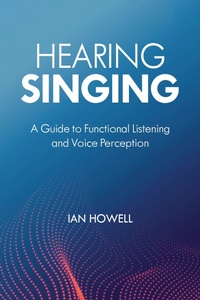
Hearing Singing
A Guide to Functional Listening and Voice Perception
1st Edition
Published on 26. February 2025
254 pages
979-8-8818-0465-7 (ISBN)
Description

Ian Howell provides a fresh, actionable framework for the perception of the singing voice which will help guide singers toward efficient and expressive singing. The book dives deeply into the connections between voice acoustics, biomechanics, aerodynamics, functional listening, perception, and pedagogy.
More details
Edition
1. Auflage
Language
English
Place of publication
New York
United States
Publishing group
Bloomsbury Publishing Plc
Target group
College/higher education
Illustrations
55 b/w illustrations; 1 table
ISBN-13
979-8-8818-0465-7 (9798881804657)
Copyright in bibliographic data and cover images is held by Nielsen Book Services Limited or by the publishers or by their respective licensors: all rights reserved.
Schweitzer Classification
Other editions
Additional editions
Book
03/2025
Rowman & Littlefield Publishers
€42.50
Shipment within 15-20 days
Book
03/2025
Rowman & Littlefield Publishers
€99.30
Shipment within 15-20 days
Content
- Cover
- Half Title
- Title Page
- Copyright Page
- Dedication
- Contents
- Acknowledgments
- Preface
- Before We Start
- Who Is This Book For?
- How to Read This Book
- Chapter 1: Introduction
- The Purpose of This Book
- The Problem
- The Argument
- The Structure of This Book
- A Few Important Guardrails and Bits of Housekeeping
- Chapter 2: How We Got Here
- The Burden of What Is Known About the Voice
- Not All Singing Transmits Language
- First Steps Toward Understanding the Timbre of a Voice
- What We Choose to Notice
- Conclusion
- Chapter 3: Refining Models for Understanding the Singing Voice
- Current Pedagogic Models
- How to Understand Phonation and Resonance in the Vocal Tract
- How Does the Ear Work?
- The Most Basic Model of the Ear
- A Simple Model of the Ear
- A More Complex Model of the Ear
- Is Sound a Complex Wave or a Spectrum?
- Introducing Pitch, Auditory Roughness, and Tone Color
- Potential Conclusions and Applications
- Discussion Questions
- Chapter 4: What Is Timbre?
- What Differs? What Is the Same?
- Time and Timbre
- Potential Conclusions and Applications
- Discussion Questions
- Chapter 5: Pitch
- Pitch and Timbre
- How Do We Perceive Pitch?
- Where pitch is-and is not-in a spectrum
- When Is a Fundamental a Fundamental?
- Restating the Perceptual Qualities of Pitch
- Unresolved Harmonics: The Noise in Pitched Sound
- Issues with the Singer's Formant and Pitch
- Beginning to Understand Pitch in Other Voices
- Conclusions and Potential Applications
- Discussion Questions
- Chapter 6: Time-and-Pressure Domain Considerations of Pitch and Timbre
- Modeling Voice Production Without the Fourier Transform
- The Timing of Timbre
- What Is Formant Tuning?
- The Pitch Exception of Overtone Singing
- The Pitch Exception of Subharmonic Singing
- The Timbre Exception of Vocal Fry
- The Pitch Exception of Noisy Distortion
- Conclusions and Potential Applications
- Discussion Questions
- Chapter 7: Perceptual Qualities of Auditory Roughness and Pitch Resolution*
- What Is Auditory Roughness?
- Exploring Auditory Roughness Experientially
- Visualizing Critical Bands of Hearing
- The Equivalent Rectangular Bandwidth
- The Intersection of Pitch Resolution and Buzziness in a Spectrum
- The Two-Timbre Model and Beyond
- Potential Conclusions and Applications
- Discussion Questions
- Chapter 8: Tone Color and Brightness
- What Is Brightness?
- Tone Color: Conflicts between Speech and Musical Sounds
- The History of Brightness
- What If Formants Have Tone Colors?
- Open Questions and Potential Applications
- Discussion Questions
- Chapter 9: Absolute Spectral Tone Color
- ABSOLUTE SPECTRAL TONE COLOR: HISTORY AND DEFINITION
- Absolute Spectral Tone Color: Limitations
- Exploring Absolute Spectral Tone Color Experientially
- Vowels Share Common Tone Colors
- Potential Conclusions and Applications
- Discussion Questions
- Chapter 10: How Pitch, Auditory Roughness, and Tone Color Intersect: Theory and Application
- The Timbre of a Formant as Pitch Changes: A Thought Experiment
- The Intersection of Auditory Roughness, Pitch Resolution, and Tone Color In A Single Formant
- The Tone Color of "Flat" versus "Pointy" Formants
- Rules of Thumb
- Some Examples of These Intersections
- The Obvious True Fundamental
- A Combined Perceptual Model
- Perceptual Signifiers of Some Common Resonance Strategies
- The Tone Color of a Strong 1fo: Solutions for the Treble Staff and Higher
- The Tone Color of a Strong 3fo or 2fo: Money Notes across Genres
- Hearing the Entire Spectrum
- What Can Be Perceived?
- Conclusions
- Chapter 11: How to Teach Singing
- How a Singer Should Think
- The Five Steps in All Singing
- The Registration Triangle
- A Few Practical Things to Keep in Mind
- Is It Consistent? Is It Representative?
- Different Parts of the Voice
- What Does a Resonance Strategy Feel Like?
- How the Entire System Works
- Respiration
- Phonation and Resonation
- Acoustical Interactions
- Summary
- Good Rules of Thumb to Connect Perception to Function
- Chapter 12: Pedagogic Practices and Functional Listening Examples
- Adjacent or Intermediate Functions and Exercises
- Airflow Is Warmth / Warmth Is Airflow
- Going on a Brightness Hunt
- The Middle-Voice Slide
- The Terrible Treble Ah
- Same Shape / New Sound for Non-Trebles
- Same Shape / New Sound for Trebles
- Loud and Exciting Is Not Enough
- There Are No Registers, Only Qualities
- What Are the Perceptual Qualities of Vocal Registers?
- What Are the Perceptual Qualities of Registration?
- Thoughts on How Perceptual Qualities Point to Vocal Function
- Some Basic Principles and Recurring Behaviors
- Epilogue
- Glossary
- Appendix A
- The Waveform
- The Spectrum
- The Spectrogram
- Appendix B
- Bibliography
- Index
- About the Author
