
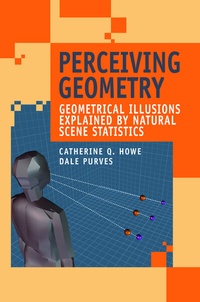
Perceiving Geometry
Description
Alles über E-Books | Antworten auf Fragen rund um E-Books, Kopierschutz und Dateiformate finden Sie in unserem Info- & Hilfebereich.
During the last few centuries, natural philosophers, and more recently vision scientists, have recognized that a fundamental problem in biological vision is that the sources underlying visual stimuli are unknowable in any direct sense, because of the inherent ambiguity of the stimuli that impinge on sensory receptors. The light that reaches the eye from any scene conflates the contributions of reflectance, illumination, transmittance, and subsidiary factors that affect these primary physical parameters. Spatial properties such as the size, distance and orientation of physical objects are also conflated in light stimuli. As a result, the provenance of light reaching the eye at any moment is uncertain. This quandary is referred to as the inverse optics problem. This book considers the evidence that the human visual system solves this problem by incorporating past human experience of what retinal images have typically corresponded to in the real world.
More details
Other editions
Additional editions

Content
System requirements
File format: PDF
Copy protection: Watermark-DRM (Digital Rights Management)
System requirements:
- Computer (Windows; MacOS X; Linux): Use the free software Adobe Reader, Adobe Digital Editions, or any other PDF viewer of your choice (see eBook Help).
- Tablet/Smartphone (Android; iOS): Install the free app Adobe Digital Editions or another reading app for eBooks, e.g., PocketBook (see eBook Help).
- E-reader: Bookeen, Kobo, Pocketbook, Sony, Tolino and many more (only limited: Kindle).
The file format PDF always displays a book page identically on any hardware. This makes PDF suitable for complex layouts such as those used in textbooks and reference books (images, tables, columns, footnotes). Unfortunately, on the small screens of e-readers or smartphones, PDFs are rather annoying, requiring too much scrolling.
This eBook uses Watermark-DRM, a „soft” copy protection. This means that there are no technical restrictions to prevent illegal distribution. However, there is a personalised watermark embedded in the eBook that can be used to identify the purchaser of the eBook in the event of misuse and to provide evidence for legal purposes.
For more information, see our eBook Help page.