

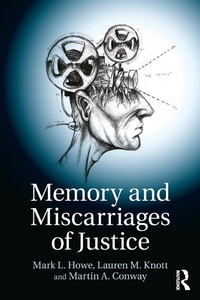
Memory and Miscarriages of Justice
Published on 16. August 2017
212 pages
978-1-317-61738-9 (ISBN)
Description

Memory is often the primary evidence in the courtroom, yet unfortunately this evidence may not be fit for purpose. This is because memory is both fallible and malleable; it is possible to forget and also to falsely remember things which never happened.
The legal system has been slow to adapt to scientific findings about memory even though such findings have implications for the use of memory as evidence, not only in the case of eyewitness testimony, but also for how jurors, barristers, and judges weigh evidence. Memory and Miscarriages of Justice provides an authoritative look at the role of memory in law and highlights the common misunderstandings surrounding it while bringing the modern scientific understanding of memory to the forefront.
Drawing on the latest research, this book examines cases where memory has played a role in miscarriages of justice and makes recommendations from the science of memory to support the future of memory evidence in the legal system. Appealing to undergraduate and postgraduate students of psychology and law, memory experts, and legal professionals, this book provides an insightful and global view of the use of memory within the legal system.
The legal system has been slow to adapt to scientific findings about memory even though such findings have implications for the use of memory as evidence, not only in the case of eyewitness testimony, but also for how jurors, barristers, and judges weigh evidence. Memory and Miscarriages of Justice provides an authoritative look at the role of memory in law and highlights the common misunderstandings surrounding it while bringing the modern scientific understanding of memory to the forefront.
Drawing on the latest research, this book examines cases where memory has played a role in miscarriages of justice and makes recommendations from the science of memory to support the future of memory evidence in the legal system. Appealing to undergraduate and postgraduate students of psychology and law, memory experts, and legal professionals, this book provides an insightful and global view of the use of memory within the legal system.
Reviews / Votes
"Overall, this book offers readers with a fascinating and informative insight into the role of memory across various aspects of law, and the affect memory has on judicial and legal systems. Any reader of this book will gain knowledge on various aspects of memory and its application to various aspects of law, which is particularly beneficial for those who are faced with the effects of memory and the evaluation of memory. As such, this book achieves its aims of informing its intended audience and, in my opinion, at points, goes beyond this; it implies the need for further collaboration between practitioners and academics to develop, evolve and enhance current best practice guidance."- Brandon May, Psychology Teaching ReviewMore details
Language
English
Place of publication
London
United Kingdom
Publishing group
Taylor & Francis Ltd
Target group
College/higher education
Professional and scholarly
Product notice
Reflowable
Illustrations
2 s/w Tabellen, 3 s/w Photographien bzw. Rasterbilder, 3 s/w Zeichnungen
2 Tables, black and white; 3 Line drawings, black and white; 3 Halftones, black and white
File size
1,62 MB
ISBN-13
978-1-317-61738-9 (9781317617389)
Copyright in bibliographic data and cover images is held by Nielsen Book Services Limited or by the publishers or by their respective licensors: all rights reserved.
Schweitzer Classification
Other editions
Additional editions
Mark L. Howe | Lauren M. Knott | Martin A. Conway
Memory and Miscarriages of Justice
Book
08/2017
1st Edition
Psychology Press Ltd
€78.30
Shipment within 10-20 days
Mark L. Howe | Lauren M. Knott | Martin A. Conway
Memory and Miscarriages of Justice
Book
08/2017
1st Edition
Psychology Press Ltd
€193.50
Shipment within 10-20 days
Persons
Prof Mark L. Howe holds a Chair in Cognitive Science at City, University of London, UK. His research on memory has addressed questions concerning memory development, memory illusions, the emergence and adaptive functions of memory, links between reasoning and memory, memory in traumatized and maltreated children, as well as memory and the law. He has published numerous peer reviewed articles and book chapters on memory, as well as authored and edited a number of books.
Dr Lauren M. Knott is a Senior Lecturer in the Department of Psychology at City, University of London, UK. She specialises in the investigation of false memory development in children and the role of retrieval processes in false recognition.
Prof Martin Conway is the Head of Psychology at City, University of London, UK. Having researched human memory for over 32 years he has published numerous papers, books, and articles as well as making contributions to television, radio, and newspapers.
Dr Lauren M. Knott is a Senior Lecturer in the Department of Psychology at City, University of London, UK. She specialises in the investigation of false memory development in children and the role of retrieval processes in false recognition.
Prof Martin Conway is the Head of Psychology at City, University of London, UK. Having researched human memory for over 32 years he has published numerous papers, books, and articles as well as making contributions to television, radio, and newspapers.
Content
PART 1. Memory and the Law: Miscarriages, Misuse, and Naive Beliefs Chapter 1. Memory and Miscarriages of Justice Chapter 2. The Origins of False and Repressed Memories Chapter 3. Myths and Naive Beliefs about Memory PART 2. The Science of Memory and the Law Chapter 4. When Adults' Memories of Childhood Serve as Evidence Chapter 5. The Nature and Neuroscience of Autobiographical Memory Chapter 6. Stress, Trauma, and Memory Chapter 7. Eyewitness Identification, Lineups, and Face Recognition Chapter 8. Suggestibility and Interviewing Chapter 9. Memory Demands on Jurors in the Courtroom Chapter 10. Collaborative Remembering in Eyewitnesses and Jurors PART 3. Conclusions and Recommendations Chapter 11. Conclusions and Recommendations for Memory and the Law
