

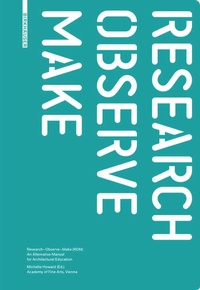
Research - Observe - Make
Description

2008 entwickelte das Institut für Kunst und Architektur der Akademie der bildenden Künste in Wien eine neue Basis für die Ausbildung. Man schuf fünf Forschungsplattformen: Analogue and Digital Production (ADP), Ecology Sustainability Conservation (ESC), History Theory Criticism (HTC), Geogra-phy Landscape Cities (GLC) und Construction Material Technology (CMT). Die zuletzt genannte Plattform CMT wird von Michelle Howard geleitet; sie hat dort das Unterrichts-Programm Research Observe Make (ROM) etabliert.
Die Publikation ROM dokumentiert dieses Programm und bildet gleichzeitig die Basis für die künftige Entwicklung. Sie besteht aus fünf einzeln lesbaren, jedoch komplementären Büchern, die in einem Band zusammengefasst sind. Nach einer Einleitung und einer theoretischen Reflexion werden die Forschungsprojekte "Elemente", "Raum" und "Material" vorgestellt. Das letzte Buch dokumentiert Workshops, Vorträge und Experimente.
Ein anregendes Lesebuch mit vielen Fachbeiträgen und kreativen studentischen Projekten.
More details
Other editions
Additional editions
Person
Content
- Intro
- Table of contents
- Preface Michelle Howard. Introducing Research - Observe - Make (ROM)
- + Research - Observe - Make + Reflect
- The Development of Research - Observe - Make (ROM)
- +1. Construction Material Technology (CMT) Konversationsreihe
- +.1.1 Interview with Michelle Howard
- +.1.2 Interview mit Peter Bauer
- +.1.3 Interview mit Helmut Hempel
- +.1.4 Interview mit Jochen Käferhaus
- +.1.5 Interview mit Günther Dreger and Benedikt Frass
- Book 1. Elemental Interactivity
- ROM - Vorsprung durch Technik
- 1.1 Elemental Interactivity I. Building a Good Climate
- Building a Good Climate. Studio description
- 1.1.1 Position vs disposition
- 1.1.2 Moss Pavilion
- 1.1.3 Bamboo Pavilion
- 1.1.4 Activating Schiller
- 1.1.5 Neglige
- 1.1.6 Stacked Pavilion
- 1.2 Elemental Interactivity II. Gone with the Wind
- Gone with the Wind. Studio description
- 1.2.1 Desislava Petkova and Matej Malenka The Beast
- 1.2.2 The Wind Waves Instrument
- 1.2.3 Exhausted! - Recycling Unwanted Air
- 1.2.4 Two Frames. Perceiving Energy
- 1.3 Elemental Interactivity III. On the Modifications of Clouds
- On the Modifications of Clouds. Studio description
- 1.3.1 Hygrometer
- 1.3.2 110G
- 1.3.3 Interpolation
- 1.3.4 Particles
- Book 2. Spatial Interactivity
- ROM - Das Einmaleins
- 2.1 The Spatial Interactivity I. Building Fast - What Succeeds the Secession?
- Building Fast - What Succeeds the Secession? Studio description
- 2.1.1 Haus 01
- 2.1.2 Simple and Strong
- 2.1.3 Pixellate
- 2.2 Spatial Interactivity II. Connecting Spaces
- Connecting Spaces. Studio description
- 2.2.1 Connecting Cubes
- 2.2.2 The Way
- 2.2.3 Atrium House
- 2.2.4 Vertical Town Square
- 2.3 Spatial Interactivity III. The Audacity of Preservation
- The Audacity of Preservation. BIG! BAD? MODERN
- The Audacity of Preservation. Studio description
- 2.3.1 Grasping Character, Introducing Looseness
- 2.3.2 Just Enough Light
- 2.3.3 The Well-Tempered Environment of the University of Economics
- 2.3.4 Continuous Change
- 2.3.5 Modern Tourism
- 2.3.6 Connecting Spaces
- 2.3.7 Lonely Platforms
- 2.4 Spatial Interactivity IV. The Efficiency of Looseness
- The Efficiency of Looseness. Studio description
- 2.4.1 Vertical Looseness
- 2.4.2 On Air
- 2.4.3 Cutting Transitions
- 2.4.4 Undesired Solitude
- 2.4.5 Loose Hub
- Book 3. Material Interactivity
- ROM - Eine Abrechnung
- 3.1 Material Interactivity I. Landscape Una[Bridge]d
- Landscape Una[Bridge]d. Studio description
- 3.1.1 Mind the Gaps
- 3.1.2 Detour
- 3.1.3 The Nature and Technology Trail
- 3.2 Material Interactivity II. Water, Aggregate, Cement and a Container
- Water, Aggregate, Cement and a Container. Studio description
- 3.2.1 Eleven Vaults
- 3.2.2 Topographic
- 3.2.3 Templar Landscape
- 3.2.4 Hidden Innards
- 3.2.5 Cones of Light and Shade
- 3.3 Material Interactivity III. There is a Light that Never Goes Out
- There is a Light that Never Goes Out. Studio description
- 3.3.1 Body, Brain and Light. A project for people with epilepsy
- 3.3.2 Retrospect and Prospect. A project for people with dementia
- 3.3.3 Light Movement Number 1. A project for people with Cystic Fibrosis
- Book 4. Workshops, Lectures and Experiments
- ROM - Modellbau ist Denken
- 4.1 Workshops & Short Projects
- 4.1.1 Glass I: Seeing Through the Transparency Myth
- 4.1.2 Glass II: There is a Light that Never Goes Out
- 4.1.3 The Good Climate Workshop
- 4.1.4 The Acoustics Workshop
- 4.1.5 The Concrete Workshop
- 4.1.6 The Architecture of Small Spaces Workshop
- 4.2 Lectures and Experiments in Shaping Material
- 4.2.1 Folding Concrete
- 4.2.2 Controlling Deformation
- 4.2.3 An Experiment with a Stretch Wrapping Film
- 4.2.4 Destroyed Trees
- 4.2.5 Inflatable Formwork for Organic Solid Shapes
- 4.2.6 Cuir Bouilli
- 4.2.7 Smocking Structures
- 4.2.8 Sugar Landscape
- 4.2.9 Concrete from Scratch
- 4.3 Lectures and Experiments In Observation
- 4.3.1 144 Hours in a Train
- 4.3.2 Daily Dust Diary
- 4.3.3 Analysis Type II
- 4.3.4 It's a Noisy Day
- 4.4 Lecture Series
- 4.4.1 Materialising Ideas in an Age of Digital Production
- 4.4.2 Our Concrete Ideas
- 4.4.3 The Practice of Research
- Appendix
- Contributors
- Commentators
- Sponsors
- Imprint
