

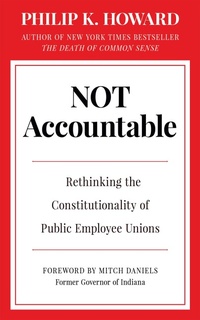
Not Accountable
Rethinking the Constitutionality of Public Employee Unions
Published on 26. January 2023
160 pages
978-1-957588-14-8 (ISBN)
Description

"Elected leaders come and go, but public unions just say no." Hiding in plain sight is a fatal defect of modern democracy. Public employee unions have a death grip on the operating machinery of government. Schools can't work, bad cops can't be fired, and politicians sell their souls for union support.
With this searing five-point indictment, Philip K. Howard argues that union controls have disempowered elected executives and should be unconstitutional.
Union power in government happened almost by accident in the 1960s, ostensibly to give public unions the same bargaining rights as trade unions. But government bargaining is not about dividing profits, but making political choices about public priorities. Moreover, the political nature of decision-making allowed unions to provide campaign support to friendly officials. Public bargaining became collusive. The unions brag about it: "We elect our own bosses."
Sitting on both sides of the bargaining table has allowed public unions to turn the democratic hierarchy upside down. Elected officials answer to public employees. Basic tools of good government have been eliminated. There's no accountability, detailed union entitlements make government largely unmanageable and unaffordable, and public policies are driven by what is good for public employees, not what is good for the public. Public unions keep it that way by brute political force-harnessing the huge cohort of public employees into a political force dedicated to preventing the reform of government.
The solution, Howard argues, is not political but constitutional. America's republican form of government requires an executive branch that is empowered to implement public policies, not one shackled to union controls. Public employees have a fiduciary duty to serve the public and should not be allowed to organize politically to harm the public.
This short book could unlock a door to fixing a broken democracy.
Common Good(www.commongood.org) is a nonpartisan reform coalition to simplify government and restore common sense in daily decisions. It proposes a new governing vision: replace red tape with individual accountability. Its Founder and Chair is lawyer and author Philip K. Howard.
With this searing five-point indictment, Philip K. Howard argues that union controls have disempowered elected executives and should be unconstitutional.
Union power in government happened almost by accident in the 1960s, ostensibly to give public unions the same bargaining rights as trade unions. But government bargaining is not about dividing profits, but making political choices about public priorities. Moreover, the political nature of decision-making allowed unions to provide campaign support to friendly officials. Public bargaining became collusive. The unions brag about it: "We elect our own bosses."
Sitting on both sides of the bargaining table has allowed public unions to turn the democratic hierarchy upside down. Elected officials answer to public employees. Basic tools of good government have been eliminated. There's no accountability, detailed union entitlements make government largely unmanageable and unaffordable, and public policies are driven by what is good for public employees, not what is good for the public. Public unions keep it that way by brute political force-harnessing the huge cohort of public employees into a political force dedicated to preventing the reform of government.
The solution, Howard argues, is not political but constitutional. America's republican form of government requires an executive branch that is empowered to implement public policies, not one shackled to union controls. Public employees have a fiduciary duty to serve the public and should not be allowed to organize politically to harm the public.
This short book could unlock a door to fixing a broken democracy.
Common Good(www.commongood.org) is a nonpartisan reform coalition to simplify government and restore common sense in daily decisions. It proposes a new governing vision: replace red tape with individual accountability. Its Founder and Chair is lawyer and author Philip K. Howard.
More details
Other editions
Additional editions
Book
02/2023
Rodin Books
€21.00
Shipment within 3-4 weeks
Person
PHILIP K. HOWARD is a lawyer, author, and civic leader. He is chair of Common Good, a nonpartisan organization aimed at simplifying government. He grew up in Kentucky and lives in New York City. Mitch Daniels is a former Governor of Indiana, former president of Purdue University, and a former senior White House official.
Content
- Intro
- Contents
- Foreword by Mitch Daniels
- Introduction7
- Chapter 1:17? Why Nothing Much Gets Fixed
- Chapter 2: How Public Employee Unions Seized Control of Public Administration
- Chapter 3: 41?How Public Employment Is Supposed to Work
- Section II: Public Employee Unions Against the Common Good: A Five-Point Indictment
- Chapter 4: No Accountability
- Chapter 5: Unmanageable Government
- Chapter 6: Unaffordable Benefits, Hidden from Taxpayers and Paid by Our Children
- Chapter 7: 83?Public Policy Against the Public Interest
- Chapter 8: Not Reformable: The Stranglehold of Public Employee Political Power
- Chapter 9: What Were They Thinking?
- Section III:125? Public Employee Controls Are Unconstitutional
- Chapter 10: Restore Executive Power under Article II
- Chapter 11:141? Public Union Controls Undermine Democratic Governance
- Chapter 12: 147?Public Service Is a Public Trust,not a Political Party
- Chapter 13: Abolish the Union Spoils System
- 199Acknowledgments
- Section I:15? Unions Against Democracy
- Notes167
