

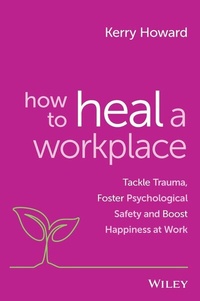
How to Heal a Workplace
Description

Your workplace's most powerful resource is its people. That's why it's critical to balance the needs of your business with the needs of the employees who make that business happen every day. At the heart of the matter is your workplace culture: the environments and relationships that shape your business, whether physical or virtual. How to Heal a Workplace shares the insights and hands-on advice that you need to better understand how your culture impacts your team. You'll learn how to manage interpersonal challenges--and anticipate the impact of policies and procedures--to create a healthier, happier and more productive environment.
Drawing on real-world stories from diverse industries, in-demand workplace mental health consultant Kerry Howard shares strategies that will help you:
* Boost employee wellbeing, and attract and retain staff by supporting their mental health
* Understand how trauma is caused by everyday events and how this impacts the workplace
* Combat bullying and harassment and prevent workplace injuries
* Foster psychological safety, improve communication, and build better relationships between colleagues
In How to Heal a Workplace, you'll find the practical advice you need to create a better culture, improve productivity and increase satisfaction across every area of your business.
More details
Other editions
Additional editions
Person
Content
Part I: Workplace Culture 1
1 What is workplace culture?: Why it's the key to profitability 3
2 Why it's really about collective mental health 27
Part II: The Role of Leadership 59
3 Compassionate Leadership: The key to psychological safety at work 61
4 Conscientious Leadership: How to foster it in the workplace 89
Part III: Risk and Psycho logical Safety 101
5 Validation: Judgement vs acknowledgement 103
6 Mitigating Risk in Psychological Safety: Know the situations that put your staff at risk 117
Part IV: Prevention and Recovery 135
7 Industry Challenges: Known problem sectors and the quiet achievers 137
8 Insurance: How to change the outcomes with attitude 175
9 Prevention: The 'recovery at work' early intervention model 203
Next Steps: The power of three 221
References 223
CHAPTER 1
What is workplace culture?: Why it's the key to profitability
I am often asked why I focus on trying to help organisations change their culture, and I point out that we spend the majority of our waking adult life at work. If we are constantly exposed to a toxic workplace culture, the chances of us being able to operate at our best and live our lives 'full of awesome' is pretty slim.
Conversely, if employees are experiencing mental health issues, for example, then their behaviour in the workplace is not going to be balanced or reasonable at all times. When employees feel safe enough to share their mental health issues, we can provide support for that team member. However we all experience difficulties in life, and we often don't recognise that they impact our mental health, and we don't label them as such.
I am sure that, like me, you have grown up in a world that told you that you needed to maintain a separation between work and life - don't let your personal problems cross over into your working life, and vice versa - but it's not only unreasonable to expect this type of compartmentalisation, it's damn near impossible to achieve!
As human beings we have many complex feelings and emotional experiences that impact our mood; we are not robots. We cannot merely switch ourselves into 'work mode' and switch off the fact that we are having relationship problems, or our parents or child are sick. There are many occupations where it can feel like we readily switch into 'work mode'. We see this in occupations that require uniforms; we put on the uniform and our behaviour changes, but it doesn't mean that the stress of our home life stops affecting us.
The same is true in reverse: our experiences at work can spill over into our mood and behaviour at home. When we are unhappy at work, it places pressure on our home life. Whether it's financial pressure, time pressure or other excessive work expectations, it is impossible to separate the impact of our working and home lives - and unreasonable of us to expect that they can be separated!
The one constant reflection that I hear from staff who have had a difficult time, but managed to work through it, is that they had a supportive supervisor. The perception of 'support' changes depending on the workplace, but it is essentially where the staff member felt that their challenges in life were seen by their supervisor to be a temporary glitch in their work performance, and they were provided the space to get through the challenge and get on with life, without it affecting their working life.
In essence, their situation was appropriately viewed as 'temporary' and they were trusted to get back to full capacity as soon as practicable. The important element here is 'trust'.
What is workplace culture?
Many people believe that they know what the term 'workplace culture' means, but for clarity, I am going to define it here and explain what it looks like in practicality. Workplace culture is the environment that you create for your employees. It plays a powerful role in determining their satisfaction with their career, their interpersonal relationships and their career progression. The culture of your workplace is determined by a combination of the company's leadership and the employees' values, beliefs and attitudes, which translate into behaviours and interactions that contribute to the relational environment of your workplace. In general, these are the intrinsic rules that govern interpersonal connections in the workplace between peers.
Workplace culture should align with the company's mission and vision statements, and be supported by policies and procedures that are designed to ensure the workplace functions effectively and achieves its overall goals. However, when I am called into an organisation to support cultural change, the number one problem is that the workplace culture has veered off track and is no longer aligned with the mission or vision.
Workplace culture can be strongly impacted by the leadership, and we often see issues develop in the culture when there is a misalignment between the leader, the company's mission and vision, and the staff. There can be several reasons for this misalignment, but not addressing the misalignment is a sure-fire way to create a toxic workplace culture.
Workplace culture is the environment that you create for your employees
Toxic workplace culture
We have all heard the term 'toxic culture' thrown around, but I will outline what I mean by this term. Toxicity in the workplace develops from a pattern of combined behaviours that are counterproductive. When promoted by toxic leadership, a toxic culture incorporates six specific behaviours:
- passive hostility
- shaming
- indifference
- team sabotage
- negativity
- exploitation.2
Toxic cultures are known to promote attitudes that adversely impact employee psychological wellbeing (see figure 1.1). Psychological wellbeing is also defined by six attributes:
- autonomy
- environment management
- personal growth
- positive relationships
- having life goals
- self-acceptance.3
Figure 1.1: The impact of toxic cultures on employee psychological wellbeing
In one particular study that considered the impact of a toxic workplace culture on psychological wellbeing, it determined, not surprisingly, that wellbeing is lower in employees who are exposed to toxic workplace cultures. What might be surprising is that almost 80 per cent of workplaces met the criteria for toxicity!3
The researchers identified that there are three main strategies adopted by employees who are confronted with these toxic work environments:
- Active rejection: These employees are the whistle-blowers, the fighters against injustice, who take action against the toxicity of the workplace and see quitting as the last resort. These employees represent over one-third of the workforce, and you will read some of their stories in this book.
- Passive rejection: These employees are those who tend to hide their dissatisfaction from the perpetrators (usually the leadership) while sharing their dissatisfaction with their peers. These employees represent a staggering 40 per cent of the workforce and perceive that all workplaces are toxic, so they remain passively disengaged because they are pessimistic. They believe that it is better the devil you know, than the devil you don't!
- Escapees: These are the ones who decide that it is easier to get out as quickly as possible, in some cases leaving the professional field. These employees represent the remaining 27 per cent of the workforce and often react swiftly to toxic experiences of blatant harassment, threats and intimidation.
Employees with higher levels of psychological wellbeing are more likely to escape when the organisation toxicity worsens, whereas employees with the lowest psychological wellbeing are the most likely to become passive rejectors.4
It isn't that difficult to see why these numbers need our attention. If 80 per cent of workplaces have a moderate to high toxicity, and 40 per cent of those employees are passively disengaged, 33 per cent are actively disrupting the workplace and 27 per cent are actively looking for work elsewhere, then it really isn't hard to understand why actively leading to reduce toxicity in the workplace should be the major goal of all compassionate leaders. The disenfranchisement of our human resources is leading to significantly reduced productivity, and this is silently eroding the profitability of businesses globally.
The Great Resignation
The Great Resignation: The mass exodus from the work environment observed post-pandemic. The term was coined by Anthony Klotz, a professor of management at University College London's School of Management, in May 2021.
The phenomena of the Great Resignation was first observed in 2021 following the disruption to the way that we work thanks to the pandemic. In July 2021, a Gallup Poll revealed that almost half the American working population was actively looking for new roles. Business is facing a staggeringly high resignation rate and record numbers of unfilled positions.5 The United States quit rate is at its highest in over 20 years, hovering at almost 3 per cent since early 2021.6
Quit rate: The number of employees who voluntarily resign, as opposed to as the result of redundancy or being fired.
There are several reasons for this phenomenon, but the primary reason is that the impact of the pandemic on people's freedom meant that their discontent with life was linked with the employer that they were connected with at the time of the strongest lockdowns and control over their movements in society.
In Australia, we saw less of this movement until 2022, primarily due to the prolonged lockdowns, which affected our general sense of security and limited the number of people changing roles due to the need for stable employment. The Australian Bureau of Statistics' annual job mobility survey shows that Australians are on the move at their highest rate in over a decade: 9.5 per cent in 2022,...
