

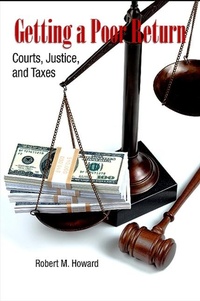
Getting a Poor Return
Description

Public policy often favors one group over another. In the case of tax policy, the conventional wisdom has been that the dominant political coalition will offer policies that favor their primary constituents. The longstanding belief has been that the disfavored group may always assert their rights in court, the expectation being, as Justice John Marshall Harlan wrote, that "all citizens are equal before the law." In this revealing and insightful study, Robert M. Howard demonstrates that long-cherished beliefs such as equality before the law are more wishful thinking than reality. Courts, he argues, differ little from national policy makers in their approach to tax policy and tax enforcement. Examining the tax litigation process, particularly the influence and impact of competing courts, Howard discovers that fairness before the law may be a laudable goal, but the appointment process ensures that tax policy and tax enforcement rulings by the courts reflect the perspectives of the dominant political coalition.
Robert M. Howard is Associate Professor of Political Science at Georgia State University.
More details
Other editions
Additional editions
Person
Robert M. Howard is Associate Professor of Political Science at Georgia State University.
Content
List of Figures and Tables
Acknowledgments
1. Tax Policy and the Pursuit of Justice Courts and Justice
Taxes and Tax Policy
Courts, Fairness, and Taxes
Chapter Overview
2. Courts and the IRS
The Need for Tax Forums
Administrative Appeals and Trial Courts: Options and Odds
Conclusion
3. Tax Litigation and Tax Forum Choice
Political Forces and Litigation
The Decision to Litigate and Forum Strategy
Hypotheses
Factors Infl uencing Litigation and Forum Choice
Results
Conclusion
4. Tax Decision Making
Courts, Law, and Politics
Taxpayers, Courts, and Outcomes
Hypotheses
Results
Conclusion
5. Influences on the IRS and the Audits of Low-Income
Taxpayers
Bureaucratic Control and the IRS
The National Political Coalition, Courts, and Bureaucratic Control
Hypotheses
Testing Infl uences
Results
Conclusion
6. Courts, Fairness, and the Creation and Enforcement of National Tax Policy
Courts, Fairness, and National Governing Coalitions
Changing Tax Policy, Changing the Courts
Appendix Methodology and the Use of Panel Data
Estimation Problems
Models for Chapter Three
Models for Chapter Four
Models for Chapter Five
Cases Cited
Notes
References
Index
