

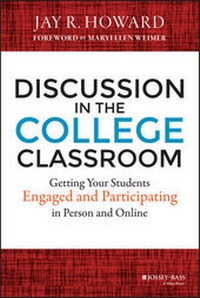
Discussion in the College Classroom
Description

More details
Other editions
Additional editions
Persons
Content
Chapter 2
Is Anyone Really Paying Attention?
Today was another one of those puzzling days in class. The students seemed to be paying attention and following along with at least muted interest as you presented material. Heads were nodding. Light chuckles came in response to those bits of humor you included here and there. Some students even made fleeting eye contact as they scribbled away in their notebooks. All seemed well. That is until you asked a question about the reading assigned for the day's topic. The initial question was friendly enough-asking simply for students' perspectives. You were not asking for a rigorous analysis of the evidence. You were not asking the question in order to find out who was and wasn't prepared. It should have been easy for students who were following the lecture and who had completed the reading assignment to offer a comment or venture to take a position. Really, they didn't even have to have finished the reading in order to participate. The in-class presentation alone should have given them a basis for offering a comment or two.
Yet, when you asked the question, instead of engagement, you got disengagement. Suddenly no one would establish eye contact with you. Many busied themselves writing down something-was it the question? Not a single student volunteered an opinion. After what seemed like a long stretch of uncomfortable silence, you call on a couple of students. They seem offended that you've called on them and their body language is clear. They don't want to participate. When you ask about their views, the first mumbled, "I don't know" and the second said, "I agree with the author."
Disappointed and frustrated, you give up and you make the link between the point just made in the presentation and the reading assignment. It quickly becomes obvious that few, if any, students have completed the reading as again no one volunteers to speak. You offer some comments, followed by leading questions in hopes of sparking students' recall of the reading-still nothing. Your composure begins to slip and your irritation starts to show. "Has anyone read the assignment?" The sullen looks you get in response to the question suggest this is not a way to win friends on the end-of-semester course evaluations. Your students may be upset with you at the moment, but you are upset with them, too! They had seemed to be engaged. They seemed to be connected as you presented. Everything was fine until you probed beneath the surface a bit. Where did it all go wrong?
In this chapter, I first explain how students demonstrate civil attention and why they are able to get away with only paying civil attention. Then we focus on strategies that encourage student engagement by ensuring that students, not the faculty member, are doing most of the work. Because, as sociologists point out, the classroom is a negotiated social setting; instructors are not stuck with civil attention as the operative classroom norm. We can, beginning on the first day of class, establish new norms, strengthen students' confidence for participation, and choose to engage in behaviors in class that foster a safe emotional environment that facilitates learning and the development of critical thinking skills through student engagement.
Creating the Appearance of Paying Attention
As we know, appearances can be deceiving. The students in the scenario described above looked like they were paying attention. But perhaps that's all they were doing-creating the appearance of paying attention, or what sociologists refer to as civil attention. As we noted in Chapter 1, Karp and Yoels (1976) first identified this college classroom norm in the middle 1970s. In the vast majority of college classrooms, we expect college students to pay civil attention. Actually paying attention is optional.
How do students go about paying civil attention-creating the appearance of paying attention without actually having to pay attention? They do this in both the ways they act and do not act in class. A student who is reading the newspaper in the back row is not paying civil attention. The same is true for a student using his or her laptop computer to comment on posts on Facebook, to shop, to check sports scores from the previous day, or to read email. When students are texting in class or having a whispered conversation with their neighbor while the instructor is speaking, they are failing to pay civil attention. Very often faculty members have specific policies in their syllabi banning such behaviors. As faculty, we find such behaviors to be impolite, distracting, and even downright offensive. Most students accept that they are not supposed to engage in behaviors of this sort during class and therefore will at least attempt to be covert when they engage in them.
Students demonstrate civil attention not only by what they don't do, but also by the behaviors they actively display. These behaviors create the impression of paying attention; however, while we as faculty see them as signals of paying attention, we cannot know with certainty that a given student is focused on the class. For example, in order to display civil attention a student needs to be facing the faculty member with his eyes open and making occasional, fleeting eye contact with the instructor. It's important for our civil attention-paying student to make only fleeting eye contact because prolonged eye contact invites interaction, which could result in the student being called up to answer a question or provide a comment. Students also display civil attention by writing. As faculty, we assume they are taking notes on our erudite presentations. But they could be making a grocery list or merely doodling. Chuckling in response to the faculty member's attempt to inject some levity into the lecture is also a way of demonstrating civil attention. Nodding of the head as the professor speaks is yet another. As long as students are demonstrating civil attention through these and similar behaviors, faculty members are generally willing to believe that they are actually paying attention and actively listening.
How Do Students "Get Away" with Only Paying Civil Attention?
Is it safe to assume students are paying attention? Karp and Yoels (1976) suggest it is a risky assumption because in the typical college classroom students can get away with merely paying civil attention. As faculty members we must recognize our own culpability in this arrangement. While it is certainly true that students can be cognitively engaged and actively listening in class without having to participate in discussion, it is quite likely that at numerous points in the course of a class session even the most well-intentioned student will slip from paying attention into paying civil attention.
Faculty Overreliance on Lecture
This is true for a variety of reasons. The most obvious reason is our overreliance on lecture as a pedagogical strategy. I am not a person who thinks lecture is always a poor pedagogical practice. There are times when a lecture, hopefully brief and targeted, is the best way to provide necessary background or introduce new concepts and perspectives. But our overuse of lecture leads students to see the college classroom as an unfocused setting for interaction rather than a focused setting (Karp and Yoels 1976). In a focused setting, everyone is expected to participate and contribute to the interaction. In an unfocused setting, one may choose to participate or not to participate. In an unfocused setting there is no obligation for active participation in the activities of the group. Because lecture centers attention on the instructor, students rightly think that it is the instructor who has the responsibility to keep the class session moving along. Students come to see their own participation in a lecture-oriented class as optional; they may participate at appropriate times if they chose to do so, but they are not obligated to do so. It is an unfocused interaction. Faculty members tend to define the classroom differently than do students. We perceive the classroom as a focused interaction; we see participation as part of every student's responsibilities. However, our behaviors-such as making lecture the dominant pedagogical strategy-communicate something else to our students.
Fear of Direct Questioning
Another reason college students are frequently able to get away with only paying civil attention is our reluctance to use direct questioning, that is, calling on an individual student who has not verbally or nonverbally signaled to us that she is willing to be called upon. This is quite different from high school. I remember a high school teacher who would begin a class with a question about the assigned reading. Then, as a check to see who had completed the reading assignment, she would scan the room looking for students who were avoiding eye contact (in hopes of not being called upon) and then call upon gaze-averting students. If the student had not read the assignment, being embarrassed in front of the teacher and the rest of the class could be sufficient motivation to make sure he or she read the assignment in the future. Even if you were not the person being embarrassed in this manner, the implied threat that it could be you the next time provided motivation for reading the assignment. However, in the college classroom professors prefer to assume that students are adults and not to treat them like wayward children. After...
