

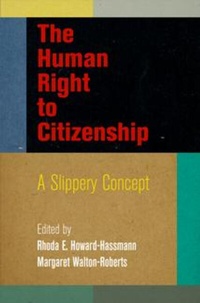
The Human Right to Citizenship
A Slippery Concept
1st Edition
Published on 28. May 2015
328 pages
978-0-8122-9142-1 (ISBN)
Description

In principle, no human individual should be rendered stateless: the Universal Declaration of Human Rights stipulates that the right to have or change citizenship cannot be denied. In practice, the legal claim of citizenship is a slippery concept that can be manipulated to serve state interests. On a spectrum from those who enjoy the legal and social benefits of citizenship to those whose right to nationality is outright refused, people with many kinds of status live in various degrees of precariousness within states that cannot or will not protect them. These include documented and undocumented migrants as well as conventional refugees and asylum seekers living in various degrees of uncertainty. Vulnerable populations such as ethnic minorities and women and children may find that de jure citizenship rights are undermined by de facto restrictions on their access, mobility, or security.
The Human Right to Citizenship provides an accessible overview of citizenship regimes around the globe, focusing on empirical cases of denied or weakened legal rights. Exploring the legal and social implications of specific national contexts, contributors examine the status of labor migrants in the United States and Canada, the changing definition of citizenship in Nigeria, Germany, India, and Brazil, and the rights of ethnic groups including Palestinians, Rohingya refugees in Bangladesh, Bangladeshi migrants to India, and Roma in Europe. Other chapters consider children's rights to citizenship, multiple citizenships, and unwanted citizenships. With a broad geographical scope, this volume provides a wide-ranging theoretical and legal framework to understand the particular ambiguities, paradoxes, and evolutions of citizenship regimes in the twenty-first century.
Contributors: Michal Baer, Kristy A. Belton, Jacqueline Bhabha, Thomas Faist, Jenna Hennebry, Nancy Hiemstra, Rhoda E. Howard-Hassmann, Audrey Macklin, Margareta Matache, Janet McLaughlin, Carolina Moulin, Alison Mountz, Helen O'Nions, Chidi Anselm Odinkalu, Sujata Ramachandran, Kim Rygiel, Nasir Uddin, Margaret Walton-Roberts, David S. Weissbrodt.
The Human Right to Citizenship provides an accessible overview of citizenship regimes around the globe, focusing on empirical cases of denied or weakened legal rights. Exploring the legal and social implications of specific national contexts, contributors examine the status of labor migrants in the United States and Canada, the changing definition of citizenship in Nigeria, Germany, India, and Brazil, and the rights of ethnic groups including Palestinians, Rohingya refugees in Bangladesh, Bangladeshi migrants to India, and Roma in Europe. Other chapters consider children's rights to citizenship, multiple citizenships, and unwanted citizenships. With a broad geographical scope, this volume provides a wide-ranging theoretical and legal framework to understand the particular ambiguities, paradoxes, and evolutions of citizenship regimes in the twenty-first century.
Contributors: Michal Baer, Kristy A. Belton, Jacqueline Bhabha, Thomas Faist, Jenna Hennebry, Nancy Hiemstra, Rhoda E. Howard-Hassmann, Audrey Macklin, Margareta Matache, Janet McLaughlin, Carolina Moulin, Alison Mountz, Helen O'Nions, Chidi Anselm Odinkalu, Sujata Ramachandran, Kim Rygiel, Nasir Uddin, Margaret Walton-Roberts, David S. Weissbrodt.
Reviews / Votes
"An empirically rich, diverse, and informative contribution to sociological citizenship studies." (Karolina S. Follis, Lancaster University)More details
Series
Language
English
Place of publication
Pennsylvania
United States
Target group
College/higher education
Professional and scholarly
Illustrations
5 illus.
5 illus.
ISBN-13
978-0-8122-9142-1 (9780812291421)
Copyright in bibliographic data and cover images is held by Nielsen Book Services Limited or by the publishers or by their respective licensors: all rights reserved.
Schweitzer Classification
Other editions
Additional editions
Book
07/2015
University of Pennsylvania Press
€79.00
Shipment within 10-20 days
Persons
Rhoda E. Howard-Hassmann is Canada Research Chair in International Human Rights at Wilfrid Laurier University and the Balsillie School of International Affairs. She is author of Reparations to Africa and coeditor of Economic Rights in Canada and the United States and The Age of Apology: Facing Up to the Past, all available from the University of Pennsylvania Press. Margaret Walton-Roberts is Associate Professor in Geography and Environmental Studies at Wilfrid Laurier University and the Balsillie School of International Affairs. She is coauthor of Cultural Geography: Environments, Landscapes, Identities, Inequalities and coeditor of Territoriality and Migration in the E.U. Neighbourhood: Spilling over the Wall.
Content
Introduction. The Human Right to Citizenship
-Rhoda E. Howard-Hassmann
PART I. THE LEGAL CONTEXT
Chapter 1. Human Rights of Noncitizens
-David Weissbrodt
Chapter 2. Statelessness: A Matter of Human Rights
-Kristy A. Belton
PART II. GROUP STATLESSNESS
Chapter 3. The Palestinian People: Ambiguities of Citizenship
-Michal Baer
Chapter 4. State of Stateless People: The Plight of Rohingya Refugees in Bangladesh
-Nassir Uddin
Chapter 5. Mobilizing Against Statelessness: The Case of Brazilian Emigrant Communities
-Carolina Moulin
PART III. LEGISLATED LIMBO
Chapter 6. Natives, Subjects, and Wannabes: Internal Citizenship Problems in Postcolonial Nigeria
-Chidi Anselm Odinkalu
Chapter 7. Capricious Citizenship: Identity, Identification, and Banglo-Indians
-Sujata Ramachandran
Chapter 8. Are Children's Rights to Citizenship Slippery or Slimy?
-Jacqueline Bhabha and Margareta Matache
Chapter 9. How Citizenship Laws Leave the Roma in Europe's Hinterland
-Helen O'Nions
PART IV. LABOR MIGRANTS
Chapter 10. Slippery Slopes into Illegality and the Erosion of Citizenship in the United States
-Nancy Ann Hiemstra and Alison Mountz
Chapter 11. Managed into the Margins: Examining Citizenship and Human Rights of Migrant Workers in Canada
-Janet McLaughlin and Jenna Hennebry
PART V. EMERGING ISSUES AND MODELS
Chapter 12. Shapeshifting Citizenship in Germany: Expansion, Erosion, and Extension
-Thomas Faist
Chapter 13. Multiple Citizenships and Slippery Statecraft
-Kim Rygiel and Margaret Walton-Roberts
Chapter 14. Sticky Citizenship
-Audrey Macklin
Conclusion: Slippery Citizenship and Retrenching Rights
-Margaret Walton-Roberts
Notes
List of Contributors
Index
Acknowledgments
-Rhoda E. Howard-Hassmann
PART I. THE LEGAL CONTEXT
Chapter 1. Human Rights of Noncitizens
-David Weissbrodt
Chapter 2. Statelessness: A Matter of Human Rights
-Kristy A. Belton
PART II. GROUP STATLESSNESS
Chapter 3. The Palestinian People: Ambiguities of Citizenship
-Michal Baer
Chapter 4. State of Stateless People: The Plight of Rohingya Refugees in Bangladesh
-Nassir Uddin
Chapter 5. Mobilizing Against Statelessness: The Case of Brazilian Emigrant Communities
-Carolina Moulin
PART III. LEGISLATED LIMBO
Chapter 6. Natives, Subjects, and Wannabes: Internal Citizenship Problems in Postcolonial Nigeria
-Chidi Anselm Odinkalu
Chapter 7. Capricious Citizenship: Identity, Identification, and Banglo-Indians
-Sujata Ramachandran
Chapter 8. Are Children's Rights to Citizenship Slippery or Slimy?
-Jacqueline Bhabha and Margareta Matache
Chapter 9. How Citizenship Laws Leave the Roma in Europe's Hinterland
-Helen O'Nions
PART IV. LABOR MIGRANTS
Chapter 10. Slippery Slopes into Illegality and the Erosion of Citizenship in the United States
-Nancy Ann Hiemstra and Alison Mountz
Chapter 11. Managed into the Margins: Examining Citizenship and Human Rights of Migrant Workers in Canada
-Janet McLaughlin and Jenna Hennebry
PART V. EMERGING ISSUES AND MODELS
Chapter 12. Shapeshifting Citizenship in Germany: Expansion, Erosion, and Extension
-Thomas Faist
Chapter 13. Multiple Citizenships and Slippery Statecraft
-Kim Rygiel and Margaret Walton-Roberts
Chapter 14. Sticky Citizenship
-Audrey Macklin
Conclusion: Slippery Citizenship and Retrenching Rights
-Margaret Walton-Roberts
Notes
List of Contributors
Index
Acknowledgments
