

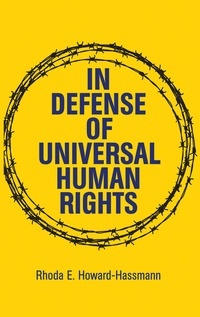
In Defense of Universal Human Rights
Description

In this book, renowned human rights scholar Rhoda E. Howard-Hassmann vigorously defends the universality of human rights, arguing that the entire range of rights is necessary for all individuals everywhere, regardless of sex, color, ethnicity, sexuality, religion or social class.
Howard-Hassmann grounds her defense of universality in her conception of human dignity, which she maintains must include personal autonomy, equality, respect, recognition, and material security. Only social democracies, she contends, can be considered fully rights-protective states. Taking issue with scholars who argue that human rights are "Western" quasi-imperialist impositions on states in the global South, and risk undermining community and social obligation, Howard-Hassmann explains how human rights support communities and can only be preserved if states and individuals observe their duties to protect them.
More details
Other editions
Additional editions
Content
2
Critical Perspectives on Human Rights
In this chapter I discuss several conceptual and theoretical challenges to the principle of universal human rights. These challenges include claims that human rights are a Western, imperialist venture; claims that human rights are overly abstract; claims that human rights are a "male" social construct; and claims that reliance on human rights undermines other ways of achieving social change. I defend universal human rights against all these criticisms. I leave to chapter 5 my discussion of claims that human rights undermine local cultures and communities, and to chapter 8 my discussion of claims about the hypocrisy of including human rights in Western aid and foreign policies.
Human Rights as Western Liberalism
Some critics have argued that human rights are an ethnocentric Western concept, an attempt to impose a liberal worldview and legal culture on the rest of the world.1 Others, while not arguing that the West is imperialist, nevertheless maintain that human rights advocates are actually promoting liberal democracy, as opposed to other types of political regimes.2
Human rights are indeed liberal at their core. They reflect liberal precepts of the dignity, autonomy, and equality of all human beings. The civil and political rights that are at the heart of the liberal worldview arose in Europe during rebellions against the arbitrary powers of monarchs and other rulers. Political activity intersected with philosophical speculations about the kind of social reforms Europeans wanted. Nevertheless, to equate the West with liberalism is to confuse regions with philosophies. Nor is this mere semantics. As long as the myth exists that "Western" human rights are merely civil and political, excluding economic and social human rights, then civil and political human rights are an easy target for ideologues and repressive political leaders in the global South. The "Western" position on human rights has included economic and social rights for more than 150 years, and Western states have provided the relevant social services in large part because citizens have exercised their civil and political rights to force them to do so.
Nevertheless, some critics confuse civil and political rights with all things Western. The postcolonial school of analysis argues that since the West (actually only some Western states) was engaged in the slave trade and colonialism at the same time as some people were advocating civil and political rights, such rights are therefore part of the slave-trading and colonialist ventures.3 The logic here appears to be that since human rights originated in the West, then all aspects of Western society are intertwined with them, rather than that human rights arose as criticisms of particular aspects of Western social and political practice, such as the slave trade. In effect, postcolonial theory argues that what was coterminous, occurring at the same period of time, was also synonymous; thus, postcolonial scholars confuse past violations of human rights with the rights themselves. The postcolonialist analysis also confuses past with present, ignoring the abolition of the slave trade two centuries ago and the effective end of colonialism 60 years ago.
Other critics argue that Western human rights discourse is bound up with the worldwide imposition of liberal economics and capitalism as an economic system. The logic in this criticism seems to be, again, that since human rights are Western, then all things Western incorporate human rights. Since capitalism originates in the West and liberal economics justify capitalism, then the function of human rights is actually to discipline the rest of the world to accept capitalism.4 Here again, critics ignore the potential of human rights as a means to curb the excesses of capitalism.
Other critics suggest that human rights are "neo"-liberal.5 Neoliberalism is an economic theory that maintains that the private sector, rather than government, is best positioned to create economic growth, and that growth rather than redistribution is the best way to ensure that everyone is economically secure. Neoliberalism and human rights are incompatible insofar as the former undermines government spending on such redistributive social services as health, education, and welfare. But human rights are not "neo"-liberal; they are relatively old principles rooted in centuries of liberal political thought and social and political activism, both by those seeking protection against government's arbitrary powers and by those seeking investment of government resources in collective goods such as health and education, and redistribution of collective assets to those unable to support themselves.
The liberal ideal of civil and political rights, combined with socialist ideals of redistribution and guaranteed provision of basic material needs, are attractive to people in all parts of the world, not only to Westerners. Yet denying credit, as it were, to Western philosophers and activists who advocate socialism provides ammunition to those who would reject human rights on the grounds that they are aspects of Western ideological imperialism. It is easier for dictatorial regimes to reject human rights if they can persuade their citizens that the ideology, purposes, and practices of human rights are foreign impositions, and that foreigners care not a whit for the material security of ordinary people in the global South. If civil and political rights are rejected because they are "Western," then non-Westerners who advocate them will be criticized for accepting "foreign" ideologies.
Some critics argue that the Universal Declaration of Human Rights was drafted entirely by Westerners. As I mentioned in chapter 1, this is an error: nine non-Western countries were represented in the drafting committee. Moreover, many non-Western states were involved in drafting later human rights documents. These states were particularly interested in the right to self-determination and economic human rights, and they fought vigorously against Western colonial states' attempts to exclude residents of colonies from the provisions of the UDHR. While some majority Muslim states wanted to limit the equality rights of women in marriage and individuals' right to change their religion, others were officially secular and strongly supported both women's rights and so-called "Western" civil and political rights.6
Nevertheless, Mark Goodale points out that two non-Western representatives in the core drafting committee of the UDHR, from pre-communist China and from Lebanon, were educated in the West, thus presumably affected by Western liberal propaganda.7 These individuals, however, could have come independently to their own conclusions about the value of human rights. It is patronizing to assume that non-Westerners educated in the West are mere passive recipients of the ideas to which they are exposed, rather than being as capable of independent thought as any Westerner would be. Some non-Westerners accept human rights, while others reject them, or change their minds when they are in positions of power in their own countries, just as Westerners do. Moyn argues that, Western or not, the individuals who drafted the UDHR were part of the "global diplomatic elite."8 While this is true of the drafters of UN documents, it does not mean that there is no pressure from below. Many individuals and organizations, including women's groups, anticolonial groups, and African Americans, lobbied for the passing of the UDHR.
The other aspect of the "Western" criticism is the contention that the global human rights regime is an imperialist venture. This does not mean strictly political imperialism; rather, it suggests a global moral imperialism whereby Westerners impose their human rights values on others, with the human rights regime assumed to be morally superior to any other system of social justice. Indeed, the Kenyan American scholar Makau Mutua is widely quoted as arguing that international human rights activists resemble Christian imperialists of the colonial era. He argues that such activists divide the world into "savages" (human rights violators) and "victims," with outside activists acting as saviors, just as Christian imperialists "saved" African populations from "savage" customs such as slavery and female genital mutilation (FGM).9
The Indian scholar Balakrishnan Rajagopal argues that the "Euro-American dominated view of human rights" sees them as a "post-WWII gift from the West" to the rest of the world.10 This imputation of imperialist motives to global human rights actors is without empirical foundation; it is possible that some think this way, but many others do not. Many people from the global South disagree with Mutua's assessment that Western human rights activists are imperialist "saviors." These individuals actively cooperate with international nongovernmental organizations, with the various UN agencies, and with foreign governments to improve human rights performance in their countries. They often consider the principles and philosophies of human rights to be liberating ideologies that they can use either as supplements to the belief systems of their home societies, or to transcend those beliefs when necessary.
Several scholars argue that human rights ought to stem from the bottom up, without being influenced by the Western universalist vision. Human...
