

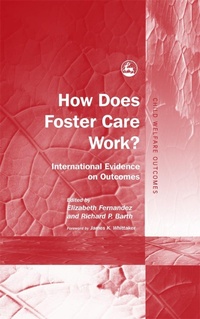
How Does Foster Care Work?
International Evidence on Outcomes
Jessica Kingsley Publishers
Published on 15. January 2011
320 pages
978-0-85700-389-8 (ISBN)
Description

How Does Foster Care Work? is an international collection of empirical studies on the outcomes of children in foster care. Drawing on research and perspectives from leading international figures in children's services across the developed world, the book provides an evidence base for programme planning, policy and practice.
This volume establishes a platform for comparison of international systems, trends and outcomes in foster care today. Each contributor provides a commentary on one other chapter to highlight the global significance of issues affecting children and young people in care. Each chapter offers new ideas about how foster care could be financed, delivered or studied in order to become more effective.
This book is important reading for anyone involved in delivering child welfare services, such as administrators, practitioners, researchers, policy makers, children's advocates, academics and students.
This volume establishes a platform for comparison of international systems, trends and outcomes in foster care today. Each contributor provides a commentary on one other chapter to highlight the global significance of issues affecting children and young people in care. Each chapter offers new ideas about how foster care could be financed, delivered or studied in order to become more effective.
This book is important reading for anyone involved in delivering child welfare services, such as administrators, practitioners, researchers, policy makers, children's advocates, academics and students.
Reviews / Votes
The authors conclude with the hope that the findings which are reflected in this volume have the potential to bring a greater understanding of the complex interplay of those factors that nurture or impede the well-being of children in care. They anticipate that it would impact positively on care planning, the provision of services, the development of policy and future research. We know that foster care works. This book may very well make it work better. -- Aotearoa New Zealand Social Work This is a must-read for any social worker who desire greater understanding of the theoretical principles and empirical evidence that undergird foster care today in a number of developed countries... We know that foster care works. This book may very well make it work better. -- Aotearoa New Zealand Social Work Each study scrupulously teases out the different variables affecting outcomes. The volume ends with a synthesis of research findings giving direction for policy, practice and research... My personal preference is for those studies that powerfully convey the experience of children, such as chapters by Fernandez on Growing up in Care and by Ward and Munro on Very Young Children in Care in England. The latter highlights the instability that was a feature for many infants, with 45 per cent having four or more placements. The consequences of placement disruption and instability on relationships, emotional and behavioural health, and education are a theme in a number of chapters. This mirrors recent findings in Hannon et al. . 2010 and gives even greater weight to the authors' call for measures to improve placement stability. Pecora et al. in their chapter on Rates of Emotional and Behavioural Disorders among Alumni of Family Foster Care in the United States make comprehensive recommendations for policy and practice to improve the mental and emotional health of young people in care, which I warmly commend. Various authors comment on both the positive and negative aspects of contact, with Farmer arguing persuasively In her chapter on Fostering Adolescents in England for differential approaches to contact decisions, to support grandparent contact and promote children's links with extended family members. The volume clearly demonstrates the value of studying fostering cross-nationally and will be of interest to policy makers, commissioners of care services, practitioners and researchers. -- Wiley Online Library, Child Abuse Review Foster care practice needs both an international perspective and an evidence base to allow us to learn and develop. This book supports both of these objectives. -- Children & Young People NowMore details
Series
Edition
Digital original
Language
English
Place of publication
London
United Kingdom
Target group
College/higher education
Professional and scholarly
Edition type
Digital original
Illustrations
55 tables, 16 figures
File size
8,26 MB
ISBN-13
978-0-85700-389-8 (9780857003898)
Copyright in bibliographic data and cover images is held by Nielsen Book Services Limited or by the publishers or by their respective licensors: all rights reserved.
Schweitzer Classification
Other editions
Additional editions
How Does Foster Care Work?
International Evidence on Outcomes
Book
07/2010
Jessica Kingsley Publishers
€86.50
Shipment within 15-20 days
Persons
Robbie Gilligan is Professor of Social Work and Social Policy at Trinity College Dublin and associate director of the Children's Research Centre. He has written extensively on child care and foster care.
Content
Part 1. Introduction. Foreword. James K. Whittaker, University of Washington, USA. Introduction: Reviewing International Evidence to Inform Foster Care Policy and Practice. Elizabeth Fernandez, University of New South Wales, Australia and Richard P. Barth, University of Maryland, USA. 1. International Perspectives on Foster Care. June Thoburn, University of East Anglia, UK. Part 2. Placement Movements and Destinations. 2. Five Year Developmental Outcomes for Young Children Remaining in Foster Care, Returned Home or Adopted. Richard P. Barth and Christopher Lloyd, University of Arkansas, USA. 3. The Placement Stability in Foster Care. Fred Wulczyn and Lijun Chen, University of Chicago, USA. 4. Foster Care in the Netherlands: Correlates of Placement Breakdown and Successful Placement. Johan Piet Strijker, University of Groningen, The Netherlands. 5. Profile and Scope of Foster Care in Spain. Jorge Fernandez del Valle and Monica Lopez, University of Oviedo, Spain. 6. Reunification in Australia: Insights from South Australia and New South Wales. Elizabeth Fernandez and Paul Delfabbro, University of Adelaide, Australia Part 3. The Foster Care Experience: A Life Course Perspective. 7. Very Young Children in Care in England: Issues for Foster Care. Harriet Ward and Emily R. Munro, Loughborough University, UK 8. Fostering Adolescents in England: What Contributes to Success? Elaine Farmer, University of Bristol, UK. 9. Rates of Mental, Emotional, and Behavioural Disorders Among Alumni of Family Foster Care in the United States: The Casey National Alumni Study. Peter J. Pecora, Catherine Roller White, Lee Ann Murdock, Kirk O'Brien, Casey Family Programs, USA, Ronald C. Kessler, Nancy Sampson and Irving Hwang Harvard Medical School, USA. Part 4. Psychological Outcomes and Correlates of Outcomes. 10. What Makes for Effective Foster Care: Some Issues. Ian Sinclair, University of York, UK. 11. Long-term Outcomes of Foster Care: Lessons from Swedish National Cohort Studies. Bo Vinnerljung, University of Stockholm, Sweden, Eva Franzen, Swedish Ministry of Health and Social Affairs, Sweden, Anders Hjern, National Board of Health and Welfare, Sweden and Frank Lindblad, Uppsala University, Sweden. 12. Foster Care in Denmark: Comparing Kinship and Non-Kinship Forms of Care. Lajla Knudsen, Tim Egelund and Anne-Dorthe Hestbaeck, SFI, The Danish National Centre for Social Research, Denmark. 13. Selected Educational Outcomes for Young People Aged 17-19 Years in Long Term Foster Care in Ireland. Fiona Daly, Irish Association of Young People in Care, Ireland and Robbie Gilligan, Trinity College Dublin, Ireland. 14. Can Tutoring by Foster Parents Improve Foster Children's Basic Academic Skills? A Canadian Randomized Field Trial. Robert J. Flynn, Marie-Pierre Paquet and Robyn Marquis, University of Ottawa, Canada. 15. Wellbeing in Foster Care: An Australian Longitudinal Study of Outcomes. Elizabeth Fernandez. Commentary by Robert Flynn. Conclusion. Richard P. Barth and Elizabeth Fernandez. List of Contributors. Index.
