

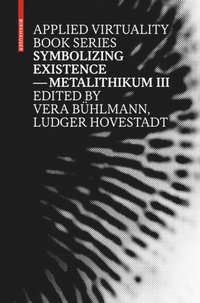
Symbolizing Existence
Description

Die Beiträge des Symposiums
Symbolizing Existence
folgen der immer rascher fortschreitenden "Deterritorialisierung" von Realität: Die Art und Weise, wie der soziale Raum mittlerweile informationstechnisch durchdrungen wird, stellt ein eigenartig a-territoriales Substrat dar, das für die Entwicklung eines digitalen Konstruktionsdenkens eine tragende Rolle spielt.
Denn heute erfasst und beschreibt ein elektronischer Code den gesamten Bereich dessen, was sich geometrisch, funktional und logisch darstellen lässt. Solche "Beschreibungen" etablieren in dem, was sie beschreiben, logistische Ordnungen: als Netze von vielwertigen Punkten, die sich unterschiedlich verbinden und verteilen lassen. Ein Punkt etwa kann hier nicht mehr länger als "das, was keine Teile hat" (Euklid) erachtet werden, sondern müsste, so der Fokus des Symposiums, als "das, was in reziproker Weise doppelt artikuliert ist", erachtet werden.
Ein interdisziplinäres Lesebuch für Architekten mit Interesse an Mathematik, Informatik, Geometrie - und an deren Bedeutung für aktuelle Entwicklungen des digitalen Entwerfens.
More details
Other editions
Additional editions
Persons
Content
- Intro
- Table of Contents
- On the book series
- Introduction - Symbolizing Existence
- I. A Scheme for a Fantastic Genealogy of the Articulable
- I. A Love Affair
- II. Speech Exercises in the Third Infinity
- III. A Genealogy of Learning to Speak
- IV. Understanding One Another
- V. The Algebraic Stage Schema
- VI. The Whole Point, O1 & O2
- VII. The Moving Point, I1 & I2
- VIII. The Mensurated Point, S1 & S2
- IX. The Rational Point, O2 & O3
- X. The Moving Point, I2 & I3
- XI. The Mensurated Point S2 & S3
- XII. The Complex Point O3 & O4
- II. Topologies of an Aesthetics of the Virtual in Music
- I. From Classical Composition to its Technical and Aesthetic Differentiation
- II. Foundations of Pyth agore an Space -Time Models in Music Theory
- III. The Mathematical Indexing of the World in Music
- IV. On Digital Beauty
- V. Hybrid Spheres-Between Analogue and Digital
- VI. Real Virtuality of Digital Composition
- IV. Non-Linear Structures in Musical Reality
- III. Media Metaphorology: Irritations in the Epistemic Field of Media Studies
- IV. From Pebbles to Digital Signs. The Joint Origin of Signs for Numbers and for Script - Their Intercult ural Standardization and Their Renewed Conjunction in the Digital Era
- I. Mesopotamia
- II. The Way to Effective Positional Systems
- III. Introd ucing the Metric System - Resistance to Universalization
- IV. The Digital Era
- V. Foucault, Boole, And Our Deleuzean Century
- I. Limit-experiences in The Order of Things
- II. Broaching Boole
- III. George Boole (1815-1864)
- IV. The Hapless Task (Continental and Analytical Philosophy)
- V. Waking Up: Our Deleuzean Century
- VI. A Mathematical Drama. Articulating a Thing Entirely in its Own Terms
- I. A Spectrograph
- II. The Spectrometer
- III. The Generic
- IV. Characterizations of The Generic
- V. Falling in Love With the In-Sinuousness Proper to an Economy of Entropy
- VI. The Master
- VII. Characterizations of The Master
- VIII. Acquiring a Body-to-Think-In
- IX. Masterpieces, and Why There Are so Few of Them
- VII. 'On the Baroque Line: the Mind-Body Problem' and the Art of Cryptography
- VIII. Nudged Viands
- I. The Cosmos
- II. The Realm
- III. The Machine
- IV. The Ecology
- V. The Obstacle
- VI. The Antenatal Prolific Mixture
- VII. The Discovery of a Castoff Viand
- VIII. The Quasi-Amalgamation of a Mob
- Image References
