

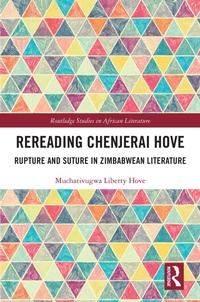
Rereading Chenjerai Hove
Rupture and Suture in Zimbabwean Literature
Published on 8. April 2026
204 pages
978-1-040-85045-9 (ISBN)
Description

This book assesses the life and works of leading Zimbabwean poet and novelist, Chenjerai Hove. Proposing a reading of Hove's work through the dual concepts of rupture and suture, this book investigates Hove's position as a writer in exile.
Described affectionately as 'Change' by his contemporaries, Hove's longing and desire for a free Zimbabwe runs through his works both in his first language, ChiShona, and in his second language, English. Whilst nationalist struggles promised a sense of suture from the wounds of colonialism, in the postcolonial period a new political elite introduced new ruptures, looting resources and flouting the rule of law. Hove's narratives of decolonisation, globalisation and indigenous becoming in his works point to these unfinished historical processes of rupture and suture, bringing in contrasting themes of beauty and ugliness, democracy and despotism, development and anarchy, independence and corruption. In deploying a framework of rupture and suture to Hove's work, this book disrupts fundamentalist frameworks suggesting a return to a pristine precolonial past and argues instead that the process of decolonising is relational and reflexive. Providing an important original analysis of Hove's work, this book also brings in comparisons with other writers in exile, arguing that displaced citizenship allows African writers to trouble the disjuncture in the nationalist and postcolonial project.
As such, this book will be an important read not only for researchers of Zimbabwean literature, but also scholars working on African and diasporic literature more widely.
Described affectionately as 'Change' by his contemporaries, Hove's longing and desire for a free Zimbabwe runs through his works both in his first language, ChiShona, and in his second language, English. Whilst nationalist struggles promised a sense of suture from the wounds of colonialism, in the postcolonial period a new political elite introduced new ruptures, looting resources and flouting the rule of law. Hove's narratives of decolonisation, globalisation and indigenous becoming in his works point to these unfinished historical processes of rupture and suture, bringing in contrasting themes of beauty and ugliness, democracy and despotism, development and anarchy, independence and corruption. In deploying a framework of rupture and suture to Hove's work, this book disrupts fundamentalist frameworks suggesting a return to a pristine precolonial past and argues instead that the process of decolonising is relational and reflexive. Providing an important original analysis of Hove's work, this book also brings in comparisons with other writers in exile, arguing that displaced citizenship allows African writers to trouble the disjuncture in the nationalist and postcolonial project.
As such, this book will be an important read not only for researchers of Zimbabwean literature, but also scholars working on African and diasporic literature more widely.
More details
Series
Language
English
Place of publication
London
United Kingdom
Publishing group
Taylor & Francis Ltd
Target group
College/higher education
Professional and scholarly
Illustrations
2 Tables, black and white
File size
5,80 MB
ISBN-13
978-1-040-85045-9 (9781040850459)
Copyright in bibliographic data and cover images is held by Nielsen Book Services Limited or by the publishers or by their respective licensors: all rights reserved.
Schweitzer Classification
Other editions
Additional editions
Book
approx. 04/2026
1st Edition
Routledge
€192.50
Not yet published
Person
Muchativugwa Liberty Hove is currently a Director in the Research Incubation Hub and Formerly Deputy Director in the School for Literature and Language Education and a Full Professor in English Language and Literature in English at North-West University, South Africa. He was formerly a Postdoctoral Research Fellow, University of Limpopo, South Africa.
Content
1. Setting and Unsettling the Cultural Context 2. Continuities and Disruptions in Chenjerai Hove's Poetry 3. Culture, nation and critique in Chenjerai Hove's essays 4. Imagining and Re-inventing the Nation Through the Novel and Auto/biography 5. Futuring a Southern Episteme; Curating Struggle and Memory 6. Connecting Narrative/s as Voicing Cultural and Epistemic Freedoms
