

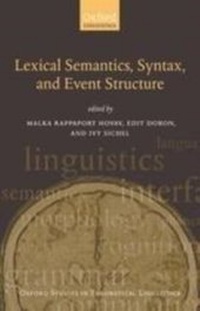
Lexical Semantics, Syntax, and Event Structure
1st Edition
Published on 25. February 2010
421 pages
978-0-19-157284-5 (ISBN)
Description

This book focuses on the linguistic representation of temporality in the verbal domain and its interaction with the syntax and semantics of verbs, arguments, and modifiers. Leading scholars explore the division of labour between syntax, compositional semantics, and lexical semantics in the encoding of event structure, encompassing event participants and the temporal properties associated with events. They examine the interface between event structure and the systems with which it interacts, including the interface between event structure and the syntactic realization of arguments and modifiers. Deploying a variety of frameworks and theoretical perspectives they consider central issues and questions in the field, among them whether argument-structure is specified in the lexical entries of verbs or syntactically constructed so that syntactic position determines thematic status, whether the hierarchical structure evidenced in argument structure find parallels in sign language, should the relation between members of an alternation pair, such as the causative-inchoative alternation, be understood lexically or derivationally, and the role of syntactic category in determining the configuration of argument structure.
More details
Other editions
Additional editions
Malka Rappaport Hovav | Edit Doron | Ivy Sichel
Lexical Semantics, Syntax, and Event Structure
Book
02/2010
Oxford University Press
€99.40
Shipment within 15-20 days
Malka Rappaport Hovav | Edit Doron | Ivy Sichel
Lexical Semantics, Syntax, and Event Structure
Book
02/2010
Oxford University Press
€110.60
Shipment within 15-20 days
Content
- Intro
- Contents
- General Preface
- Notes on Contributors
- 1. Introduction
- 1.1 Overview
- 1.2 Linguistic representations of event structure
- 1.3 Specific issues and the structure of the volume
- 1.3.1 Lexical representation
- 1.3.2 Argument structure and the compositional construction of predicates
- 1.3.3 Syntactic and semantic composition of event structure
- 1.4 A tribute to Professor Anita Mittwoch
- Part I: Lexical Representation
- 2. Reflections on Manner/Result Complementarity
- 2.1 Roots and event schemas
- 2.2 The lexicalization constraint
- 2.3 Refining the notions of manner and result
- 2.4 Manner and result as scalar and non-scalar changes
- 2.5 A motivation for the lexicalization constraint
- 2.6 The lexicalization constraint in a larger context
- 2.7 Concluding remarks
- 3. Verbs, Constructions, and Semantic Frames
- 3.1 Semantic frames: profile and background frame
- 3.2 Verbs
- 3.3 Previously proposed constraints on a verb meaning
- 3.4 Predications designated by combinations of verb and construction
- 3.5 Conclusion
- 4. Contact and Other Results
- 4.1 The theory of atoms
- 4.2 Alternating contact verbs
- 4.3 'Splash'-similar but different
- 4.4 Conclusion
- 5. The Lexical Encoding of Idioms
- 5.1 Defining properties of idioms
- 5.2 (Non-)compositionality
- 5.3 Structuring the lexicon
- 5.4 The lexical representation of idioms
- 5.5. Conclusion
- Part II: Argument Structure and the Compositional Construction of Predicates
- 6. The Emergence of Argument Structure in Two New Sign Languages
- 6.1 History and social settings of two new sign languages
- 6.2 Relevant aspects of sign language structure: referential system and verb agreement
- 6.3 Method: sentence production elicitation task
- 6.4 Emergence of argument structure: initial stages
- 6.5 Later developments: emergence of grammatical systems
- 6.6. Conclusion
- 7. Animacy in Blackfoot: Implications for Event Structure and Clause Structure
- 7.1 Blackfoot finals do not express event structure
- 7.2 Blackfoot finals do not express argument structure
- 7.3 Animacy, agency, and verb classification
- 7.4 Finals are light verbs (v)
- 7.5 Conclusion
- 8. Lexicon versus Syntax: Evidence from Morphological Causatives
- 8.1 Setting the stage
- 8.2 Two types of causatives
- 8.3 No access to syntactic structure
- 8.4 The formation of morphological causatives
- 9. On the Morphosyntax of (Anti)Causative Verbs
- 9.1 Setting the stage
- 9.2 Structures and morphological patterns of (anti)causatives
- 9.3 English de-transitivization processes
- 9.4 Productivity of the alternation
- 9.5 Conclusion
- 10. Saturated Adjectives, Reified Properties
- 10.1 The basic facts
- 10.2 The analysis
- 10.3 The broader relevance of R and SAT
- 10.4 Conclusion and further implications
- Part III: Syntactic and Semantic Composition of Event Structure
- 11. Incremental Homogeneity and the Semantics of Aspectual for-Phrases
- 11.1 Two problems
- 11.2 Previous accounts
- 11.3 Predicate types which allow modification by aspectual for-phrases
- 11.4 Our proposal
- 11.5 Accounting for the facts about aspectual for-phrases
- 12. Event Measurement and Containment
- 12.1 The length of atelic eventualities
- 12.2 Why no double measuring
- 12.3 The length of telic eventualities
- 12.4 Further peculiarities of telic adverbials
- 12.5 Comparison with the take construction
- 12.6 Conclusion
- 13. Draw
- 13.1 Drawing in Hungarian
- 13.2 Analysing draw
- 13.3 A comparison with Forbes (2003)
- 13.4 Conclusion
- 14. Morphological Aspect and the Function and Distribution of Cognate Objects Across Languages
- 14.1 Cognate objects across languages
- 14.2 Further ramifications
- 14.3 A solution
- 14.4 Conclusions
- 15. Locales
- 15.1 Licensing V1 with locales
- 15.2 What do locales license?
- 15.3 Back to locales
- 15.4 Licensing telicity with locales
- 15.5 Conclusion
- 16. Modal and Temporal Aspects of Habituality
- 16.1 Background: the perfective/imperfective aspectual operators
- 16.2 Habituality and aspect
- 16.3 The nature of retrospective habituals
- 16.4 The modal nature of habituality
- 16.5 The structure of habituality
- 16.6 Comparison with other analyses
- 16.7 Conclusion
- References
- Indexes
- Name Index
- A
- B
- C
- D
- E
- F
- G
- H
- I
- J
- K
- L
- M
- N
- O
- P
- Q
- R
- S
- T
- V
- W
- Z
- Index of Topics
- A
- B
- C
- D
- E
- F
- G
- H
- I
- K
- L
- M
- N
- P
- Q
- R
- S
- T
- U
- V
- W
- Index of Languages
