

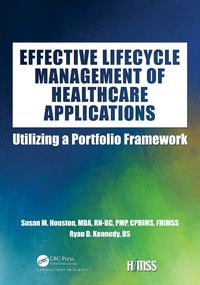
Effective Lifecycle Management of Healthcare Applications
Utilizing a Portfolio Framework
1st Edition
Published on 24. January 2020
172 pages
978-1-000-02608-5 (ISBN)
Description

The rapid growth of software applications within healthcare organizations has made it essential to have defined methodologies and formal processes for the management of the entire Information Technology (IT) portfolio. Utilizing a portfolio management framework throughout an application's lifecycle will provide the necessary structure to ensure that all new applications are properly evaluated, and, once implemented, remain relevant while continuing to meet organizational requirements.
While an organization may have a few large "organization-wide" systems such as the Electronic Health Record (EHR), lab or radiology systems, they also have a large quantity of other clinical, administrative, and research systems. Some larger organizations now have hundreds of software applications to support and manage. The IT staff must be able to implement new requests while still maintaining the current application portfolio. Utilizing a standard repeatable process will help to manage these large portfolios of software applications.
This book reviews the management of applications throughout their lifecycle, from initial request through disposition. Best practices dictate that every newly requested application undergoes analysis followed by an approval decision from the organization's governance committee. The initial implementation project must include activities to prepare for ongoing support while ensuring the application is compliant with all security, privacy, and architecture requirements. An application spends years in operations and maintenance where changes occur regularly through configuration and release management, or additional projects. The cycle continues until disposition. Understanding when to dispose of an application is just as important as deciding when to implement a new one. A defined process for disposing of an application ensures all parts are properly removed or destroyed.
While an organization may have a few large "organization-wide" systems such as the Electronic Health Record (EHR), lab or radiology systems, they also have a large quantity of other clinical, administrative, and research systems. Some larger organizations now have hundreds of software applications to support and manage. The IT staff must be able to implement new requests while still maintaining the current application portfolio. Utilizing a standard repeatable process will help to manage these large portfolios of software applications.
This book reviews the management of applications throughout their lifecycle, from initial request through disposition. Best practices dictate that every newly requested application undergoes analysis followed by an approval decision from the organization's governance committee. The initial implementation project must include activities to prepare for ongoing support while ensuring the application is compliant with all security, privacy, and architecture requirements. An application spends years in operations and maintenance where changes occur regularly through configuration and release management, or additional projects. The cycle continues until disposition. Understanding when to dispose of an application is just as important as deciding when to implement a new one. A defined process for disposing of an application ensures all parts are properly removed or destroyed.
More details
Series
Edition
1. Auflage
Language
English
Place of publication
London
United Kingdom
Publishing group
Taylor & Francis Ltd
Target group
Professional and scholarly
Illustrations
17 Tables, black and white; 10 Illustrations, black and white
File size
7,13 MB
ISBN-13
978-1-000-02608-5 (9781000026085)
Copyright in bibliographic data and cover images is held by Nielsen Book Services Limited or by the publishers or by their respective licensors: all rights reserved.
Schweitzer Classification
Other editions
Additional editions
Susan Houston | Ryan Kennedy
Effective Lifecycle Management of Healthcare Applications
Utilizing a Portfolio Framework
Book
02/2020
1st Edition
CRC Press
€167.13
Shipment within 15-20 days
Susan Houston | Ryan Kennedy
Effective Lifecycle Management of Healthcare Applications
Utilizing a Portfolio Framework
Book
02/2020
1st Edition
CRC Press
€72.00
Shipment within 15-20 days
Persons
Susan M. Houston is a senior consultant in healthcare IT after retiring as the Chief, Portfolio Office within the Department of Clinical Research Informatics at the National Institutes of Health Clinical Center. Her background includes clinical nursing, informatics, and project and portfolio management. Ms. Houston has presented at the local, regional, national and international levels. She has authored a variety of articles and books on project management and informatics. She is a member of Project Management Institute (PMI), American Nursing Informatics Association (ANIA), and the Healthcare Information and Management Systems Society (HIMSS), while serving on various committees.
Ryan D. Kennedy is the Chief of the Project and Portfolio Office at the National Institutes of Health, Clinical Center and an instructor for an IT Project Management course at the University of Maryland, School of Nursing. Mr. Kennedy's project work has contributed to the implementation of new clinical systems, infrastructure upgrades, and improved workflow processes. In addition, he has presented workshops and lectures at several national healthcare and project management conferences and has been a contributing author on multiple publications related to project and configuration management. His background includes 20 years of experience in configuration management and project management, spanning across multiple government agencies and hospital systems.
Ryan D. Kennedy is the Chief of the Project and Portfolio Office at the National Institutes of Health, Clinical Center and an instructor for an IT Project Management course at the University of Maryland, School of Nursing. Mr. Kennedy's project work has contributed to the implementation of new clinical systems, infrastructure upgrades, and improved workflow processes. In addition, he has presented workshops and lectures at several national healthcare and project management conferences and has been a contributing author on multiple publications related to project and configuration management. His background includes 20 years of experience in configuration management and project management, spanning across multiple government agencies and hospital systems.
Content
Acknowledgments
Authors
1 Introduction
2 Project Management Overview
3 New Application Request Management
4 Governance
5 Initial Implementation Project
6 Transition to Support
7 Operations and Maintenance
8 Application Disposition
Index
Authors
1 Introduction
2 Project Management Overview
3 New Application Request Management
4 Governance
5 Initial Implementation Project
6 Transition to Support
7 Operations and Maintenance
8 Application Disposition
Index
