

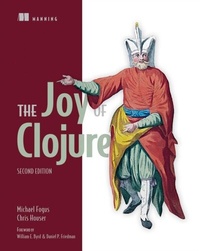
The Joy of Clojure
1st Edition
Published on 28. May 2014
520 pages
978-1-63835-128-3 (ISBN)
Description

Summary
The Joy of Clojure, Second Edition is a deep look at the Clojure language. Fully updated for Clojure 1.6, this new edition goes beyond just syntax to show you the "why" of Clojure and how to write fluent Clojure code. You'll learn functional and declarative approaches to programming and will master the techniques that make Clojure so elegant and efficient.
Purchase of the print book includes a free eBook in PDF, Kindle, and ePub formats from Manning Publications.
About the Technology
The Clojure programming language is a dialect of Lisp that runs on the Java Virtual Machine and JavaScript runtimes. It is a functional programming language that offers great performance, expressive power, and stability by design. It gives you built-in concurrency and the predictable precision of immutable and persistent data structures. And it's really, really fast. The instant you see long blocks of Java or Ruby dissolve into a few lines of Clojure, you'll know why the authors of this book call it a "joyful language." It's no wonder that enterprises like Staples are betting their infrastructure on Clojure.
About the Book
The Joy of Clojure, Second Edition is a deep account of the Clojure language. Fully updated for Clojure 1.6, this new edition goes beyond the syntax to show you how to write fluent Clojure code. You'll learn functional and declarative approaches to programming and will master techniques that make Clojure elegant and efficient. The book shows you how to solve hard problems related to concurrency, interoperability, and performance, and how great it can be to think in the Clojure way.
Appropriate for readers with some experience using Clojure or common Lisp.
What's Inside
About the Authors
Michael Fogus and Chris Houser are contributors to the Clojure and ClojureScript programming languages and the authors of various Clojure libraries and language features.
Table of Contents
The Joy of Clojure, Second Edition is a deep look at the Clojure language. Fully updated for Clojure 1.6, this new edition goes beyond just syntax to show you the "why" of Clojure and how to write fluent Clojure code. You'll learn functional and declarative approaches to programming and will master the techniques that make Clojure so elegant and efficient.
Purchase of the print book includes a free eBook in PDF, Kindle, and ePub formats from Manning Publications.
About the Technology
The Clojure programming language is a dialect of Lisp that runs on the Java Virtual Machine and JavaScript runtimes. It is a functional programming language that offers great performance, expressive power, and stability by design. It gives you built-in concurrency and the predictable precision of immutable and persistent data structures. And it's really, really fast. The instant you see long blocks of Java or Ruby dissolve into a few lines of Clojure, you'll know why the authors of this book call it a "joyful language." It's no wonder that enterprises like Staples are betting their infrastructure on Clojure.
About the Book
The Joy of Clojure, Second Edition is a deep account of the Clojure language. Fully updated for Clojure 1.6, this new edition goes beyond the syntax to show you how to write fluent Clojure code. You'll learn functional and declarative approaches to programming and will master techniques that make Clojure elegant and efficient. The book shows you how to solve hard problems related to concurrency, interoperability, and performance, and how great it can be to think in the Clojure way.
Appropriate for readers with some experience using Clojure or common Lisp.
What's Inside
- Build web apps using ClojureScript
- Master functional programming techniques
- Simplify concurrency
- Covers Clojure 1.6
About the Authors
Michael Fogus and Chris Houser are contributors to the Clojure and ClojureScript programming languages and the authors of various Clojure libraries and language features.
Table of Contents
- Clojure philosophy
- Drinking from the Clojure fire hose
- Dipping your toes in the pool
- On scalars
- Collection types
- Being lazy and set in your ways
- Functional programming
- Macros
- Combining data and code
- Mutation and concurrency
- Parallelism
- Java.next
- Why ClojureScript?
- Data-oriented programming
- Performance
- Thinking programs
- Clojure changes the way you think
More details
Other editions
Additional editions
Michael Fogus | Chris Houser
The Joy of Clojure
Book
06/2014
2nd Edition
Manning Publications
€47.00
Shipment within 10-20 days
Persons
Chris Houser is a software developer at LonoCloud. His lifelong passion for programming began when he was a child and drives him to continue learning and exploring new languages today. He's currently a primary contributor to Clojure and has implemented several features for the language.
Michael Fogus is a programmer in the DC area specializing in artificial intelligence, compilation, code generation, and distributed simulation systems. He is also a contributor to the Clojure and ClojureScript programming languages and author of various Clojure-contrib libraries.
Michael Fogus is a programmer in the DC area specializing in artificial intelligence, compilation, code generation, and distributed simulation systems. He is also a contributor to the Clojure and ClojureScript programming languages and author of various Clojure-contrib libraries.
Content
- Intro
- Copyright
- Brief Table of Contents
- Table of Contents
- Praise for the First Edition
- Foreword to the Second Edition
- Foreword to the First Edition
- Preface
- Acknowledgments
- About this Book
- About Clojure
- About the Cover Illustration
- Part 1. Foundations
- Chapter 1. Clojure philosophy
- Chapter 2. Drinking from the Clojure fire hose
- Chapter 3. Dipping your toes in the pool
- Part 2. Data types
- Chapter 4. On scalars
- Chapter 5. Collection types
- Part 3. Functional programming techniques
- Chapter 6. Being lazy and set in your ways
- Chapter 7. Functional programming
- Part 4. Large-scale design
- Chapter 8. Macros
- Chapter 9. Combining data and code
- Chapter 10. Mutation and concurrency
- Chapter 11. Parallelism
- Part 5. Host symbiosis
- Chapter 12. Java.next
- Chapter 13. Why ClojureScript?
- Part 6. Tangential considerations
- Chapter 14. Data-oriented programming
- Chapter 15. Performance
- Chapter 16. Thinking programs
- Chapter 17. Clojure changes the way you think
- Resources
- Index
- List of Figures
- List of Tables
- List of Listings
