

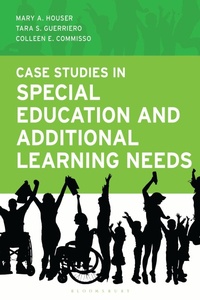
Case Studies in Special Education and Additional Learning Needs
1st Edition
Published on 5. February 2026
312 pages
979-8-216-39690-1 (ISBN)
Description

Case Studies in Special Education and Additional Learning Needs is an all-important resource containing 44 high quality case studies portraying students of different ages and abilities. Part I addresses both the disability categories under IDEA (e.g., learning disabilities and autism) and additional learning needs (e.g., impact of trauma, language and cultural differences, assistive technology, and gifted/talented). Part II exhibits case studies depicting processes and procedures associated with early intervention, collaboration, law, IEPs, student and parental rights, obtaining special education services, and accountability and documentation in the special education process.
More details
Series
Edition
1. Auflage
Language
English
Place of publication
United States
Publishing group
Bloomsbury Publishing Plc
Target group
College/higher education
Professional and scholarly
ISBN-13
979-8-216-39690-1 (9798216396901)
Copyright in bibliographic data and cover images is held by Nielsen Book Services Limited or by the publishers or by their respective licensors: all rights reserved.
Schweitzer Classification
Other editions
Additional editions
Mary A. Houser | Tara S. Guerriero | Colleen E. Commisso
Case Studies in Special Education and Additional Learning Needs
Book
approx. 04/2026
Bloomsbury Academic USA
€27.50
Not yet published
Persons
Dr. Mary Houser received a BFA in related arts from Kutztown University of Pennsylvania, an MAT in special education from the College of New Jersey, and an EdD in educational leadership from Fayetteville State University. She is currently a professor in the Department of Special Education at West Chester University of Pennsylvania. She teaches both undergraduate and graduate courses in foundations of special education, behavior management, autism spectrum disorder, language development, and family systems. Dr. Houser has also taught graduate special education courses for Walden University, where she served as a graduate special education curriculum developer and assessor. In addition, she has taught graduate special education courses and supervised pre-service teachers for Campbell University (NC). Dr. Houser has worked as a learning disabilities specialist and has taught high school special education in both inclusive and self-contained settings to children with various disabilities. Her research interests include families of students with autism spectrum disorders and improving school-home relationships for students with disabilities.
Dr. Tara Guerriero attended Northwestern University where she received her Ph.D. in Learning Disabilities, with a concentration in Cognitive Neuroscience. She also received her M.A. in Learning Disabilities and her B.S. in Communication Sciences and Disorders with a concentration in Learning Disabilities and a minor in Psychology from Northwestern University. She is currently a professor in the Department of Special Education at West Chester University of Pennsylvania. She teaches at the graduate and undergraduate level in the areas of foundations of Special Education, assessment, curriculum and instruction/methodology, family systems, and communication/language development and assistive technology. Dr. Guerriero was certified as a Special Education Teacher in the state of Pennsylvania, as well as a Learning Behavior Specialist in Learning Disabilities in the state of Illinois. She was both a clinician and supervisor in a learning clinic at Northwestern University, where she provided remediation for children with learning disabilities and conducted psycho-educational evaluations of children and adults for the purpose of identifying and diagnosing learning disabilities. Dr. Guerriero's research interests include assessment in special education, inclusive practices associated with special education, and both assessment and teaching within the areas of mathematics and reading in the field of learning disabilities.
Dr. Colleen Commisso received a BS in Special Education (PK-12) and Elementary Education (K-6) and a certification in Secondary English (7-12) from Bloomsburg University. She also received an MS in Special Education and a Supervisory Certificate from Bloomsburg University and her PhD in Special Education from Lehigh University. She is currently an Assistant Professor at West Chester University of Pennsylvania. She teaches both undergraduate and graduate courses in foundations of special education, behavior management, trauma-informed practices, and supervises student teachers. Her research interests include brain-based approaches to support students who have experienced trauma, educational practices for pre-service teachers, and interventions for students who engage in problem behaviors.
Dr. Tara Guerriero attended Northwestern University where she received her Ph.D. in Learning Disabilities, with a concentration in Cognitive Neuroscience. She also received her M.A. in Learning Disabilities and her B.S. in Communication Sciences and Disorders with a concentration in Learning Disabilities and a minor in Psychology from Northwestern University. She is currently a professor in the Department of Special Education at West Chester University of Pennsylvania. She teaches at the graduate and undergraduate level in the areas of foundations of Special Education, assessment, curriculum and instruction/methodology, family systems, and communication/language development and assistive technology. Dr. Guerriero was certified as a Special Education Teacher in the state of Pennsylvania, as well as a Learning Behavior Specialist in Learning Disabilities in the state of Illinois. She was both a clinician and supervisor in a learning clinic at Northwestern University, where she provided remediation for children with learning disabilities and conducted psycho-educational evaluations of children and adults for the purpose of identifying and diagnosing learning disabilities. Dr. Guerriero's research interests include assessment in special education, inclusive practices associated with special education, and both assessment and teaching within the areas of mathematics and reading in the field of learning disabilities.
Dr. Colleen Commisso received a BS in Special Education (PK-12) and Elementary Education (K-6) and a certification in Secondary English (7-12) from Bloomsburg University. She also received an MS in Special Education and a Supervisory Certificate from Bloomsburg University and her PhD in Special Education from Lehigh University. She is currently an Assistant Professor at West Chester University of Pennsylvania. She teaches both undergraduate and graduate courses in foundations of special education, behavior management, trauma-informed practices, and supervises student teachers. Her research interests include brain-based approaches to support students who have experienced trauma, educational practices for pre-service teachers, and interventions for students who engage in problem behaviors.
Content
Preface
Acknowledgements of Additional Contributors
General Acknowledgements
Characteristics Matrix
Part I: Case Studies by Disability and Additional Learning Need Categories
Introduction to Part I
Chapter One: Assistive Technology
Chapter Two: Attention-Deficit Hyperactivity Disorder
Chapter Three: Autism Spectrum Disorder
Chapter Four: Culturally and Linguistically Diverse Exceptional Learners
Chapter Five: Developmental Delay
Chapter Six: Emotional Disturbance
Chapter Seven: Gifted and Talented
Chapter Eight: Intellectual Disability
Chapter Nine: Learning Disability
Chapter Ten: Multiple Disabilities
Chapter Eleven: Other Health Impairment: Epilepsy
Chapter Twelve: Orthopedic Impairment: Cerebral Palsy
Chapter Thirteen: Sensory Impairments
Chapter Fourteen: Speech or Language Impairment
Chapter Fifteen: Trauma-Informed Practice
Chapter Sixteen: Traumatic Brain Injury
Part II: Case Studies by Special Education Topic
Introduction to Part II
Chapter Seventeen: Laws
Chapter Eighteen: Individualized Education Programs (IEPs)
Chapter Nineteen: Early Intervention (EI) and Individualized Family Service Plans (IFSP)
Chapter Twenty: Collaboration and Inclusive Practices
About the Authors
Acknowledgements of Additional Contributors
General Acknowledgements
Characteristics Matrix
Part I: Case Studies by Disability and Additional Learning Need Categories
Introduction to Part I
Chapter One: Assistive Technology
Chapter Two: Attention-Deficit Hyperactivity Disorder
Chapter Three: Autism Spectrum Disorder
Chapter Four: Culturally and Linguistically Diverse Exceptional Learners
Chapter Five: Developmental Delay
Chapter Six: Emotional Disturbance
Chapter Seven: Gifted and Talented
Chapter Eight: Intellectual Disability
Chapter Nine: Learning Disability
Chapter Ten: Multiple Disabilities
Chapter Eleven: Other Health Impairment: Epilepsy
Chapter Twelve: Orthopedic Impairment: Cerebral Palsy
Chapter Thirteen: Sensory Impairments
Chapter Fourteen: Speech or Language Impairment
Chapter Fifteen: Trauma-Informed Practice
Chapter Sixteen: Traumatic Brain Injury
Part II: Case Studies by Special Education Topic
Introduction to Part II
Chapter Seventeen: Laws
Chapter Eighteen: Individualized Education Programs (IEPs)
Chapter Nineteen: Early Intervention (EI) and Individualized Family Service Plans (IFSP)
Chapter Twenty: Collaboration and Inclusive Practices
About the Authors
