

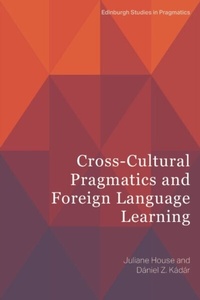
Cross-Cultural Pragmatics and Foreign Language Learning
Description

Cross-Cultural Pragmatics and Foreign Language Learning provides a new ground-breaking approach to the study of second language learning through the lens of cross-cultural pragmatics. Cross-cultural pragmatics involves the use of contrastive linguistic research, supported by a variety of methodologies such as surveys, interviews and discourse completion tests. A key strength of the speech act-centred interactional framework proposed is that it allows the reader to understand difficulties faced by foreign language learners through pragmatic evidence. An important advantage of this approach is that it consistently avoids ideological pre-assumptions and related overgeneralisations. The book presents the framework in a highly accessible and reader-friendly way and illustrates how to put this framework to use with a number of case studies. The authors are internationally leading experts of pragmatics and applied linguistics whose work is a must-read for both academics and students focusing on applied linguistics and second language learnings.
More details
Other editions
Additional editions
Persons
Content
- Cover
- Half Title
- Dedication
- Title Page
- Copyright
- Contents
- List of figures and tables
- About the authors
- Acknowledgements
- Series introduction
- 1 Introduction
- 1.1 Background
- 1.2 Conventions
- 1.3 Contents
- 1.4 Recommended reading
- 2 The foundations of cross-cultural pragmatics
- 2.1 Introduction
- 2.2 The development of cross-cultural pragmatics
- 2.2.1 The birth of cross-cultural pragmatics
- 2.2.2 The CCSARP project
- 2.3 The basics of cross-cultural pragmatics
- 2.4 What makes pragmatic contrasting possible?
- 2.5 Conclusion
- 2.6 Recommended reading
- 3 Our contrastive pragmatic framework and its use in L2 pragmatics
- 3.1 Introduction
- 3.2 Our framework
- 3.3 Pitfalls in previous L2 pragmatic research
- 3.4 Our interactional typology of speech acts
- 3.5 Research procedure
- 3.6 Conclusion
- 3.7 Recommended reading
- 4 Exploring speech acts through expressions in L2 pragmatics
- 4.1 Introduction
- 4.2 Selected previous studies
- 4.3 Analytic procedure
- 4.3.1 The corpus-based study of RFIEs
- 4.3.2 The L2 pragmatic study of RFIEs
- 4.4 Conclusion
- 4.5 Recommended reading
- 5 On the problem of altered speech act indication in L2 pragmatics
- 5.1 Introduction
- 5.2 The first phase of our research
- 5.3 The second phase of our research
- 5.3.1 Analysis and results
- 5.4 Conclusion
- 5.5 Recommended reading
- 6 Speech acts and interactional acts 1: the case of criticising
- 6.1 Introduction
- 6.2 Selected previous studies
- 6.3 Methodology and data
- 6.3.1 Part 1
- 6.3.2 Part 2
- 6.4 Analysis
- 6.4.1 Part 1
- 6.4.2 Part 2
- 6.5 Conclusion
- 6.6 Recommended reading
- 7 Speech acts and interactional acts 2: the case of ritual congratulating
- 7.1 Introduction
- 7.2 Selected previous studies
- 7.3 Methodology and data
- 7.4 Analysis
- 7.4.1 Results of the Chinese DCTs
- 7.4.2 Results of the learner DCTs
- 7.5 Conclusion
- 7.6 Recommended reading
- 8 Types of Talk in L2 pragmatics 1: greeting in English as a foreign language
- 8.1 Introduction
- 8.2 Selected previous research
- 8.3 Methodology and data
- 8.3.1 Step 1
- 8.3.2 Step 2
- 8.4 Analysis
- 8.4.1 Step 1
- 8.4.2 Step 2
- 8.5 Conclusion
- 8.6 Recommended reading
- 9 Types of Talk in L2 pragmatics 2: the case of extracting
- 9.1 Introduction
- 9.2 Case study
- 9.2.1 Contrastive research
- 9.2.2 Discussion
- 9.3 Conclusion
- 9.4 Recommended reading
- 10 Types of Talk in L2 pragmatics 3: the case of phatic Opening versus Business Talk
- 10.1 Introduction 165
- 10.2 Case study
- 10.2.1 Experiment
- 10.2.2 Outcome
- 10.3 Conclusion
- 10.4 Recommended reading
- 11 Conclusion
- 11.1 Retrospect
- 11.2 Prospect
- Glossary
- References
- Index
