

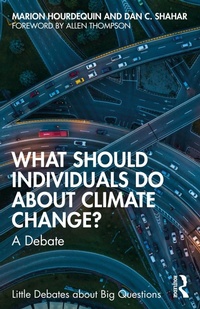
What Should Individuals Do about Climate Change?
A Debate
1st Edition
Published on 10. June 2025
222 pages
978-1-040-35111-6 (ISBN)
Description

Climate change is a pressing problem. Does each of us have a moral responsibility to help tackle it? In this volume, Marion Hourdequin and Dan Shahar debate the timely issue of individual behavior and climate change, examining what it takes to live morally in a warming world.
Hourdequin argues there are important reasons for people to translate their concerns about climate change into actions in their personal lives. This includes attending to the many ways a single individual can help catalyze systemic change through choices about voting and political participation, food and clothing, energy use, travel, and so on. Shahar disagrees because he endorses moral specialization and division of labor in a world filled with many problems. He argues we should not expect everyone to take action on every serious issue: rather, it is acceptable and even desirable for people to focus on certain issues and decline to act on others - including climate change. The two authors take turns responding to each other and then defending their ultimate conclusions. This volume is sure to draw attention to the question of "individual choice" in climate change debates and to help clarify some of the best thinking on this issue.
Key Features:
Refocuses attention from big-picture debates over the actions of nations and corporations to more tractable questions about individual choices
Examines whether there are good reasons to structure our daily lives to reduce our impacts on the climate
Explores whether it would be best if individuals became "moral specialists" by focusing on a small number of problems while declining to act on many others
Is highly accessible, with clear language and an easy-to-follow format
Provides a glossary of key terms that are bolded in the main text
Includes section summaries that give an overview of the main arguments and a comprehensive bibliography for further reading
Hourdequin argues there are important reasons for people to translate their concerns about climate change into actions in their personal lives. This includes attending to the many ways a single individual can help catalyze systemic change through choices about voting and political participation, food and clothing, energy use, travel, and so on. Shahar disagrees because he endorses moral specialization and division of labor in a world filled with many problems. He argues we should not expect everyone to take action on every serious issue: rather, it is acceptable and even desirable for people to focus on certain issues and decline to act on others - including climate change. The two authors take turns responding to each other and then defending their ultimate conclusions. This volume is sure to draw attention to the question of "individual choice" in climate change debates and to help clarify some of the best thinking on this issue.
Key Features:
Refocuses attention from big-picture debates over the actions of nations and corporations to more tractable questions about individual choices
Examines whether there are good reasons to structure our daily lives to reduce our impacts on the climate
Explores whether it would be best if individuals became "moral specialists" by focusing on a small number of problems while declining to act on many others
Is highly accessible, with clear language and an easy-to-follow format
Provides a glossary of key terms that are bolded in the main text
Includes section summaries that give an overview of the main arguments and a comprehensive bibliography for further reading
Reviews / Votes
"The authors agree that climate change is a serious problem and there are many ways people can appropriately respond; they disagree about the threat posed by climate change, the relevant moral normativity, and I think, ultimately, about ethics and the constitution of a person's ethical agency. In the end, both positions are reasonable. There's no crucial error to be found here, on one side or the other. Taking a side in this debate, it seems, is to hold one of two competing ways to think about who we are and the best ways to respond to problems posed by climate change."- Allen Thompson, from the Foreword "The authors agree that climate change is a serious problem and there are many ways people can appropriately respond; they disagree about the threat posed by climate change, the relevant moral normativity, and I think, ultimately, about ethics and the constitution of a person's ethical agency. In the end, both positions are reasonable. There's no crucial error to be found here, on one side or the other. Taking a side in this debate, it seems, is to hold one of two competing ways to think about who we are and the best ways to respond to problems posed by climate change."
- Allen Thompson, from the Foreword
More details
Series
Edition
1. Auflage
Language
English
Place of publication
London
United Kingdom
Publishing group
Taylor & Francis Ltd
Target group
College/higher education
File size
10,25 MB
ISBN-13
978-1-040-35111-6 (9781040351116)
Copyright in bibliographic data and cover images is held by Nielsen Book Services Limited or by the publishers or by their respective licensors: all rights reserved.
Schweitzer Classification
Other editions
Additional editions
Book
06/2025
1st Edition
Routledge
€205.10
Shipment within 15-20 days
Book
06/2025
1st Edition
Routledge
€56.70
Shipment within 15-20 days
Persons
Marion Hourdequin is a Professor of Philosophy at Colorado College whose work focuses on environmental philosophy, climate ethics, and relational ethics. She is the author of Environmental Ethics: From Theory to Practice (2nd edition, 2024) and co-editor, with David Havlick, of Restoring Layered Landscapes (2016). She served as President of the International Society for Environmental Ethics from 2022 to 2024, and she is an Associate Editor for the journal Environmental Ethics.
Dan C. Shahar is MBA Program Director and a Teaching Assistant Professor at West Virginia University. His research explores the moral and political dimensions of humanity's relationship with the natural world. He is the author of Why It's OK to Eat Meat (Routledge, 2021), co-editor (with David Schmidtz) of Environmental Ethics: What Really Matters, What Really Works (3rd edition, 2018), and author of over a dozen journal articles and book chapters.
Allen Thompson is Associate Professor of Ethics and Environmental Philosophy at Oregon State University.
Dan C. Shahar is MBA Program Director and a Teaching Assistant Professor at West Virginia University. His research explores the moral and political dimensions of humanity's relationship with the natural world. He is the author of Why It's OK to Eat Meat (Routledge, 2021), co-editor (with David Schmidtz) of Environmental Ethics: What Really Matters, What Really Works (3rd edition, 2018), and author of over a dozen journal articles and book chapters.
Allen Thompson is Associate Professor of Ethics and Environmental Philosophy at Oregon State University.
Content
Opening Statements 1. Opening Statement: Why Individual Emissions Matter - Marion Hourdequin 2. Opening Statement: Facing our Limits - Dan C. Shahar Replies 3. Reply to Shahar: The Pervasiveness of Climate Change Provides Reasons and Opportunities to Act - Marion Hourdequin 4. Reply to Hourdequin: Defending Specialization and Division of Moral Labor - Dan C. Shahar Concluding Statements 5. Closing Statement: Individual Actions Matter for Climate Change - Marion Hourdequin 6. Closing Statement: Embracing Diversity among Altruists - Dan C. Shahar
