

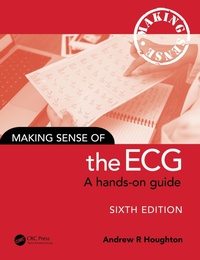
Making Sense of the ECG
A Hands-On Guide
6th Edition
Published on 23. January 2025
286 pages
978-1-040-22577-6 (ISBN)
Description

Interpreting an ECG correctly and working out what to do next can seem like a daunting task to the non-specialist, yet it is a skill that will be invaluable to any doctor, nurse or paramedic when evaluating the condition of a patient.
Making Sense of the ECG has been written specifically with this in mind and, across multiple editions, has helped students and more experienced healthcare practitioners to identify and answer crucial questions, including:
Are these abnormalities significant?
How do I distinguish between VT and SVT?
Does this patient have an acute coronary syndrome?
How do I measure the QT interval?
Should I refer this patient to a cardiologist?
This popular, easy-to-read and easy-to-remember guide to the ECG as a tool for diagnosis and management has been fully updated in its sixth edition to reflect the latest guidelines, with new chapters added: 'Reading an ECG Recording' and 'Ten ECGs Not to Miss'.
Key features:
Real ECGs - with annotation throughout to highlight key features and new examples included
Strong clinical emphasis - for rapid reference in the emergency department, ward or outpatient setting with increased focus on urgency of action required
Enhanced summaries and improved tip boxes - for speedy access to key info and advice when to act quickly or seek help
New to this edition - reading an ECG recording from first principles added, ten ECG abnormalities with the most serious clinical consequences if missed or misdiagnosed flagged, more detail on 'normal' heart rates, cardiac activation and conduction, optimal electrode placement, updated guidance on acute coronary syndromes and cardiopulmonary resuscitation and improved relevance for pre-hospital care
Pair with Making Sense of the ECG: Cases for Self Assessment, Third Edition, for the complete ECG learning and revision package!
Making Sense of the ECG has been written specifically with this in mind and, across multiple editions, has helped students and more experienced healthcare practitioners to identify and answer crucial questions, including:
Are these abnormalities significant?
How do I distinguish between VT and SVT?
Does this patient have an acute coronary syndrome?
How do I measure the QT interval?
Should I refer this patient to a cardiologist?
This popular, easy-to-read and easy-to-remember guide to the ECG as a tool for diagnosis and management has been fully updated in its sixth edition to reflect the latest guidelines, with new chapters added: 'Reading an ECG Recording' and 'Ten ECGs Not to Miss'.
Key features:
Real ECGs - with annotation throughout to highlight key features and new examples included
Strong clinical emphasis - for rapid reference in the emergency department, ward or outpatient setting with increased focus on urgency of action required
Enhanced summaries and improved tip boxes - for speedy access to key info and advice when to act quickly or seek help
New to this edition - reading an ECG recording from first principles added, ten ECG abnormalities with the most serious clinical consequences if missed or misdiagnosed flagged, more detail on 'normal' heart rates, cardiac activation and conduction, optimal electrode placement, updated guidance on acute coronary syndromes and cardiopulmonary resuscitation and improved relevance for pre-hospital care
Pair with Making Sense of the ECG: Cases for Self Assessment, Third Edition, for the complete ECG learning and revision package!
More details
Series
Edition
6th edition
Language
English
Place of publication
London
United Kingdom
Publishing group
Taylor & Francis Ltd
Target group
College/higher education
Professional and scholarly
Illustrations
29 Tables, black and white; 14 Line drawings, color; 43 Line drawings, black and white; 154 Halftones, color; 168 Illustrations, color; 43 Illustrations, black and white
ISBN-13
978-1-040-22577-6 (9781040225776)
Copyright in bibliographic data and cover images is held by Nielsen Book Services Limited or by the publishers or by their respective licensors: all rights reserved.
Schweitzer Classification
Other editions
Additional editions
Book
01/2025
6th Edition
CRC Press
€30.00
Shipment within 10-20 days
Book
01/2025
6th Edition
CRC Press
€227.50
Shipment within 10-20 days

Book
01/2025
CRC Press
Unfortunately, price unknown
Available (delivery time upon request)
Person
Dr Andrew R Houghton MA(Oxon), DM, BM BCh, FRCP (Lond) studied medicine at the University of Oxford and undertook postgraduate training in cardiology in Nottingham and Leicester. He has also trained at Stanford University in California and at the Mayo Clinic in Minnesota. He was appointed as a consultant cardiologist at the United Lincolnshire Hospitals NHS Trust, UK, in 2002. His subspecialty interest is in cardiac imaging (echocardiography and cardiovascular MRI). He is a fellow of the Royal College of Physicians (London). He has published several textbooks in cardiology, including Making Sense of the ECG (winner of the Royal Society of Medicine's Richard Asher Prize and the BMA's Student Textbook Award), Making Sene of the ECG: Cases for Self Assessment and Making Sense of Echocardiography (Highly Commended at the BMA's Medical Book Awards).
Content
Preface to the sixth edition.
About the author.
Acknowledgements.
1. Anatomy and physiology. 2. PQRST: Where the waves come from. 3. Performing an ECG recording. 4. Reading an ECG recording. 5. Heart rate. 6. An approach to heart rhythms. 7. The axis. 8. The P wave. 9. The PR interval. 10. The Q wave. 11. The QRS complex. 12. The ST segment. 13. The T wave. 14. The QT interval. 15. The U wave. 16. Artefacts on the ECG. 17. Supraventricular rhythms. 18. Ventricular rhythms. 19. Conduction problems. 20. Reporting an ECG recording. 21. ECG interpretation in athletes. 22. Cardiac implantable electronic devices. 23. Ambulatory ECG recording. 24. Exercise ECG testing. 25. Ten ECGs not to miss.
Appendix 1: Glossary
Appendix 2: ECG resources
Index.
About the author.
Acknowledgements.
1. Anatomy and physiology. 2. PQRST: Where the waves come from. 3. Performing an ECG recording. 4. Reading an ECG recording. 5. Heart rate. 6. An approach to heart rhythms. 7. The axis. 8. The P wave. 9. The PR interval. 10. The Q wave. 11. The QRS complex. 12. The ST segment. 13. The T wave. 14. The QT interval. 15. The U wave. 16. Artefacts on the ECG. 17. Supraventricular rhythms. 18. Ventricular rhythms. 19. Conduction problems. 20. Reporting an ECG recording. 21. ECG interpretation in athletes. 22. Cardiac implantable electronic devices. 23. Ambulatory ECG recording. 24. Exercise ECG testing. 25. Ten ECGs not to miss.
Appendix 1: Glossary
Appendix 2: ECG resources
Index.
