

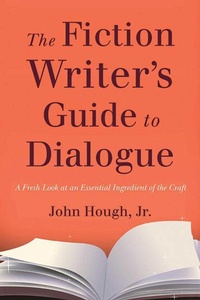
The Fiction Writer's Guide to Dialogue
A Fresh Look at an Essential Ingredient of the Craft
Published on 17. February 2015
144 pages
978-1-62153-449-5 (ISBN)
Description

Dialogue is often overlooked as a necessary and potent instrument in the novelist's repertoire. A novel can rise or fall on the strength of its dialogue. Superb dialogue can make a superb novel. F. Scott Fitzgerald wrote, "Action is character.? George V. Higgins said, "Dialogue is character.? They were both right, because dialogue is action. It comprises much, if not all, of the clarifying drama of any novel. How much physical action can there be in 300 pages, even in a crime novel or a thriller? And all conflict, even physical, begins as dialogue.
Hough explains how dialogue can reveal a character's nature as well as his or her defining impulses and emotions. He says there must be tension in every colloquy in fiction, and shows the reader ways to achieve it. Hough illustrates his precepts with examples from his own work and from that of the best modern writers of dialogue, including Cormac McCarthy, Kent Haruf, Joan Didion, Annie Proulx, Lee Smith, Elmore Leonard, George V. Higgins, William Kennedy and Howard Frank Mosher. He cites early 20th century writers who refined and advanced dialogue as an art form: Ernest Hemingway, Ring Lardner, Dorothy Parker, and William Saroyan.
Hough's novel Seen the Glory: A Novel of the Battle of Gettysburg was praised by Lee Smith as containing "the best dialogue of the period I have ever read.? Hough on Dialogue will give writers and aspiring writers a fresh look at one of the essential ingredients of their craft.
Allworth Press, an imprint of Skyhorse Publishing, publishes a broad range of books on the visual and performing arts, with emphasis on the business of art. Our titles cover subjects such as graphic design, theater, branding, fine art, photography, interior design, writing, acting, film, how to start careers, business and legal forms, business practices, and more. While we don't aspire to publish a New York Times bestseller or a national bestseller, we are deeply committed to quality books that help creative professionals succeed and thrive. We often publish in areas overlooked by other publishers and welcome the author whose expertise can help our audience of readers.
Hough explains how dialogue can reveal a character's nature as well as his or her defining impulses and emotions. He says there must be tension in every colloquy in fiction, and shows the reader ways to achieve it. Hough illustrates his precepts with examples from his own work and from that of the best modern writers of dialogue, including Cormac McCarthy, Kent Haruf, Joan Didion, Annie Proulx, Lee Smith, Elmore Leonard, George V. Higgins, William Kennedy and Howard Frank Mosher. He cites early 20th century writers who refined and advanced dialogue as an art form: Ernest Hemingway, Ring Lardner, Dorothy Parker, and William Saroyan.
Hough's novel Seen the Glory: A Novel of the Battle of Gettysburg was praised by Lee Smith as containing "the best dialogue of the period I have ever read.? Hough on Dialogue will give writers and aspiring writers a fresh look at one of the essential ingredients of their craft.
Allworth Press, an imprint of Skyhorse Publishing, publishes a broad range of books on the visual and performing arts, with emphasis on the business of art. Our titles cover subjects such as graphic design, theater, branding, fine art, photography, interior design, writing, acting, film, how to start careers, business and legal forms, business practices, and more. While we don't aspire to publish a New York Times bestseller or a national bestseller, we are deeply committed to quality books that help creative professionals succeed and thrive. We often publish in areas overlooked by other publishers and welcome the author whose expertise can help our audience of readers.
More details
Other editions
Additional editions
John Hough
The Fiction Writer's Guide to Dialogue
A Fresh Look at an Essential Ingredient of the Craft
Book
03/2015
Allworth Press,U.S.
€19.00
Shipment within 3-4 weeks
Person
John Hough, Jr. grew up on Cape Cod and graduated from Haverford College. He is the author of six novels, including Seen the Glory: A Novel of the Battle of Gettysburg, winner of the 2010 W. Y. Boyd Aware for excellence in military fiction from the American Library Association, and Little Bighorn (Arcade 2014). Mr. Hough teaches creative writing at his home on Martha's Vineyard and in the island's Adult Community Education program. For many years he taught dialogue at SEAK, Inc. fiction writing conferences. He lives with his wife in West Tisbury.
Content
- Intro
- Title Page
- Copyright
- Contents
- Introduction: Dialogue is Character
- 1: The Mechanics of Dialogue: Tags, Talking Verbs, and Punctuation
- Dialogue Tags and When to Use Them
- The Wisdom of Elmore Leonard and the Talking Verbs
- Avoiding Adverbs to Modify "Said"
- Italics in Dialogue
- Exclamation Points
- Quotation Marks: They're Optional
- 2: How Art Does not Imitate Life
- The Watergate Tapes-Why Real Conversation Makes for Poor Reading
- Keeping It Short and Sweet
- When Short and Sweet Isn't Enough
- Keeping It Unreal: Avoiding the Quirks, Tics, and Habits of Real Life
- Omitting Greetings and Salutations
- Phone Conversations
- When and How to Use Repetition
- Conveying Hesitation or Halting Speech without Interjections
- The Paradox of Good Dialogue
- The Writer as Hoarder-Where the Pickings Are Good
- 3: Tension: Surprise in Every Line
- When Lovers Talk
- Keeping an Imbalance Between Friends
- When the Tension Is High
- Keeping the Suspense in Monologues
- 4: Hearing is Seeing
- Voice as Physical Description
- Evoking Facial Expression
- Film Dialogue vs. Dialogue on the Page
- 5: Choreography and Description and Their Relationship to Dialogue
- Interrupting Dialogue to Keep a Character's Physical Appearance Front and Center
- Interrupting Dialogue to Create a Needed Pause
- Interrupting Dialogue to Stop Time
- 6: Telling Story Through Dialogue
- The First Person Narrative of Conrad's Charley Marlow
- The Henry Wiggen Novels: a Storyteller's Dialogue with a Difference
- Multiple Storytellers
- Plausible Dialogue as Narrative: The Ordinary Storyteller
- Taking Exposition out of Dialogue
- Indirect Discourse
- 7: Dialect, Accents, and the Vernacular
- Imparting Dialect
- Indicating Foreign Accents
- Using the Vernacular
- Conveying Regional Patois
- To Curse or Not to Curse
- 8: Great Lines: Why i Love to Write Dialogue
- List of Works Cited
- Index
