

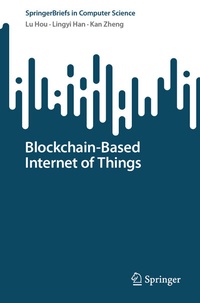
Blockchain-Based Internet of Things
Description

This book focuses on the integration of blockchain technology for IoT systems, exploring the methodologies behind each component of the system to bolster the data security and protect privacy. It also discusses the essential algorithms necessary for the efficient implementation of blockchain in IoT systems to provide security and privacy. With the advancement of Internet of Things (IoT), ensuring data security and privacy has become a critical concern due to the significant economic value associated with IoT data.
This book presents algorithms that encompass the processes, starting with the generation of a block containing IoT data to the finalization of the consensus. These algorithms provide realistic methods for effectively integrating blockchain into IoT systems. The primary objective is to thoroughly examine the process of integrating decentralization paradigm into a conventional centralized system to address persistent problems.
This book is appropriate for advanced-level students in computer science and electrical engineering, who are studying relevant subjects such as the Internet of Things, blockchain, wireless communications and artificial intelligence. Researchers and professionals working in blockchain-based IoT or equivalent fields will want to purchase this book as well.
More details
Other editions
Additional editions
Persons
Lu Hou received the B.S. and Ph.D. degrees from the Beijing University of Posts and Telecommunications (BUPT), Beijing, China, in 2014, and 2019, respectively. He finished his post-doctoral project in 2021, which majors in the blockchain technology for IoT applications. He is currently working as an assistant professor at Intelligent Computing and Communications (IC2) Lab, BUPT. His research interests include IoT, vehicular networks, blockchain and artificial intelligence.
Lingyi Han received the Bachelor's, Master's, and Doctoral degrees from the Beijing University of Posts and Telecommunications (BUPT), Beijing, China, in 2013, 2016, and 2020, respectively. She is currently an engineer at the China Aero Geophysical Survey & Remote Sensing Center for Natural Resources. Her research interests include data mining and artificial intelligence.
Kan Zheng received the B.S., M.S., and Ph.D. degrees from Beijing University of Posts and Telecommunications (BUPT), China, in 1996, 2000, and 2005, respectively. He is currently a full professor with Ningbo University, Ningbo, Zhejiang, China. He has rich experience in research and standardization of new emerging technologies. He has authored over 200 journal articles and conference papers in the field of wireless communications, vehicular networks, IoT, security, and so on. He holds editorial board positions with several journals and also served in the organizing/TPC committees for conferences.
Content
Introduction.- Architecture of BIoT.- Transaction Migration Scheme for BIoT.- Lightweight Consensus Mechanism for BIoT.- Prototype Implementation of BIoT.- Conclusion and Outlook.
