

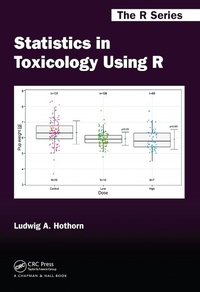
Statistics in Toxicology Using R
Published on 13. January 2016
252 pages
978-1-4987-8675-1 (ISBN)
Description

The apparent contradiction between statistical significance and biological relevance has diminished the value of statistical methods as a whole in toxicology. Moreover, recommendations for statistical analysis are imprecise in most toxicological guidelines. Addressing these dilemmas, Statistics in Toxicology Using R explains the statistical analysi
Reviews / Votes
"The field of toxicology raises all sorts of statistical issues. This book is a practical guide to an important subset of those issues, those that are addressable by comparison of response means for two or more dose treatments. ... The material in the book is organized in a way that is useful both for someone interested in general principles and someone interested in a specific type of toxicological study. ...Unlike many books of the "using R" flavor that focus on one R package, this book illustrates the use of functions from many different packages. Compilations at the end of the book list 24 packages used for statistical analyses, five packages used for data manipulation or graphics, and another 11 packages that provide datasets. ... This book will be useful to many applied statisticians, not just those working with toxicological data. The principles and methods discussed here are relevant formany types of studies. In particular, if you are interested in multiple testing or evaluating monotonic trends, you will find a wealth of methods, examples, and R code here."-Philip M. Dixon, Iowa State University, in The American Statistician, July 2017
"This book has the potential to become the go-to text for those working at the intersection of statistics and toxicology...The book is very thorough in its coverage of toxicological tests, how to carry them out and how to interpret them in R, with over 400 references...Use is made of a wide array of R packages, from coin to WinProb, most of which appear in CRAN. The key package SiTuR, which provides access to the example data and selected functions in the book, is available on Github."
- Alice Richardson, ANU College of Medicine, Australia, in International Statistical Review, April 2017
"The book presents a wealth of hands-on examples, explanations, methods, insights, and references on how statistical analysis in toxicology may be approached from a modern, 21st-century point of view, discarding or at least devaluing some long-standing but quite useless concepts and methods along the way. ... The versatile R packages 'multcomp' and 'coin' are key players in this approach throughout the book as demonstrated in the many concrete R examples throughout the book. As far as I know, no similar book is currently available. It should be extremely useful for applied statisticians and toxicologists alike."
-Christian Ritz, University of Copenhagen, Denmark "The field of toxicology raises all sorts of statistical issues. This book is a practical guide to an important subset of those issues, those that are addressable by comparison of response means for two or more dose treatments. ... The material in the book is organized in a way that is useful both for someone interested in general principles and someone interested in a specific type of toxicological study. ...Unlike many books of the "using R" flavor that focus on one R package, this book illustrates the use of functions from many different packages. Compilations at the end of the book list 24 packages used for statistical analyses, five packages used for data manipulation or graphics, and another 11 packages that provide datasets. ... This book will be useful to many applied statisticians, not just those working with toxicological data. The principles and methods discussed here are relevant formany types of studies. In particular, if you are interested in multiple testing or evaluating monotonic trends, you will find a wealth of methods, examples, and R code here."
-Philip M. Dixon, Iowa State University, in The American Statistician, July 2017
"This book has the potential to become the go-to text for those working at the intersection of statistics and toxicology...The book is very thorough in its coverage of toxicological tests, how to carry them out and how to interpret them in R, with over 400 references...Use is made of a wide array of R packages, from coin to WinProb, most of which appear in CRAN. The key package SiTuR, which provides access to the example data and selected functions in the book, is available on Github."
- Alice Richardson, ANU College of Medicine, Australia, in International Statistical Review, April 2017
"The book presents a wealth of hands-on examples, explanations, methods, insights, and references on how statistical analysis in toxicology may be approached from a modern, 21st-century point of view, discarding or at least devaluing some long-standing but quite useless concepts and methods along the way. ... The versatile R packages 'multcomp' and 'coin' are key players in this approach throughout the book as demonstrated in the many concrete R examples throughout the book. As far as I know, no similar book is currently available. It should be extremely useful for applied statisticians and toxicologists alike."
-Christian Ritz, University of Copenhagen, Denmark
More details
Series
Language
English
Place of publication
Philadelphia, PA
United States
Publishing group
Taylor & Francis Inc
Target group
College/higher education
Product notice
Reflowable
Illustrations
98 s/w Abbildungen, 115 s/w Tabellen
98 b/w images and 115 tables
File size
4,34 MB
ISBN-13
978-1-4987-8675-1 (9781498786751)
Copyright in bibliographic data and cover images is held by Nielsen Book Services Limited or by the publishers or by their respective licensors: all rights reserved.
Schweitzer Classification
Other editions
Additional editions
Ludwig A. Hothorn
Statistics in Toxicology Using R
Book
06/2021
1st Edition
Chapman & Hall/CRC
€71.60
Shipment within 10-20 days
Ludwig A. Hothorn
Statistics in Toxicology Using R
Book
12/2015
1st Edition
Chapman & Hall/CRC
€131.00
Shipment within 15-20 days
Person
Ludwig A. Hothorn is a professor in the Institute of Biostatistics at the Leibniz University of Hannover. Dr. Hothorn has published more than 130 papers in peer-reviewed journals and contributed numerous book chapters. His research interests include computational statistics using R as well as the application of statistical methods in biology, agriculture, medicine, life sciences, toxicology, pharmacology, and quantitative genetics.
Content
Principles. Simultaneous comparisons versus a negative control. Evaluation of long-term carcinogenicity assays. Evaluation of mutagenicity assays. Evaluation of reproductive toxicity assays. Ecotoxicology: Test on significant toxicity. Modeling of dose-response relationships. Further methods. Conclusions. Appendix.
