

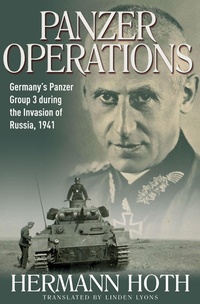
Panzer Operations
Germany's Panzer Group 3 During the Invasion of Russia, 1941
Published on 10. January 2020
200 pages
978-1-61200-270-5 (ISBN)
Description

A German commander's "
very readable and thought-provoking" study of Operation Barbarossa (
Military Review).
This book unveils a wealth of experiences and analysis about Operation Barbarossa, perhaps the most important military campaign of the twentieth century, from a perspective rarely encountered.
Hermann Hoth led Germany's 3rd Panzer Group in Army Group Center-in tandem with Guderian's 2nd Group-during the invasion of the Soviet Union, and together, these two daring panzer commanders achieved a series of astounding victories, encircling entire Russian armies at Minsk, Smolensk, and Vyazma, all the way up to the very gates of Moscow.
This work begins with Hoth discussing the use of nuclear weapons in future conflicts. This cool-headed postwar reflection, from one of Nazi Germany's top panzer commanders, is rare enough. But then Hoth dives into his exact command decisions during Barbarossa-still the largest continental offensive ever undertaken-to reveal new insights into how Germany could, and in his view should, have succeeded in the campaign.
Hoth critically analyses the origin, development, and objective of the plan against Russia, and presents the situations confronted, the decisions taken, and the mistakes made by the army's leadership, as the new form of mobile warfare startled not only the Soviets on the receiving end but the German leadership itself, which failed to provide support infrastructure for their panzer arm's breakthroughs.
Hoth sheds light on the decisive and ever-escalating struggle between Hitler and his military advisers on the question of whether, after the Dnieper and the Dvina had been reached, to adhere to the original idea of capturing Moscow. Hitler's momentous decision to divert forces to Kiev and the south only came in late August 1941. He then finally considers in detail whether the Germans, after obliterating the remaining Russian armies facing Army Group Center in Operation Typhoon, could still hope for the occupation of the Russian capital that fall.
Hoth concludes his study with several lessons for the offensive use of armored formations in the future. His firsthand analysis, here published for the first time in English, will be vital reading for every student of World War II.
This book unveils a wealth of experiences and analysis about Operation Barbarossa, perhaps the most important military campaign of the twentieth century, from a perspective rarely encountered.
Hermann Hoth led Germany's 3rd Panzer Group in Army Group Center-in tandem with Guderian's 2nd Group-during the invasion of the Soviet Union, and together, these two daring panzer commanders achieved a series of astounding victories, encircling entire Russian armies at Minsk, Smolensk, and Vyazma, all the way up to the very gates of Moscow.
This work begins with Hoth discussing the use of nuclear weapons in future conflicts. This cool-headed postwar reflection, from one of Nazi Germany's top panzer commanders, is rare enough. But then Hoth dives into his exact command decisions during Barbarossa-still the largest continental offensive ever undertaken-to reveal new insights into how Germany could, and in his view should, have succeeded in the campaign.
Hoth critically analyses the origin, development, and objective of the plan against Russia, and presents the situations confronted, the decisions taken, and the mistakes made by the army's leadership, as the new form of mobile warfare startled not only the Soviets on the receiving end but the German leadership itself, which failed to provide support infrastructure for their panzer arm's breakthroughs.
Hoth sheds light on the decisive and ever-escalating struggle between Hitler and his military advisers on the question of whether, after the Dnieper and the Dvina had been reached, to adhere to the original idea of capturing Moscow. Hitler's momentous decision to divert forces to Kiev and the south only came in late August 1941. He then finally considers in detail whether the Germans, after obliterating the remaining Russian armies facing Army Group Center in Operation Typhoon, could still hope for the occupation of the Russian capital that fall.
Hoth concludes his study with several lessons for the offensive use of armored formations in the future. His firsthand analysis, here published for the first time in English, will be vital reading for every student of World War II.
More details
Other editions
Additional editions
Book
04/2015
Casemate Publishers
€31.00
Shipment within 3-4 weeks
Persons
Hermann Hoth (1885-1971) began World War II in command of a motorized corps. During Operation Barbarossa he commander Panzer Group 3 of Army Group Center, and toward the end of 1941 was promoted to command of 17th Army. In June 1942 he was given command of 4th Panzer Army. In 1943, following the battle of Kursk, he was relieved of command. After serving six years in prison following the Nuremberg Trials, Hoth turned to writing and died at age 85 in Goslar, Germany.Linden Lyons holds a master's degree in history from Monash University in Melbourne, Australia. He also studied German at the University of Freiburg and librarianship at the University of Canberra. He is the translator for Panzer Operations, Vitebsk, and Leningrad in the Die Wehrmacht im Kampf series.
Content
- Intro
- Cover
- Title Page
- Copyright
- Contents
- Preface
- Maps
- ONE Introduction
- TWO Background
- THREE Destruction of the Enemy in the Border Areas, 22 June-1 July
- FOUR At Hitler's Headquarters, 26-30 June 1941
- FIVE From Minsk to the Western Dvina, 1-7 July 1941
- SIX The Battle of Smolensk, 8-16 July
- SEVEN Closing the Smolensk Pocket, 16 July-18 August
- EIGHT Moscow, Kiev, or Leningrad
- NINE The Operations of the Battle of Vyazma
- Conclusion
- Epilogue : Hermann Hoth's Career after the Battle of Vyazma by Linden Lyons
- Appendices
- Notes
- Bibliography
