

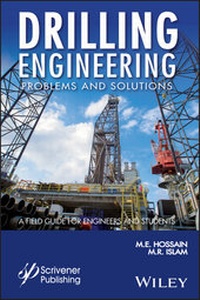
Drilling Engineering Problems and Solutions
Description

Petroleum and natural gas still remain the single biggest resource for energy on earth. Even as alternative and renewable sources are developed, petroleum and natural gas continue to be, by far, the most used and, if engineered properly, the most cost-effective and efficient, source of energy on the planet. Drilling engineering is one of the most important links in the energy chain, being, after all, the science of getting the resources out of the ground for processing. Without drilling engineering, there would be no gasoline, jet fuel, and the myriad of other "have to have" products that people use all over the world every day.
Following up on their previous books, also available from Wiley-Scrivener, the authors, two of the most well-respected, prolific, and progressive drilling engineers in the industry, offer this groundbreaking volume. They cover the basic tenets of drilling engineering, the most common problems that the drilling engineer faces day to day, and cutting-edge new technology and processes through their unique lens. Written to reflect the new, changing world that we live in, this fascinating new volume offers a treasure of knowledge for the veteran engineer, new hire, or student.
This book is an excellent resource for petroleum engineering students, reservoir engineers, supervisors & managers, researchers and environmental engineers for planning every aspect of rig operations in the most sustainable, environmentally responsible manner, using the most up-to-date technological advancements in equipment and processes.
More details
Other editions
Additional editions
Persons
M.E. Hossain is a professor at Nazarbayev University, Kazakhstan, where he is in charge of starting a new program in petroleum engineering. Previously, he was Canada's first Statoil Chair at Memorial University of Newfoundland (MUN), Canada. Dr. Hossain authored/co-authored nearly 200 research articles, including seven books, focusing on reservoir characterization, enhanced oil recovery (EOR), drilling engineeering and environmental sustainability.
M. Rafiq Islam is the President of Emertec R&D Ltd. and an adjunct professor at Dalhousie University, where he was Canada's first Killam Chair in Oil and Gas. He has over 30 years of experience in teaching and research, during which time he has supervised over 150 graduate and undergraduate students and postdoctoral fellows and completed over $20 million of funded research. During his career, he has published nearly 800 research papers and dozens of books and research monographs on topics ranging from petroleum engineering to economics. He is the founding executive editor of Journal of Nature Science and Journal of Characterization and Development of Novel Materials, and serves on the editorial board of a number of journals. Previously, he held editorial positions with SPE, AIChEJ, JCPT, JPSE, and others.
Content
Foreword xvii
Acknowledgements xix
1. Introduction 1
1.1. Introduction of the Book 1
1.2. Introduction of Drilling Engineering 2
1.3. Importance of Drilling Engineering 2
1.4. Application of Drilling Engineering 3
1.5. Drilling Problems, Causes, and Solutions 3
1.5.1 Common Drilling Problems 5
1.6. Drilling Operations and its Problems 4
1.7. Sustainable Solutions for Drilling Problems 6
1.8. Summary 8
References 8
2. Problems Associated with Drilling Operations 11
2.1. Introduction 11
2.2. Problems Related to Drilling Methods and Solutions 12
2.2.1. Sour Gas Bearing Zones 12
2.2.1.1. How to Tackle H2S 12
2.2.2. Shallow Gas-Bearing Zones 17
2.2.2.1. Prediction of Shallow Gas Zone 18
2.2.2.2. Identification of Shallow Gas Pockets 19
2.2.2.3. Case Study 20
2.2.3. General Equipment, Communication and Personnel Related Problems 24
2.2.3.1. Equipment 24
2.2.3.2. Communication 28
2.2.3.3. Personnel 30
2.2.4. Stacked Tools 31
2.2.4.1. Objects Dropped into the Well 32
2.2.4.2. Fishing Operations 34
2.2.4.3. Junk Retrieve Operations 45
2.2.4.4. Twist-off 46
2.2.5. Difficult-to-drill Rocks 48
2.2.6. Resistant Beds Encountered 48
2.2.7. Slow Drilling 49
2.2.7.1. Factors Affecting Rate of Penetration 50
2.2.8. Marginal Aquifer Encountered 62
2.2.9. Well Stops Producing Water 62
2.2.10. Drilling Complex Formations 63
2.2.11. Complex Fluid Systems 63
2.2.12. Bit Balling 64
2.2.13. Formation Cave-in 66
2.2.14. Bridging in Wells 67
2.2.14.1. Causes of Bridging in Wells 69
2.2.14.2. Warning Signs of Cutting Setting in Vertical Well 70
2.2.14.3. Remedial Actions of Bridging in Wells 70
2.2.14.4. Preventive Actions 71
2.2.14.5. Volume of Solid Model 71
2.3. Summary 73
References 73
3. Problems Related to the Mud System 77
3.1. Introduction 77
3.2. Drilling Fluids and its Problems with Solutions 78
3.2.1. Lost Circulation 79
3.2.1.1. Mechanics of Lost Circulation 86
3.2.1.2. Preventive Measures 88
3.2.1.3. Mud Loss Calculation 90
3.2.1.4. Case Studies 92
3.2.2. Loss of Rig Time 95
3.2.3. Abandonment of Expensive Wells 96
3.2.4. Minimized Production 97
3.2.5. Mud Contamination 97
3.2.5.1. Sources and Remediation of the Contamination 99
3.2.6. Formation Damage 104
3.2.6.1. Prevention of Formation Damage 113
3.2.6.2. Quantifying Formation Damage 116
3.2.7. Annular Hole Cleaning 118
3.2.7.1. New Hole Cleaning Devices 120
3.2.8. Mud Cake Formation 122
3.2.8.1. Filtration Tests 123
3.2.8.2. Mud Cake Removal Using Ultrasonic Wave Radiation 124
3.2.8.3. Wellbore Filter Cake Formation Model 125
3.2.9. Excessive Fluid Loss 126
3.2.10. Drilling Fluid Backflow 128
3.3. General Case Studies on Lost Circulation 128
3.3.1. Lessons Learned 130
3.4. Summary 130
References 131
4. Problem Related to Drilling Hydraulics 139
4.1. Introduction 139
4.2. Drilling Hydraulics and its Problems and Solutions 141
4.2.1. Borehole Instability 147
4.2.1.1. Hole Enlargement 148
4.2.1.2. Hole Closure 150
4.2.1.3. Fracturing 150
4.2.1.4. Collapse 151
4.2.1.5. Prevention and Remediation 153
4.2.2. Proper Hole Trajectory Selection 154
4.2.3. Drill Bit Concerns 156
4.2.3.1. Bit Balling 156
4.2.4. Hydraulic Power Requirement 157
4.2.5. Vibration 160
4.3. Overall Recommendations 161
4.3.1. The Rig Infrastructure 161
4.3.2. Problems Related to Stuckpipe 162
4.3.3. Mechanical Pipe Sticking 163
4.3.4. Borehole Instability 164
4.3.4.1. Bottom Hole Pressure (mud density) 165
4.3.4.2. Well Inclination and Azimuth 165
4.3.4.3. Physical/chemical Fluid-rock Interaction 165
4.3.4.4. Drillstring Vibrations 166
4.3.4.5. Drilling Fluid Temperature 166
4.4. Summary 168
References 168
5. Well Control and BOP Problems 171
5.1. Introduction 171
5.2. Well Control System 172
5.3. Problems with Well Control and BOP and their Solutions 174
5.3.1. Kicks 174
5.3.1.1. Warning Signals of Kicks 177
5.3.1.2. Control of Influx and Kill Mud 180
5.3.2. Blowout 197
5.4. Case Studies 199
5.4.1. Blowout in East Coast of India 199
5.4.1.1. Solutions 201
5.4.1.2. Causes of the Blowout 203
5.4.1.3. Lessons Learned and Recommendations 204
5.4.2. Deepwater Horizon Blowout 205
5.4.2.1. Solutions 207
5.4.2.2. Reasons Behind the Blowout 214
5.4.2.3. Lessons Learned and Recommendation 217
5.5. Summary 218
References 219
6. Drillstring and Bottomhole Assembly Problems 221
6.1. Introduction 221
6.2. Problems Related to Drillstring and their Solutions 223
6.2.1. Stuck Pipe 223
6.2.1.1. Free Point - Stuck Point Location 224
6.2.1.2. The Most Common Causes of Stuck Pipe 227
6.2.1.3. Prevention of Stuck Pipe 229
6.2.1.4. Freeing Stuck Pipe 230
6.2.1.5. Measures to Reduce Stuck Pipe Costs 231
6.2.1.6. Some Examples of Field Practices 231
6.2.2. Drillpipe Failures 234
6.2.2.1. Twist-off 237
6.2.2.2. Parting and other Failures 240
6.2.2.3. Collapse and Burst 240
6.2.2.4. Tension Load 245
6.2.2.5. Fatigue 254
6.2.3. Problems Related to Catches 256
6.2.4. Fishing Operation 257
6.2.4.1. Stuck Pipe Fishing 257
6.2.4.2. Fishing for a "Twist-off " 257
6.2.5. Failures Caused by Downhole Friction Heating 258
6.2.5.1. Heat Check Cracking 259
6.3. Case Studies 274
6.3.1. Vibration Control 274
6.3.1.1. Execution 276
6.3.1.2. Lessons Learned 278
6.3.2. Twist-off 279
6.4. Summary 280
References 280
7. Casing Problems 285
7.1. Introduction 285
7.2. Problems Related to Casing and their Solutions 286
7.2.1. Casing Jams during Installation 287
7.2.2. Buckling 287
7.2.2.1. Buckling Criteria 288
7.2.2.2. General Guideline 292
7.2.3. Temperature Effect 292
7.2.4. Casing Leaks 294
7.2.5. Contaminated Soil/Water-Bearing Zones 297
7.2.6. Problem with Depth to Set Casing 299
7.2.6.1. Special Considerations of a Surface Casing 301
7.2.6.2. Practical Guideline 304
7.2.6.3. Influence of Casing Shoe Depth on Sustained Casing Pressure (SCP) during Production 306
7.3. Case Studies 311
7.3.1. Case Study - 1 (Casing Jamming) 313
7.3.1.1. Lessons Learned 314
7.3.2. Case Study - 2 (Casing Installation Problems) 314
7.3.3. Case Study - 3 (Casing Installation Problems in an Offshore Field) 316
7.3.3.1. Lessons Learned 316
7.3.4. Case Study - 4 (Leaky Casing) 318
7.3.4.1. Repair Alternatives 319
7.3.4.2. Setting Patches 320
7.3.4.3. Results and Lessons Learned 321
7.3.5. Case Study - 5 (Use of Gel for Water Leaks) 323
7.3.6. Case Study - 6 (Unusual Lithology) 325
7.3.6.1. Case 1: Leak below Production Packer 327
7.3.6.2. Case 2: Casing Shoe above Unsealed High Pressure Formation 329
7.3.6.3. Case 3: Casing Shoe set in Weak Formation 332
7.3.6.4. Case 4: Leak below Production Casing Shoe 334
7.3.6.5. Lessons Learned and Recommendations 336
7.3.7. Case Study - 7 (Surface Casing Setting) 340
7.2.7.1. Leak-off Tests. 341
7.2.7.2. Reduction System. 344
7.3 Summary 347
References 347
8. Cementing Problems 353
8.1. Introduction 353
8.2. Problems Related to Cementing and their Solutions 354
8.2.1. Leaks due to Cement Failure 355
8.2.1.1. Preventive Methods 358
8.2.2. Key Seating 362
8.2.2.1. Prevention 363
8.2.2.2. Remediation 364
8.2.3. Cement Blocks 366
8.2.4. Problems Related to Mud/Cement Rheology 366
8.2.4.1. Contamination with Oil-based Mud 367
8.2.4.2. Problem Related to Eccentric Annulus 370
8.2.4.3. Flow Regime of Cement Displacement 372
8.2.4.4. Improper Mud Cake Removal during Cementing 374
8.2.4.5. Poor Mixing and/or Testing of Cement Slurry 375
8.2.5. Blowout Potentials 379
8.2.5.1. Overall Guidelines 381
8.3. Good Cementing Practices 382
8.3.1. Drilling Fluid 383
8.3.2. Hole Cleaning 384
8.3.3. Gel Strength 384
8.3.4. Spacers and Flushes. Contents. 386
8.2.5. Slurry Design 388
8.2.6. Casing Rotation and Reciprocation 390
8.2.7. Centralizing Casing 391
8.2.8. Displacement Efficiency 392
8.2.9. Cement Quality 393
8.2.10. Special Considerations 394
8.3. Case Studies 394
8.3.1. Causes of Cement Job Failures 394
8.3.2. Casinghead Pressure Problems 398
8.3.3. Cases of Good Cement Jobs 401
8.3.3.1. Good Case I 402
8.3.3.2. Good Case II 403
8.3.3.3. Good Case III 403
8.3.3.4. Good Case IV 406
8.3.3.5. Good Case V 409
8.3.4. Cases of Failed Cement Jobs 413
8.3.4.1. Failed Cementing Case 01 416
8.3.4.2. Failed Case 02 417
8.3.4.3. Failed Case 03 428
8.3.4.4. Failed Case 04 429
8.4. Summary 440
References 440
9. Wellbore Instability Problems 443
9.1. Introduction 443
9.2. Problems Related to Wellbore Instability and their Solutions 444
9.2.1. Causes of Wellbore Instability 445
9.2.1.1. Uncontrollable Factors 445
9.2.1.2. Controllable Factors 453
9.2.2. Indicators of Wellbore Instability 464
9.2.2.1. Diagnosis of Wellbore Instability 465
9.2.2.2. Preventative Measures 465
9.3. Case Studies 469
9.3.1. Chemical Effect Problems in Shaley Formation 469
9.3.1.1. Geological Considerations 470
9.3.1.2. Drilling Problems 470
9.3.1.3. Instability Mechanism 471
9.3.1.4. Instability Analysis 473
9.3.1.5. Shale Hydration 475
9.3.1.6. Dynamic Effects 479
9.3.1.7. Lessons Learned from Countermeasures 480
9.3.2. Minimizing Vibration for Improving Wellbore Stability 481
9.3.3. Mechanical Wellbore Stability Problems 483
9.2.3.1. Case Study for Well X-51 (Shale Problems). 483
9.2.3.2. Case Study for Well X-53 (Shale and Sand Problems). 486
9.2.3.3. Case Study for Well X-52 (Successful Case). 489
9.2.3.4. Lessons Learned. 491
9.3 Summary 493
References 494
10. Directional and Horizontal Drilling Problems 497
10.1. Introduction 497
10.2. Problems Related to Directional Drilling their Solutions 499
10.2.1. Accuracy of Borehole Trajectory 501
10.2.1.1. Guidelines and Emerging Technologies 507
10.2.2. Fishing with Coiled Tubing 508
10.2.3. Crookedness of Wells/Deflection of Wells 509
10.2.3.1. Causes of Crookedness 511
10.2.3.2. Outcomes of Crooked Borehole and Possible Remedies 515
10.2.4. Stuck Pipe Problems 517
10.2.5. Horizontal Drilling 520
10.2.5.1. Problems Associated with Horizontal Well Drilling 523
10.2.5.2. Unique Problems Related to Horizontal Well Drilling 526
10.3. Case Studies 527
10.3.1. Drilling of Multilateral and Horizontal Wells 527
10.3.2. Directional Drilling Challenges in Deepwater Subsalt 539
10.2.2.1. Description of the Reservoir. 540
10.2.2.2. Planning of Drilling. 541
10.2.2.3. Drilling Operations. 542
10.2.2.4. Planning the Sidetracks. 543
10.2.2.5. Lessons Learned. 545
10.3. Summary 545
References 545
11. Environmental Hazard and Problems during Drilling 549
11.1. Introduction 549
11.2. Problems Related to Environment during Drilling 550
11.2.1. Environmental Degradation 551
11.2.1.1. Acoustics (Noise) 551
11.2.1.2. Air Quality 552
11.2.1.3. Contamination during Drilling 554
11.2.1.4. Cultural Resources 556
11.2.1.5. Ecological Resources 556
11.2.1.6. Environmental Justice 557
11.2.1.7. Hazardous Materials and Waste Management 558
11.2.1.8. Health and Safety 559
11.2.1.9. Land Use 560
11.2.1.10. Paleontological Resources 560
11.2.1.11. Socioeconomics 561
11.2.1.12. Soils and Geologic Resources 561
11.2.1.13. Transportation 562
11.2.1.14. Water Resources 562
11.2.2. Drill Cutting Management 563
11.2.2.1. Regulatory Aspects of Drill Cutting Disposal 567
11.2.3. Subsidence of Ground Surface 570
11.2.4. Deep Water Challenges 573
11.2.4.1. Narrow Operational Window 573
11.2.4.2. Marine Drilling Riser 573
11.2.4.3. Shallow Formation Hazards 574
11.2.4.4. Risk Analysis of Offshore Drilling 575
11.3. Case Studies 579
11.3.1. Effect of Drilling Fluid Discharge on Oceanic Organisms 579
11.3.1.1. Observations and Lessons Learned 582
11.3.2. Long-term Impact on Human Health 584
11.3.2.1. Lessons Learned 590
11.4. Summary 590
References 590
12. Summary and Conclusions 595
12.1. Summary 595
12.2. Conclusions 596
12.2.1. Chapter 1: Introduction 596
12.2.2. Chapter 2: Problems Associated with Drilling Operations 597
12.2.3. Chapter 3: Problems Related to the Mud System 598
12.2.4. Chapter 4: Problem Related to Drilling Hydraulics 600
12.2.5. Chapter 5: Well Control and BOP Problems 601
12.2.6. Chapter 6: Drillstring and Bottomhole Assembly Problems 602
12.2.7. Chapter 7: Casing Problems 604
12.2.8. Chapter 8: Cementing Problems 606
12.2.9. Wellbore Instability Problems 608
12.2.10. Chapter 10: Directional and Horizontal Drilling Problems 611
12.2.11. Chapter 11: Environmental Hazard and Problems during Drilling 612
Index 615
Chapter 1
Introduction
1.0 Introduction of the Book
Albert Einstein famously stated, "Scientists investigate that which already is; engineers create that which has never been." It is no surprise that any engineering project begins with defining a problem. However, the degree and the magnitude of the problems vary due to the nature of an engineering endeavor. Petroleum resources are the lifeline of modern civilization and drilling operations form the most important component of the petroleum industry. As such, drilling engineering has numerous problems, solutions of which are challenging. Added to this complexity is the fact that drilling operations involve the subsurface - clearly out of our sight. In absence of direct evidence, the best a drilling engineer can do is to speculate based on existing geological data and experience of the region. As a result, planning of drilling and its implementation is one of the greatest challenges for planners, administrators, and field professionals. To complete an engineering project, the planning phase must have all possible problem scenarios, followed by projected solutions. This is because once the problem occurs, one doesn't have the time to figure out the solution impromptu. This book is designed to help in solving likely problems encountered during drilling operations. Of course, the list of problems is not exhaustive but the science established in solving the problem is comprehensive, thereby allowing operators to draw upon personal experiences and use this book as a guideline. This chapter introduces the fundamental aspects of the drilling problems faced by the drilling operators, drillers, crews, and related professionals in general. It identifies the key areas in which drilling problems are encountered, along with their root causes.
1.1 Introduction of Drilling Engineering
Despite recent concerns about their sustainability, petroleum resources continue to be the lifeline of modern civilization. This role of oil and gas will continue in the foreseeable future. Petroleum production is inherently linked to drilling technology, ranging from exploration to production, from monitoring to remediation and environmental restoration. Nearly one-quarter of the petroleum industry's entire exploration and production budget is dedicated to drilling expenses. The complete cycle of petroleum operations includes seismic survey, exploration, field development, hydrocarbon production, refining, storage, transportation/distribution, marketing, and final utilization to the end user. The drilling technology has been developed through the efforts of many individuals, professionals, companies and organizations. This technology is a necessary step for petroleum exploration and production. Drilling is one of the oldest technologies in the world. Drilling engineering is a branch of knowledge where the design, analysis and implementation procedure are completed to drill a well as sustainable as possible (Hossain and Al-Majed, 2015). In a word, it is the technology used to unlock crude oil and natural gas reserves. The responsibilities of a drilling engineer are to facilitate the efficient penetration of the subsurface with wellbore and cementing operations that range from the surface to an optimum target depth, while minimizing safety and environmental hazards.
1.2 Importance of Drilling Engineering
It is well known that the petroleum industry drives the energy sector, which in turn drives modern civilization. It is not unlikely that every day human beings are getting the benefits out of the petroleum industry. The present modern civilization is based on energy and hydrocarbon resources. The growth of human civilization and necessities of livelihood over time inspired human beings to bore a hole for different reasons (such as drinking water, agriculture, hydrocarbon extraction for lighting, power generation, to assemble different mechanical parts, etc.). Only a small fraction of petroleum resources is considered to be recoverable and an even tinier fraction of that is available on the surface, making underground resources virtually the only source of hydrocarbons. The flow of oil is ensured only through drilling engineering playing a pivotal role. Naturally, any improvement in drilling practices will bring multifold benefits to the energy sector and much more to the overall economy.
1.3 Application of Drilling Engineering
Throughout human civilization, drilling in numerous forms played a significant role. As such, the applications of drilling technology are numerous. The applications of drilling range from children's toys to modern drilling of a hole for the purpose of any scientific and technological usage. Humans have been using this technology for underground water withdrawal from ancient times. Drilling technology is a widely used expertise in the applied sciences and engineering such as manufacturing industries, pharmaceutical industries, aerospace, military defense, research laboratories, and any small-scale laboratory to a heavy industry, such as petroleum. Modern cities and urban areas use the drilling technology to get the underground water for drinking and household use. The underground water extraction by boring a hole is also used for agricultural irrigation purposes. Therefore, there is no specific field of application of this technology. It has been used for a widespread field based on its necessity. This book focuses only on drilling a hole with the hope of hydrocarbon discovery; therefore, here the drilling engineering application means a shaft-like tool (i.e., drilling rig) with two or more cutting edges (i.e., drill bit) for making holes toward the underground hydrocarbon formation through the earth layers especially by rotation. Hence the major application of drilling engineering is to discover and produce redundant hydrocarbon from a potential oil field.
1.4 Drilling Problems, Causes, and Solutions
The oil and gas industry is recognized as one of the most hazardous industries on earth. Extracting hydrocarbon from an underground reservoir is very risky and uncertain. Therefore, it is very important to find out the root causes of its risk and uncertainty. The majority of the risks and uncertainties related to this business are encountered while drilling. As a result, drilling problems offer an excellent benchmark for other practices in petroleum engineering as well as other disciplines. However, the key to having a successful achievement of the drilling objectives is to design drilling programs based on anticipation of potential drilling problems. The more comprehensive the list of problems the more accurate the solution manual will become. The best modus operandi is to avoid running into a scenario where problems arise. This preventative style will lead to safer and more cost-effective drilling schemes. It is well understood that even one occurrence of the loss of human life, environmental disaster, or loss of rig side area can have a profound effect on the welfare of the entire petroleum industry. Some of the drilling problems comprise of drillpipe sticking, stuck pipe, drillstring failures, wellbore instabilities, hole deviation and well path control, mud contamination, kicks, hazardous and shallow gas release, lost circulation, formation damage, loss of equipment, personnel, and communications. There are some other problems specifically related to slim hole drilling, coiled tubing drilling, extended reach drilling, and under-balance drilling, etc. There is a famous saying, "prevention is better than cure". So, the motto should be "drill a hole safely without having any accident, incident, or harm to this planet, with minimum costs". The drilling operations should be in a sustainable fashion where the minimization of drilling problems and costs has to have the top priority.
1.5 Drilling Operations and its Problems
Globally, modern rotary oil well drilling has been continued for over a century. Although, drilling itself has been a technology known to mankind for millennia (going back to Ancient China and Egypt), the earliest known commercial oil well in the United States was drilled in Titusville, Pennsylvania, in 1857. Before this time, such innovations as 4-legged derrick, "jars", reverse circulation drilling, spring pole method, and other drilling accessory techniques had been patented. Drake's famed well itself was drilled with cable tool and reached only 69 ft below the surface - a distance far shallower than drilling feats achieved by water wells. Even though M. C. and C. E. Baker, two brothers from South Dakota, were drilling shallow water wells in unconsolidated formations of the Great Plains, it wasn't until the late 1800s that the Baker brothers were using rotary drilling in the Corsicana field of Navarro County, Texas. In 1901 Captain Anthony Lucas and Patillo Higgins applied it to their Spindletop well in Texas. By 1925, the rotary drilling method was improved with the use of a diesel engine. In the meantime, soon after the Drake well, the Sweeney stone drill was patented in 1866. This invention had essential components of modern-day drilling, such as swivel head, rotary drive and roller bit. In terms of drilling bit, the most important discovery was the introduction of the diamond bit. This French invention of 1863 (although ancient Egyptians were known to use such drills in rock quarries) was put in practice to drill a 1,000 ft hole with a 9" diamond bit in 1876. In terms of drilling mud, the history of early oil wells indicates that natural drilling mud was used, with the addition of locally available clay. It...
