

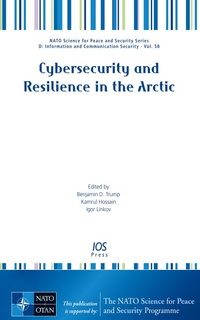
Cybersecurity and Resilience in the Arctic
1st Edition
Published on 15. July 2020
456 pages
978-1-64368-077-4 (ISBN)
Description

Until recently, the Arctic was almost impossible for anyone other than indigenous peoples and explorers to traverse. Pervasive Arctic sea ice and harsh climatological conditions meant that the region was deemed incapable of supporting industrial activity or a Western lifestyle. In the last decade, however, that longstanding reality has been dramatically and permanently altered. Receding sea ice, coupled with growing geopolitical disputes over Arctic resources, territory, and transportation channels, has stimulated efforts to exploit newly-open waterways, to identify and extract desirable resources, and to leverage industrial, commercial, and transportation opportunities emerging throughout the region.
This book presents papers from the NATO Advanced Research Workshop (ARW) Governance for Cyber Security and Resilience in the Arctic. Held in Rovaniemi, Finland, from 27-30 January 2019, the workshop brought together top scholars in cybersecurity risk assessment, governance, and resilience to discuss potential analytical and governing strategies and offer perspectives on how to improve critical Arctic infrastructure against various human and natural threats. The book is organized in three sections according to topical group and plenary discussions at the meeting on: cybersecurity infrastructure and threats, analytical strategies for infrastructure threat absorption and resilience, and legal frameworks and governance options to promote cyber resilience. Summaries and detailed analysis are included within each section as summary chapters in the book.
The book provides a background on analytical tools relevant to risk and resilience analytics, including risk assessment, decision analysis, supply chain management and resilience analytics. It will allow government, native and civil society groups, military stakeholders, and civilian practitioners to understand better on how to enhance the Arctic's resilience against various natural and anthropogenic challenges.
This book presents papers from the NATO Advanced Research Workshop (ARW) Governance for Cyber Security and Resilience in the Arctic. Held in Rovaniemi, Finland, from 27-30 January 2019, the workshop brought together top scholars in cybersecurity risk assessment, governance, and resilience to discuss potential analytical and governing strategies and offer perspectives on how to improve critical Arctic infrastructure against various human and natural threats. The book is organized in three sections according to topical group and plenary discussions at the meeting on: cybersecurity infrastructure and threats, analytical strategies for infrastructure threat absorption and resilience, and legal frameworks and governance options to promote cyber resilience. Summaries and detailed analysis are included within each section as summary chapters in the book.
The book provides a background on analytical tools relevant to risk and resilience analytics, including risk assessment, decision analysis, supply chain management and resilience analytics. It will allow government, native and civil society groups, military stakeholders, and civilian practitioners to understand better on how to enhance the Arctic's resilience against various natural and anthropogenic challenges.
More details
Series
Language
English
Place of publication
London
Netherlands
Publishing group
IOS Press
Target group
Professional and scholarly
File size
44,52 MB
ISBN-13
978-1-64368-077-4 (9781643680774)
Copyright in bibliographic data and cover images is held by Nielsen Book Services Limited or by the publishers or by their respective licensors: all rights reserved.
Schweitzer Classification
Other editions
Additional editions

Kamrul Hossain | Igor Linkov
Cybersecurity and Resilience in the Arctic
Book
07/2020
1st Edition
IOS Press,US
€163.68
Article exhausted; check different version
Content
- Intro
- Title Page
- About the Editors
- Acknowledgments
- Contents
- Resilience in the Arctic: Infrastructure, Cybersecurity, and Society
- Framing the Arctic Part I: Actors, Communities, and the Environment
- Framing the Arctic Part II: Complex Systems and the Need for Resilience
- Cyber Security Challenges to Arctic Critical Infrastructures
- Security and Resilience for a 4.0 Ship
- U.S. Navy Resilience in the Arctic: The Importance of Resilience for Countering Emerging Environmental, Cyber, and Geopolitical Threats in a Rapidly Changing Region
- Threat Characterization for Various Layers of Infrastructure
- Cyber Security Challenges to Arctic Infrastructures
- Interference with Subsea Cables: An Arctic Perspective
- Analytical Strategies to Operationalize Arctic Infrastructure Threat Absorption and Resilience
- Analytics for Decision Support in the Arctic
- Cyber Security and Resilience of Smart Grid Infrastructure in the Arctic
- The Wave Analogy of Cyber-Resilience as Applied to Shipping Operations
- Use of Blockchain for Ensuring Cyber Security in the Arctic
- Quantitative Modeling of Supply Chain Resilience: Literature Review
- Cyber Resiliency Measurements and Metrics
- Challenges in Establishing Legal Frameworks and Governance Options That Promote Arctic Cyber Resilience
- Governance and Government
- Some Mathematical Models Which Could Be Applied to Develop Arctic Cybersecurity Systems
- Stoke the Spirit of Arctic Agency
- Digital Social Resilience: Navigating in the New Normal
- An Information-Based Resilience Framework for the Changing Arctic
- Author Index
