

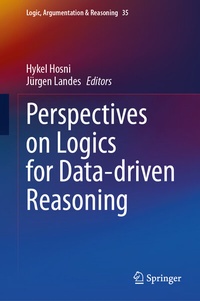
Perspectives on Logics for Data-driven Reasoning
Description

This book calls for a rethinking of logic as the core methodological tool for scientific reasoning in the context of a steadily increasing emphasis on data-centered science. To do so it provides a state-of-the-art presentation of the role logic can have in making the most of the current opportunities while making explicit the key challenges opened up by the data-driven age of scientific research.
Particular attention is given to the following four core fields and applications: Reasoning with correlations (medical, life-science applications); logics for statistical inference (machine learning, and societal applications thereof); reasoning with evidence (defining good evidence); causal reasoning (forensic reasoning).
The book collects contributions from key logicians, methodologists and scientists. This multidisciplinary perspective benefits both scientists and logicians interested in data-driven science. Scientists are introduced to logics that go beyond classical and thus are applicable to reasoning with data; Logicians have a change to focus on the potential applications of their methods and techniques to pressing scientific problems. This book is, therefore, of interest to scientists and logicians working on data-centered science.
More details
Other editions
Additional editions
Persons
Hykel Hosni is professor of Logic at the Department of Philosophy at University of Milan, and currently head of the Logic, Uncertainty, Computation, and Information (LUCI) Lab. He contributed to the logical foundations of reasoning and decision-making under uncertainty. His main current interest lies with the logical foundation of data-intensive and AI-driven science.
Jürgen Landes is a researcher Munich Center for Mathematical Philosophy at the LMU Munich. His work spans a wide variety of problems, approaches and techniques related to uncertain inference. In particular, he contributed to Pure Inductive Logic, the Principle of Maximum Entropy, general Bayesian inference and Bayesian inference in medicine.
Content
Chapter 1. A note on logic and the methodology of data-driven science (Hosni and Landes).- Chapter 2. Pure Inductive Logic (Vencovska).- Chapter 3. Where do we stand on maximal entropy? (Williamson).- Chapter 4. Probability logic and statistical relational artificial intelligence (Weitkamper).- Chapter 5. An Overview of the Generalization Problem (Facciuto).- Chapter 6. The Logic of DNA Identification (Zabell).- Chapter 7. Reasoning With and About Bias (Manganini and Primiero).- Chapter 8. Knowledge Representation, Scientific Argumentation and Non-monotonic Logic (Landes et al).- Chapter 9. Reasoning with Data in the framework of a Quantum Approach to Machine Learning (Chiara et al).
